
St. Patrick’s Day is the perfect opportunity to bring playful learning into therapy sessions, classrooms, and homes. Holiday themes naturally increase engagement, and when activities feel like play, children are more likely to participate and practice important developmental skills.
For occupational therapists, teachers, and parents, St. Patrick’s Day activities can support:
• Fine motor strength
• Visual motor integration
• Sensory processing and regulation
• Coordination and motor planning
• Bilateral hand use
The activities below use materials commonly found at home or school and can easily be adapted for toddlers, preschoolers, and elementary students.
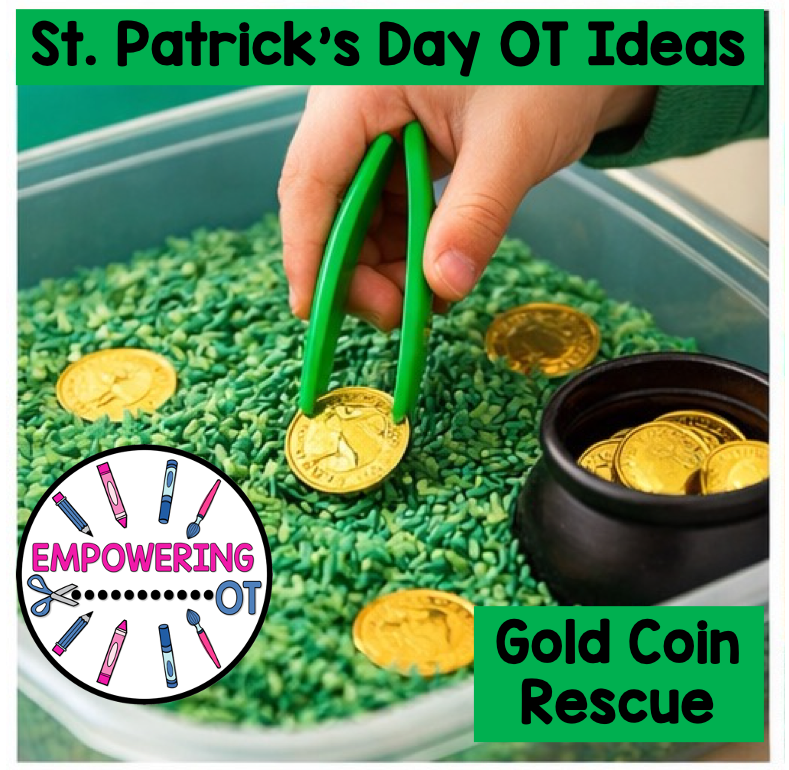
1. Gold Coin Rescue
Skills Targeted:
Fine motor strength, pincer grasp, bilateral coordination, tactile exploration
Materials
- Plastic coins, buttons, or tokens
- Green rice, dry beans, or shredded paper
- Small bowls or cups
- Tweezers, clothespins, or tongs
Activity
Hide “gold coins” inside a sensory bin filled with green rice or beans. Children use tweezers or clothespins to rescue the coins and place them into a treasure bowl.
Ways to Help
- Demonstrate how to squeeze tweezers slowly.
- Stabilize the bowl so it does not slide.
- Start with larger objects before using smaller coins.
Extensions
- Sort coins by color or size.
- Count coins and record totals.
- Create patterns with the coins.
Adaptations
- Younger children can scoop coins with hands or cups.
- Use larger objects for children developing grasp skills.
- For tactile-sensitive children, place coins in cups within the bin rather than burying them.
2. Shamrock Paper Tear Collage
Skills Targeted:
Hand strength, bilateral coordination, visual motor planning
Materials
- Green construction paper
- White paper
- Glue stick
- Marker
Activity
Draw a large shamrock outline on paper. Children tear small pieces of green paper and glue them inside the shamrock.
Ways to Help
- Show children how to pinch and tear paper slowly.
- Hold the paper steady while they tear.
- Provide a visual example of the finished collage.
Extensions
- Add glitter or tissue paper.
- Create multiple shamrocks and build a “field of clovers.”
- Trace shamrocks before gluing.
Adaptations
- Pre-tear some paper pieces for children with weaker hands.
- Use stickers instead of torn paper.
- Use larger shapes for younger children.

3. Leprechaun Treasure Hunt Obstacle Course
Skills Targeted:
Proprioceptive input, coordination, motor planning, sensory regulation
Materials
- Chairs
- Pillows
- Tape on the floor
- Plastic coins
Activity
Children follow a treasure map path. They crawl under chairs, jump over pillows, and follow taped lines to collect coins along the way.
Ways to Help
- Model each movement before starting.
- Offer hand support during balance tasks.
- Use visual cues on the floor.
Extensions
- Time the obstacle course.
- Add animal walks between stations.
- Have children hide coins for peers.
Adaptations
- Simplify the course with fewer steps.
- Replace jumping with stepping for children needing lower impact movement.
- Allow crawling instead of balancing if needed.
4. Pipe Cleaner Shamrocks
Skills Targeted:
Hand strength, finger isolation, bilateral coordination
Materials
- Green pipe cleaners
- Pony beads
Activity
Children bend pipe cleaners into shamrock shapes and thread beads onto them.
Ways to Help
- Demonstrate how to bend pipe cleaners slowly.
- Hold one side while the child bends the other.
- Use thicker pipe cleaners for easier control.
Extensions
- Create rainbow bead patterns.
- Form letters or shapes with pipe cleaners.
- Build a chain of shamrocks.
Adaptations
- Use larger beads for easier threading.
- Offer pipe cleaners already bent into shape.
- Use straws cut into pieces instead of beads.
5. Rainbow Dot Path
Skills Targeted:
Visual motor integration, visual tracking, coordination
Materials
- Dot markers or crayons
- Paper with a rainbow path drawn
Activity
Children place dots along a rainbow path leading to a pot of gold.
Ways to Help
- Encourage slow movements along the path.
- Guide the child’s hand for the first few dots.
- Provide a visual model.
Extensions
- Trace the rainbow first.
- Use multiple colors to follow a pattern.
- Turn the rainbow into a maze.
Adaptations
- Use stickers instead of markers.
- Widen the path for younger children.
- Use finger paint for sensory exploration.
6. Lucky Coin Stacking Challenge
Skills Targeted:
Precision grip, graded force control, visual motor coordination
Materials
- Plastic coins or buttons
- Table surface
Activity
Children stack coins as high as possible without knocking them down.
Ways to Help
- Demonstrate slow placement.
- Stabilize the base coin.
- Encourage two-hand support if needed.
Extensions
- Build the tallest tower.
- Time stacking challenges.
- Create coin pyramids.
Adaptations
- Use larger objects such as blocks.
- Stack cups instead of coins.
- Allow coins to be placed in small containers.
7. Shamrock Scissor Snips
Skills Targeted:
Scissor skills, bilateral coordination, hand strength
Materials
- Green paper
- Child scissors
Activity
Children cut along lines or fringe around shamrock shapes.
Ways to Help
- Draw thick cutting lines.
- Provide hand-over-hand guidance.
- Use spring-loaded scissors if needed.
Extensions
- Cut spirals or zigzag paths.
- Create shamrock garlands.
- Glue cut shapes into artwork.
Adaptations
- Pre-cut strips for beginners.
- Use play dough cutting instead.
- Provide loop scissors.
8. Leprechaun Sensory Bin
Skills Targeted:
Tactile processing, sensory exploration, fine motor play
Materials
- Shredded paper
- Plastic coins
- Scoops or cups
Activity
Children explore the sensory bin while searching for hidden treasure.
Ways to Help
- Encourage slow digging.
- Model scooping and pouring.
- Use descriptive language.
Extensions
- Hide letters or numbers.
- Use measuring cups for pouring games.
- Create treasure maps.
Adaptations
- Use dry pasta or beans instead of shredded paper.
- Offer gloves if tactile sensitivity is present.
- Place items in small containers within the bin.
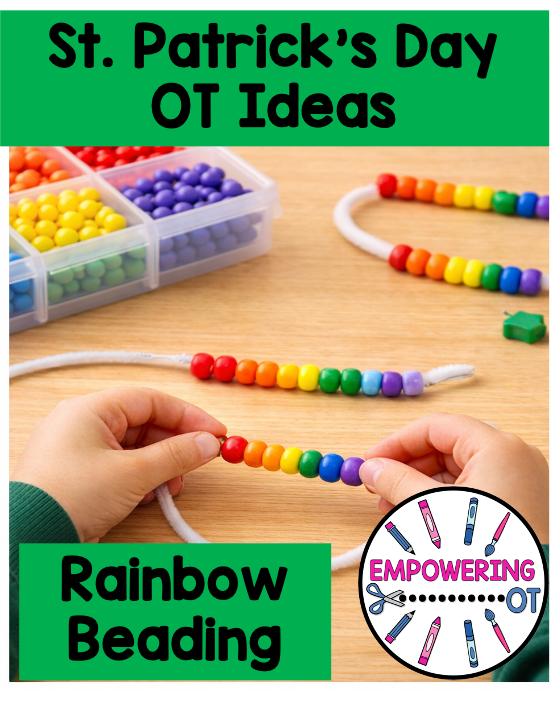
9. Rainbow Bead Threading
Skills Targeted:
Pincer grasp, visual motor coordination, sequencing
Materials
- String or pipe cleaners
- Colored beads
Activity
Children create rainbow patterns with beads.
Ways to Help
- Tape the end of the string to make threading easier.
- Demonstrate how to hold the bead steady.
Extensions
- Copy bead patterns.
- Count beads in each color group.
Adaptations
- Use large beads or pasta.
- Thread onto pipe cleaners instead of string.
10. Clover Tracing Paths
Skills Targeted:
Pre-writing skills, visual motor integration
Materials
- Paper with shamrock tracing paths
- Crayons or markers
Activity
Children trace curved paths inside shamrocks.
Ways to Help
- Encourage slow tracing.
- Provide hand-over-hand assistance.
Extensions
- Add zigzag or spiral paths.
- Trace while standing at a vertical surface.
Adaptations
- Use finger tracing first.
- Provide thicker markers.
11. Leprechaun Hat Building
Skills Targeted:
Bilateral coordination, construction play, planning
Materials
- Paper cups
- Construction paper
- Tape
Activity
Children build their own leprechaun hats using simple materials.
Ways to Help
- Show step-by-step assembly.
- Hold pieces while children tape them.
Extensions
- Decorate hats with shapes.
- Add patterns or stickers.
Adaptations
- Pre-cut shapes.
- Use glue dots instead of tape.
12. Gold Coin Sorting
Skills Targeted:
Visual discrimination, fine motor control
Materials
- Coins or buttons
- Muffin tin
Activity
Children sort coins by size or color.
Ways to Help
- Label sorting sections.
- Demonstrate sorting first.
Extensions
- Create patterns.
- Add counting challenges.
Adaptations
- Use larger objects.
- Sort into cups instead of muffin tins.
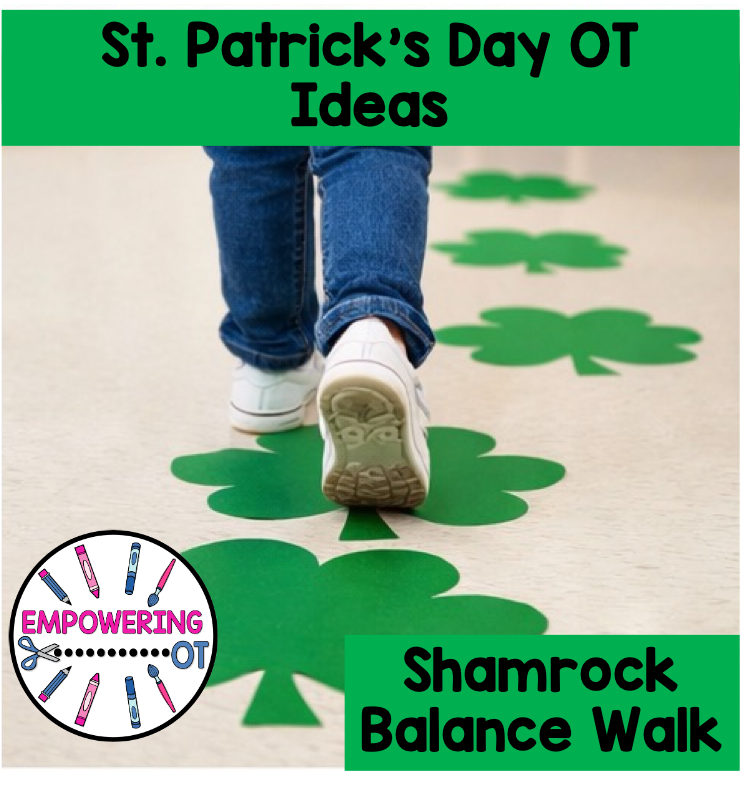
13. Shamrock Balance Walk
Skills Targeted:
Balance, body awareness, motor planning
Materials
- Paper shamrocks taped to floor
Activity
Children step from shamrock to shamrock across the room.
Ways to Help
- Provide hand support.
- Place shamrocks closer together.
Extensions
- Hop between shamrocks.
- Carry coins while walking.
Adaptations
- Allow stepping instead of jumping.
- Use wider stepping areas.
14. Rainbow Straw Blowing
Skills Targeted:
Oral motor skills, breath control, visual tracking
Materials
- Straw
- Pom poms
- Rainbow path
Activity
Children blow pom poms across the rainbow path.
Ways to Help
- Model blowing slowly.
- Demonstrate breath control.
Extensions
- Race pom poms across the path.
- Add turns and curves.
Adaptations
- Push pom poms with fingers instead.
- Use larger balls for easier movement.
15. Lucky Pattern Building
Skills Targeted:
Visual perception, sequencing, fine motor skills
Materials
- Colored cereal or beads
Activity
Children create repeating patterns.
Ways to Help
- Start simple (AB patterns).
- Provide visual models.
Extensions
- Build complex patterns.
- Turn patterns into bracelets.
Adaptations
- Use larger objects.
- Create patterns with blocks instead.
Final Thoughts
St. Patrick’s Day doesn’t need elaborate crafts or complicated setups to support meaningful skill development. With a little creativity, everyday materials can become powerful tools for building fine motor skills, visual motor coordination, and sensory processing abilities.
Whether you are a therapist, teacher, or parent, these activities offer simple ways to bring learning and play together.
And who knows? You might even discover a pot of gold at the end of the rainbow.