Does your child struggle with pencil grip, handwriting, scissors, buttons, manipulating small objects, or other fine motor skills even after plenty of practice?
For some children, the challenge may involve more than hand strength or practice alone.
Fine motor development depends on a complex combination of postural stability, shoulder strength, bilateral coordination, crossing midline, visual-motor integration, sensory processing, motor planning, and refined control of the hands and fingers. Early movement patterns, including primitive reflexes, are one piece of this developmental picture.
When primitive reflexes remain active beyond the period when they are typically expected to integrate, they may influence the way a child uses their body during fine motor tasks.
This does not mean that every child with fine motor difficulties has retained primitive reflexes. Fine motor challenges can have many causes. However, for occupational therapists, educators, and parents trying to understand why certain hand skills continue to feel difficult, looking at the whole body can provide useful information.
In this post, we’ll explore the connection between primitive reflexes and fine motor skills, which reflexes may be particularly relevant to hand development, what you might notice during everyday activities, and practical ways to support children at home, school, and in therapy.
If primitive reflexes are new to you, start with my guide to primitive reflex integration and why primitive reflexes matter.
What Are Fine Motor Skills?
Fine motor skills involve the coordinated use of the small muscles of the hands and fingers. Children rely on these skills throughout the day for much more than handwriting.
Fine motor skills are involved when a child:
- Holds and controls a pencil, crayon, or marker
- Uses scissors
- Buttons and unbuttons clothing
- Pulls a zipper
- Manipulates snaps and other fasteners
- Uses a fork and spoon
- Opens containers and packages
- Builds with small blocks
- Strings beads
- Manipulates coins
- Turns pages
- Uses school supplies
- Picks up and positions small objects
- Types or uses a touchscreen
- Completes crafts
- Ties shoes
These activities may look like “hand tasks,” but successful fine motor performance actually depends on much more than the hands.
Fine Motor Skills Start With the Whole Body
One of the most important concepts for parents and educators to understand is that fine motor control is built on a foundation of whole-body stability and coordination.
Think about a child writing at a desk.
The fingers are moving the pencil, but the rest of the body is working too. The child needs enough trunk stability to remain upright, shoulder stability to position the arm, coordination between the two sides of the body so one hand can write while the other stabilizes the paper, and visual-motor control to guide the pencil across the page.
If maintaining that foundation requires significant effort, the child may have fewer resources available for precise hand movements.
That is one reason occupational therapists often look beyond the fingers when evaluating fine motor difficulties in children.
What Do Primitive Reflexes Have to Do With Fine Motor Skills?
Primitive reflexes are automatic movement responses that are present during early development. They serve important purposes during infancy and gradually become less dominant as the nervous system matures and voluntary movement becomes more refined.
When an early reflexive pattern continues to strongly influence movement later in development, a child may need to compensate during activities requiring controlled, coordinated movement.
For fine motor tasks, that could affect areas such as:
- Hand and finger control
- Grasp and release
- Pencil control
- Bilateral coordination
- Crossing the body’s midline
- Shoulder and trunk stability
- Hand-eye coordination
- Visual tracking
- Motor planning
- Sitting posture
- Fine motor endurance
The connection is rarely as simple as “retained reflex = poor handwriting.”
Instead, think of primitive reflexes as one possible developmental factor among many that may influence how efficiently a child organizes their body for skilled hand use.
Which Primitive Reflexes May Affect Fine Motor Skills?
Several primitive reflexes may be worth considering when a child has persistent fine motor challenges.
1. Palmar Reflex and Fine Motor Skills
The Palmar Grasp Reflex has one of the clearest connections to hand development.
In infancy, pressure or touch to the palm produces an automatic closing of the fingers. This early grasping response serves an important developmental purpose before voluntary grasp-and-release skills emerge.
As children develop, they need increasingly independent control of the fingers and thumb for activities such as manipulating objects, using utensils, fastening clothing, cutting, and writing.
If an early Palmar pattern continues to influence hand use, you might notice:
- An unusually tight pencil grasp
- Excessive pressure on the pencil
- Thumb wrapping or tucking during grasp
- Difficulty opening and closing the hand smoothly
- Difficulty manipulating small objects
- Hand fatigue during writing or coloring
- Awkward scissor grasp
- Difficulty with buttons or other fasteners
- Avoidance of longer fine motor activities
It is important to remember that pencil grasp alone does not tell us whether a reflex is retained. Children use many functional grasp patterns, and an unconventional grasp does not automatically need to be changed if it is efficient, comfortable, and functional.
For a deeper look at this reflex, read Palmar Reflex Integration: Supports for School & Home.
2. ATNR and Fine Motor Coordination
The Asymmetrical Tonic Neck Reflex (ATNR) connects head position with movement of the arms and legs during infancy.
As voluntary control develops, children become better able to turn their head without their arm automatically following the movement.
Why might this matter for fine motor skills?
Many school and self-care activities require a child to move their eyes, head, arms, and hands independently while coordinating both sides of the body.
A child who continues to be strongly influenced by an ATNR pattern may have more difficulty with:
- Crossing midline
- Using one hand while the other stabilizes
- Writing across a page
- Drawing horizontal lines
- Copying
- Cutting across paper
- Coordinating two-handed activities
- Dressing
- Manipulating objects at the center of the body
You may notice a child frequently switching hands when an object crosses the middle of the body, rotating their entire paper or body instead of reaching across midline, or moving their head and arm together during certain tasks.
Learn more in ATNR Reflex Integration: Supports for School & Home.
3. STNR, Posture, and Hand Use
The Symmetrical Tonic Neck Reflex (STNR) is strongly associated with the developmental transition toward hands-and-knees positioning and later postural control.
Although STNR may not seem like a “hand reflex,” posture matters enormously for fine motor performance.
Imagine trying to carefully thread a needle while balancing on an unstable chair. Your hands might be perfectly capable of the task, but your body would have to spend so much effort staying stable that precision becomes harder.
Children can experience a similar challenge.
During tabletop work, you might notice:
- Slouching
- Leaning heavily on the desk
- Propping the head on one hand
- Frequently changing position
- Difficulty maintaining an upright seated posture
- Fatigue during handwriting
- Difficulty looking between the board and desk
- Reduced endurance for tabletop activities
Instead of assuming the child is “lazy” or simply needs to sit up straight, consider whether the seating position itself requires more effort than it appears.
Read more about STNR reflex integration, posture, and focus.
4. TLR, Postural Stability, and Fine Motor Control
The Tonic Labyrinthine Reflex (TLR) is associated with early flexion and extension patterns and the development of head and postural control.
Fine motor precision is easier when the body has a stable base.
A child who is working hard to maintain their position against gravity may have difficulty sustaining the stable shoulder, arm, and hand position needed for precise tabletop activities.
You might see:
- Slumped posture
- Difficulty maintaining an upright position
- Leaning on furniture
- Reduced endurance
- Difficulty stabilizing the arm during writing
- Challenges with balance or body awareness in addition to fine motor difficulties
Learn more about TLR integration, balance, posture, and regulation.
What Might Retained Primitive Reflexes Look Like During Fine Motor Tasks?
Primitive reflexes should never be identified from one behavior alone.
Instead, therapists look at patterns across activities, environments, and movement demands.
A child with fine motor difficulties might:
- Grip pencils very tightly
- Press hard when writing or coloring
- Tire quickly during handwriting
- Shake or stretch their hands frequently
- Avoid coloring, drawing, crafts, or writing
- Struggle to manipulate small objects
- Have difficulty with buttons, snaps, or zippers
- Use scissors awkwardly
- Have difficulty stabilizing paper while cutting
- Switch hands frequently
- Avoid reaching across the middle of the body
- Rotate the whole body instead of crossing midline
- Lean heavily against the table
- Prop their head during desk work
- Have difficulty coordinating two hands together
- Complete fine motor activities much more slowly than expected
- Become frustrated during tasks requiring precision
None of these signs prove that a child has retained primitive reflexes.
They simply provide information about how the child is performing a task and where additional assessment or support may be helpful.
Primitive Reflexes and Pencil Grip
Pencil grip is one of the most common reasons children are referred to occupational therapy.
However, grasp should never be considered in isolation.
A child’s pencil grasp may be influenced by:
- Hand strength
- Finger dexterity
- Joint stability
- Sensory preferences
- Motor planning
- Shoulder stability
- Posture
- Visual-motor skills
- Experience with writing tools
- The size and shape of the pencil
- Task demands
- Early movement patterns
The Palmar reflex may be particularly relevant when a child demonstrates excessive gripping or difficulty with refined finger movements, while ATNR, STNR, and TLR patterns may influence the postural and bilateral foundation needed for efficient writing.
Most importantly, the goal should not be to make every child’s pencil grip look identical.
Function matters more than appearance.
If a child’s grasp allows them to write comfortably, efficiently, and legibly without pain or excessive fatigue, an unusual-looking grip may still be perfectly functional.
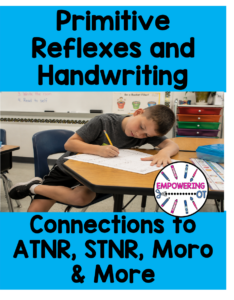
Primitive Reflexes and Handwriting
Handwriting is an especially complex fine motor activity.
Successful handwriting requires:
Postural stability + shoulder control + bilateral coordination + visual-motor integration + motor planning + hand strength + finger control + attention + practice.
This explains why repeatedly practicing letters may not solve every handwriting problem.
For example, a child who is struggling to stabilize their body at the desk may benefit from addressing positioning and postural demands in addition to letter formation.
A child who has difficulty crossing midline may need opportunities to develop bilateral and midline skills.
A child whose hand fatigues quickly may need a different pencil, shorter writing periods, alternative ways to demonstrate knowledge, or activities supporting hand function.
Looking at handwriting through this broader lens helps us ask a more useful question:
What is making writing difficult for this particular child?
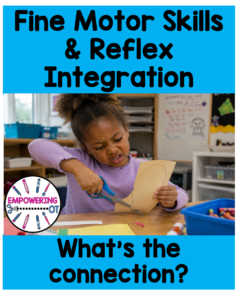
Primitive Reflexes and Scissor Skills
Cutting with scissors is another deceptively complex task.
To cut along a line, a child typically needs to:
- Hold and operate the scissors with one hand
- Stabilize and rotate the paper with the other
- Coordinate both hands simultaneously
- Visually follow the cutting line
- Adjust wrist and arm position
- Grade how far the scissors open and close
- Maintain postural stability
That means bilateral coordination, hand strength, visual-motor skills, motor planning, and postural control are all working together.
If a child struggles with scissors, simply giving them more worksheets to cut may not address the underlying difficulty.
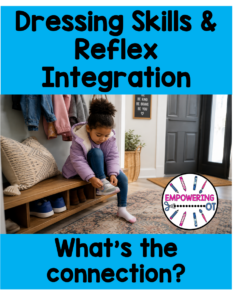
Primitive Reflexes and Dressing Skills
Fine motor skills are also essential for independence with everyday routines.
Getting dressed may require a child to:
- Button
- Unbutton
- Zip
- Snap
- Pull
- Pinch
- Grasp fabric
- Manipulate fasteners
- Coordinate both hands
- Reach across the body
- Adjust clothing while maintaining balance
This is why children who struggle with fine motor coordination may also have difficulty becoming independent with dressing.
The goal isn’t simply to “practice buttons more.” Sometimes we need to consider the broader combination of bilateral coordination, body awareness, motor planning, posture, sensory processing, and hand skills required by the task.
Why Bilateral Coordination Matters for Fine Motor Skills
Many fine motor activities aren’t actually “one-hand” activities.
One hand may be doing the obvious work while the other performs an equally important stabilizing role.
Consider:
Writing: one hand writes while the other holds the paper.
Cutting: one hand operates the scissors while the other turns the paper.
Buttoning: both hands coordinate to manipulate the button and fabric.
Opening a container: one hand stabilizes while the other twists.
Stringing beads: one hand holds the string while the other manipulates the bead.
This is called bilateral coordination, or the ability to use both sides of the body together in an organized way.
Primitive reflex patterns such as ATNR and STNR may be considered as part of the broader developmental picture when bilateral coordination is persistently difficult.
Crossing Midline and Fine Motor Development
Crossing midline means moving a hand, foot, or other body part across the imaginary line dividing the left and right sides of the body.
Children cross midline constantly during daily life.
They may reach across their body to grab a crayon, write from one side of a page to the other, turn a puzzle piece into position, or reach for a sleeve while getting dressed.
A child who has difficulty crossing midline may:
- Switch hands at the middle of the page
- Move objects from one hand to the other
- Rotate their body instead of reaching across
- Reposition paper frequently
- Have difficulty establishing consistent hand preference
- Avoid activities requiring cross-body movement
Because ATNR is related to early head and limb movement patterns, it may be one developmental factor considered when looking at persistent midline difficulties.
Fine Motor Skills Are More Than Hand Strength
When children struggle with fine motor activities, adults often immediately reach for hand-strengthening exercises.
Play dough, clothespins, tongs, putty, and squeezing activities can certainly be useful.
But strength is only one piece of fine motor development.
A child can have adequate hand strength and still struggle because of challenges with:
- Dexterity
- Motor planning
- Bilateral coordination
- Visual-motor integration
- Postural control
- Sensory processing
- Body awareness
- Crossing midline
- Grading force
- Endurance
This is why occupational therapy looks at how the entire person, task, and environment interact, rather than treating the hand as an isolated body part.
How Can Parents Support Fine Motor Development at Home?
You don’t need to turn home into a therapy clinic.
Some of the best fine motor opportunities happen naturally through everyday play and routines.
Try activities such as:
- Building with blocks or construction toys
- Playing with play dough
- Drawing and coloring
- Using stickers
- Completing puzzles
- Cooking and baking
- Opening snack containers
- Helping with clothing fasteners
- Stringing beads
- Using tongs during play
- Building with small manipulatives
- Tearing and gluing paper for crafts
- Water play with squeeze bottles or sponges
- Picking up small objects during games
Whenever possible, choose activities the child actually enjoys.
Fine motor development does not have to look like repetitive worksheets.
How Can Occupational Therapists Support Fine Motor Skills?
When a child has persistent fine motor difficulties, occupational therapists can look beyond the immediate skill to identify what may be affecting performance.
Depending on the child, intervention might address:
- Postural stability
- Shoulder stability
- Bilateral coordination
- Crossing midline
- Visual-motor integration
- Fine motor dexterity
- Motor planning
- Sensory processing
- Environmental adaptations
- Tool selection
- Task demands
- Primitive reflex patterns when clinically appropriate
This whole-child approach is particularly important when a child has already received lots of fine motor practice but continues to struggle.
Instead of simply asking:
“How can we get this child to practice more?”
we can ask:
“What is making this activity difficult, and how can we make participation more successful?”
Should My Child Be Tested for Retained Primitive Reflexes?
Fine motor difficulties alone are not enough to determine whether a child has retained primitive reflexes.
If you notice persistent difficulties across several areas, such as fine motor skills combined with posture, bilateral coordination, crossing midline, balance, visual-motor skills, or motor planning, it may be helpful to discuss those observations with an occupational therapist or another appropriately trained professional.
Assessment should consider the child’s overall development and functional participation, rather than treating a reflex response as a diagnosis by itself.
You can also read my guide to 12 primitive reflexes and common signs to watch for to learn more about the different reflex patterns.
Supporting Primitive Reflexes Through Play and Movement
When primitive reflex patterns are relevant to a child’s occupational performance, support should remain child-centered, functional, and respectful.
Movement does not need to be rigid or drill-based.
Activities involving crawling, reaching, pushing, pulling, weight bearing, bilateral movement, crossing midline, balance, rhythm, and whole-body play can provide rich opportunities for developing the foundational motor skills that support hand use.
The goal is not to make a child perform a movement perfectly.
The goal is to provide varied movement experiences while supporting participation in meaningful activities.
Looking for Primitive Reflex Activities?
If you’re an occupational therapist, educator, or parent looking for structured ideas, my Reflex Integration Bundle Toolkit includes educational handouts and play-based activities addressing 12 primitive reflexes, including Moro, ATNR, STNR, TLR, Palmar, Plantar, Babinski, Spinal Galant, Rooting, Suck, Landau, and Perez.
You can also explore individual reflex information and activities based on the child’s needs.
For fine motor concerns in particular, these are helpful places to start:
- Palmar Reflex Integration and Fine Motor Skills
- ATNR Reflex Integration and Bilateral Coordination
- STNR Reflex Integration and Postural Control
- TLR Reflex Integration and Postural Stability
For additional fine motor practice, the Fine Motor Daily Skills Workbook provides quick activities targeting fine motor, visual-motor, visual-perceptual, and pencil-control skills.
Frequently Asked Questions About Primitive Reflexes and Fine Motor Skills
Can retained primitive reflexes cause fine motor problems?
Retained primitive reflexes may be one factor associated with difficulties in areas that support fine motor performance, such as posture, bilateral coordination, crossing midline, grasp development, and motor control. However, fine motor difficulties have many possible causes, and a retained reflex should not automatically be assumed to be the reason a child struggles.
Which primitive reflex affects fine motor skills?
Several reflexes may be relevant. The Palmar reflex has a direct relationship with early grasp development, while ATNR may influence crossing midline and bilateral coordination. STNR and TLR may also be considered when posture and whole-body stability are affecting tabletop performance.
Can primitive reflexes affect pencil grip?
Early reflex patterns may be one developmental factor affecting how a child organizes their hand and body for writing. However, pencil grip is influenced by many factors, and an unconventional grasp is not necessarily a problem if it is comfortable and functional.
Can retained primitive reflexes affect handwriting?
They may contribute to underlying areas needed for handwriting, including postural stability, bilateral coordination, visual-motor skills, crossing midline, and hand control. Handwriting should therefore be evaluated as a complex functional skill rather than attributed to one reflex.
What primitive reflex is associated with grasping?
The Palmar Grasp Reflex is the early reflex most directly associated with grasping. During infancy, stimulation of the palm produces automatic finger flexion. As development progresses, this early response becomes less dominant as voluntary grasp-and-release skills emerge.
Do fine motor exercises integrate primitive reflexes?
Not necessarily. Fine motor activities can support hand strength, dexterity, coordination, and functional participation, while reflex-focused movement activities target different aspects of motor development. The most appropriate approach depends on the individual child’s needs.
When should I be concerned about my child’s fine motor skills?
Consider discussing concerns with an occupational therapist or other qualified professional when fine motor difficulties are persistent, significantly interfere with everyday activities, cause pain or excessive fatigue, or limit a child’s participation in school, play, self-care, or other meaningful routines.
Final Thoughts: Look Beyond the Hands
When a child struggles with fine motor skills, it can be tempting to focus entirely on the hands.
But hands do not work alone.
Posture, shoulder stability, bilateral coordination, crossing midline, visual-motor integration, motor planning, sensory processing, and early movement development all contribute to skilled hand use.
Primitive reflexes are one possible piece of that larger developmental puzzle.
For parents, the takeaway isn’t to look at every awkward pencil grasp or difficult button and assume a retained reflex.
For therapists, it is a reminder to consider the whole child and the demands of the activity.
When we understand what is underneath a difficult task, we can move beyond simply asking children to “practice more” and instead provide supports that make everyday participation more successful.
primitive reflexes and fine motor skills, retained primitive reflexes and fine motor skills, primitive reflexes and handwriting, primitive reflexes and pencil grip, primitive reflexes and scissor skills, retained reflexes in children, Palmar reflex and fine motor skills, Palmar reflex and pencil grip, ATNR and handwriting, ATNR and fine motor skills, STNR and handwriting, primitive reflexes and bilateral coordination, primitive reflexes and crossing midline, fine motor difficulties in children, reflex integration occupational therapy, reflex integration activities for kids, primitive reflexes and hand skills, retained reflexes and handwriting, primitive reflexes occupational therapy, fine motor development in children