Does your child seem to know what they want to do but have trouble figuring out how to make their body do it?
Maybe learning to ride a bike takes much longer than expected. They may struggle to imitate a new movement, figure out how to climb onto playground equipment, learn a new dance, get their body into position for a sport, or complete a multi-step movement activity.
Sometimes these difficulties are described as challenges with motor planning.
Motor planning is a complex process that allows us to think of an action, organize the movements needed to complete it, and carry out those movements successfully. It depends on many different systems working together, including body awareness, sensory processing, postural control, balance, bilateral coordination, timing, sequencing, and previous movement experiences.
Early movement patterns, including primitive reflexes, are one piece of this developmental picture.
When primitive reflexes continue to strongly influence movement beyond the period when they are typically expected to integrate, they may be considered alongside other factors when a child has difficulty developing efficient, coordinated movement.
This does not mean that retained primitive reflexes cause every motor planning difficulty. Motor planning is complex, and children can struggle for many different reasons. However, understanding the possible relationship between primitive reflexes and motor planning can help parents and therapists look beyond the individual task and consider the child’s overall movement foundation.
If primitive reflexes are new to you, start with my guide to primitive reflex integration and why primitive reflexes matter.
What Is Motor Planning?
Motor planning is the brain and body’s ability to plan, organize, and carry out a movement that may be unfamiliar or require problem-solving.
We use motor planning throughout the day, often without realizing it.
A child uses motor planning when they:
- Figure out how to climb onto unfamiliar playground equipment
- Learn how to ride a scooter or bike
- Copy a new movement during PE
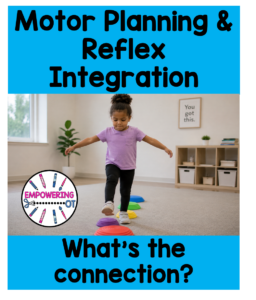
- Navigate an obstacle course
- Get into a new yoga pose
- Learn a dance or movement sequence
- Put on clothing
- Climb into a car
- Position their body to catch or kick a ball
- Learn to use scissors
- Build something from a model
- Complete a new craft
- Carry several objects across a room
- Figure out how to move through a crowded space
- Learn a new self-care routine
Motor planning is particularly important when an activity is new.
Once we have practiced an activity many times, the movement may become more automatic. But when something changes, the brain has to create or adjust the movement plan.
Motor Planning Is More Than Coordination
Motor planning and coordination are related, but they aren’t exactly the same thing.
Coordination generally refers to how smoothly and effectively different parts of the body work together.
Motor planning involves figuring out what movements are needed and how to organize them to accomplish a goal.
For example, imagine a child standing in front of a climbing structure they have never seen before.
They have to determine:
Where do I put my foot?
Where should my hands go?
How much force do I need?
Which leg moves next?
How do I shift my weight without falling?
That requires much more than muscle strength.
The child needs information about where their body is in space, how the equipment is positioned, how their body can move, and what sequence of movements will get them to their goal.
What Does Motor Planning Look Like in Everyday Life?
Motor planning difficulties can look very different from one child to another.
You might notice a child who:
- Takes longer to learn new physical activities
- Watches other children before attempting something
- Has difficulty imitating movements
- Seems unsure how to position their body
- Has trouble starting an unfamiliar movement
- Uses trial and error much more than peers
- Has difficulty sequencing movements
- Struggles with obstacle courses
- Avoids unfamiliar playground equipment
- Has difficulty learning sports
- Appears awkward during new movement activities
- Has difficulty figuring out how to get onto or off equipment
- Struggles with multi-step self-care tasks
- Has difficulty adjusting a familiar movement when the environment changes
- Needs more repetition before a movement becomes familiar
A child may understand the instruction perfectly and still have difficulty figuring out how to organize their body to do it.
That distinction is important.
Primitive Reflexes and Motor Planning: What Is the Connection?
Primitive reflexes are automatic movement responses that play important roles during early development.
As babies gain more voluntary control, these early reflexive patterns become less dominant and increasingly complex movement becomes possible.
Motor planning requires almost the opposite of an automatic reflexive response.
Instead of the body responding automatically to a particular position or sensory input, the child needs to be able to select, organize, adjust, and sequence voluntary movement based on what the situation requires.
This is where primitive reflexes may become relevant.
If an early movement pattern continues to strongly influence how a child moves, the child may need to work around that pattern while simultaneously trying to plan a more complex movement.
Think of it like trying to follow a new dance routine while someone keeps gently pulling one part of your body in another direction.
You can still learn the dance.
But it may require more attention, effort, repetition, and problem-solving.
For some children, persistent primitive reflex patterns may be considered alongside difficulties involving:
- Body awareness
- Postural control
- Bilateral coordination
- Crossing midline
- Balance
- Head and body dissociation
- Visual-motor coordination
- Movement sequencing
- Motor control
All of these skills can contribute to successful motor planning.
Which Primitive Reflexes May Be Related to Motor Planning?
There isn’t one single “motor planning reflex.”
Instead, several primitive reflex patterns may influence the developmental skills that support coordinated voluntary movement.
ATNR and Motor Planning
The Asymmetrical Tonic Neck Reflex (ATNR) connects head position with movement of the arms and legs during infancy.
When a baby turns their head to one side, the limbs respond in a characteristic pattern. As development progresses, children become increasingly able to move their head, arms, and legs independently.
That independence is important for complex movement.
If an ATNR pattern continues to strongly influence movement, a child may have additional difficulty with skills involving:
- Crossing midline
- Bilateral coordination
- Hand-eye coordination
- Reaching across the body
- Coordinating head and arm movements
- Throwing and catching
- Dressing
- Writing across a page
- Activities requiring the two sides of the body to perform different jobs
Imagine trying to catch a ball while turning your head toward it. Your eyes, head, trunk, and arms need to coordinate while still being able to move somewhat independently.
That is much more difficult if turning the head strongly influences what the arms want to do.
Learn more about ATNR reflex integration, crossing midline, and coordination.
STNR and Motor Planning
The Symmetrical Tonic Neck Reflex (STNR) helps support the developmental transition toward hands-and-knees positioning and crawling.
Crawling is a rich developmental experience because it requires the child to coordinate the upper and lower body, shift weight, alternate sides, maintain stability, visually explore the environment, and continuously adjust movement.
These experiences help build foundations that are also useful for more complex motor tasks.
If STNR continues to strongly influence movement, a child may have more difficulty coordinating the head, arms, trunk, and legs independently during certain activities.
You might notice challenges with:
- Crawling patterns
- Moving through obstacle courses
- Coordinating upper and lower body movements
- Ball skills
- Maintaining posture during movement
- Moving between positions
- Activities requiring simultaneous head and body control
Read more about STNR reflex integration, posture, and coordination.
TLR and Motor Planning
The Tonic Labyrinthine Reflex (TLR) is associated with early flexion and extension patterns and the developing relationship between head position, muscle tone, balance, and movement against gravity.
Motor planning becomes much harder when a child is also working hard to maintain their balance or determine where their body is in space.
For example, imagine trying to learn a new obstacle course while standing on an unstable surface.
Part of your attention would be devoted to figuring out the course, but another part would constantly be managing your balance.
Children who have difficulty with postural stability or body position may face a similar challenge.
TLR may therefore be one reflex considered when a child demonstrates motor planning difficulties alongside challenges with:
- Balance
- Postural control
- Body awareness
- Movement against gravity
- Spatial awareness
- Coordinated whole-body movement
Learn more about TLR reflex integration, balance, and postural control.
Moro Reflex and Trying New Movements
The Moro reflex is an early protective response associated with sudden changes in movement and sensory input.
The connection to motor planning is somewhat different from ATNR, STNR, or TLR.
A child who is highly uncomfortable with unpredictable movement may be less willing to explore unfamiliar physical activities.
For example, they may avoid:
- Swings
- Climbing equipment
- Balance challenges
- Jumping from heights
- Moving backward
- Activities where their feet leave the ground
- Unfamiliar playground equipment
This matters because children develop motor planning partly through experience.
They climb, fall, adjust, try again, discover another way, and gradually build a larger library of movement experiences.
If movement frequently feels unpredictable or uncomfortable, a child may have fewer opportunities to experiment with those experiences.
You can learn more in my guide to Moro reflex integration and supportive activities.
Body Awareness and Motor Planning
Before you can efficiently plan where your body needs to go, it helps to have a strong sense of where your body already is.
This is body awareness.
Imagine trying to park a car if you couldn’t accurately judge where the front, back, and sides of the car were.
Motor planning works in a similar way.
A child needs information about:
- Where their arms and legs are
- How far they can reach
- How much force they are using
- Where their body is relative to objects
- How their joints are positioned
- How their body changes as they move
This information comes from multiple sensory systems, particularly proprioceptive, vestibular, tactile, and visual input.
Primitive reflexes are not the same thing as body awareness, but early movement experiences contribute to the developmental foundation from which increasingly complex body awareness and voluntary movement emerge.
Bilateral Coordination and Motor Planning
Many complex movements require the two sides of the body to work together.
This is called bilateral coordination.
Consider riding a bike.
The legs alternate while pedaling. The hands stabilize and steer. The trunk maintains balance. The head moves to look around the environment.
Or consider getting dressed.
One hand may hold a waistband while the other pulls. One leg has to maintain balance while the other enters the pant leg.
These movements require the brain to organize multiple body parts simultaneously.
Children with bilateral coordination difficulties may therefore have trouble with:
- Riding a bike
- Jumping jacks
- Catching a ball
- Cutting with scissors
- Dressing
- Climbing
- Opening containers
- Using playground equipment
- Coordinating dance or exercise movements
ATNR and STNR are two primitive reflex patterns that may be considered when looking at persistent bilateral coordination difficulties.
Crossing Midline and Motor Planning
Crossing midline means moving one side of the body across the imaginary center line dividing the left and right sides.
It happens constantly during functional activities.
A child crosses midline when they:
- Reach for an object on the opposite side
- Write across a page
- Throw a ball across their body
- Reach for a seat belt
- Put on clothing
- Participate in sports
- Complete cross-body movement games
Difficulty crossing midline can make movement less efficient because the child may reposition their entire body, switch hands, or use additional movements to accomplish the task.
ATNR is particularly relevant when therapists are considering the developmental foundations of crossing midline and bilateral coordination.
Primitive Reflexes, Motor Planning, and Fine Motor Skills
Motor planning isn’t only about gross motor activities.
Fine motor activities require motor planning too.
Think about using scissors.
The child has to determine how to position the scissors, where to place their fingers, how far to open the blades, when to close them, how to rotate the paper, and how to continuously adjust their hands while following the line.
Or think about buttoning a shirt.
The child needs to position both hands, orient the button, stabilize the fabric, push the button through the opening, and adjust finger position as the task progresses.
That requires fine motor control + bilateral coordination + body awareness + sensory feedback + motor planning.
If you’re interested in the broader connection between primitive reflexes and hand development, read Primitive Reflexes and Fine Motor Skills: Could Retained Reflexes Affect Hand Skills?.
Motor Planning and Everyday Self-Care
Motor planning difficulties can become especially noticeable during everyday routines because self-care activities often involve many movements performed in sequence.
Consider getting dressed.
A child needs to:
- Determine how the clothing is oriented.
- Position their body.
- Place the correct limb into the opening.
- Shift their balance.
- Pull the clothing into position.
- Adjust it if something becomes twisted.
- Move on to the next step.
Brushing teeth, tying shoes, washing hair, using utensils, packing a backpack, and completing toileting routines can involve similar motor-planning demands.
This is one reason a child may understand exactly what they are supposed to do but still need help figuring out how to organize their body to do it.
Motor Planning vs. “Not Trying”
Motor planning difficulties can easily be misunderstood.
A child may be described as:
“Clumsy.”
“Not paying attention.”
“Not trying.”
“Always waiting for someone to help.”
“Too afraid to try new things.”
But sometimes the child isn’t refusing the activity.
They genuinely don’t know how to start.
Watching other people can provide useful visual information. Asking for help can reduce the motor demands. Avoiding an unfamiliar activity may be a reasonable response when previous attempts have been frustrating.
Instead of asking:
“Why won’t they just try?”
try asking:
“What part of this movement is difficult to figure out?”
That shift can completely change how we support the child.
How Can Parents Support Motor Planning at Home?
Motor planning develops through opportunities to explore, experiment, problem-solve, and experience different types of movement.
You do not need special therapy equipment.
Try incorporating activities such as:
- Building pillow obstacle courses
- Crawling under and over furniture
- Playing follow-the-leader
- Copying animal movements
- Dancing to favorite songs
- Building forts
- Playing catch
- Carrying groceries
- Helping with laundry
- Climbing at the playground
- Playing hopscotch
- Riding scooters or bikes when appropriate
- Doing simple cooking activities
- Creating movement challenges
- Playing Simon Says
- Trying familiar activities in slightly different ways
Most importantly, allow time for problem-solving.
If the child is safe, resist immediately showing them exactly how to complete every movement.
Sometimes a pause gives the child an opportunity to create their own motor plan.
Supporting Motor Planning Without Creating Frustration
For a child who finds new movements difficult, simply saying “try again” may not be enough.
Instead, consider changing the task.
You might:
- Break the movement into smaller steps
- Demonstrate one step at a time
- Use visual models
- Slow the movement down
- Practice one part before combining the sequence
- Reduce environmental distractions
- Provide stable surfaces first
- Allow extra processing time
- Repeat activities in playful ways
- Use familiar movements as a starting point
- Let the child watch before participating
- Offer choices about how to complete the activity
The goal is not to make the child perform a movement exactly like everyone else.
The goal is to help them develop effective movement strategies that support participation and independence.
What Can Occupational Therapists Look For?
When evaluating a child with motor planning concerns, occupational therapists may consider much more than whether the child can complete one particular task.
Observations might include:
- How the child approaches unfamiliar movement
- Ability to imitate movements
- Body awareness
- Bilateral coordination
- Crossing midline
- Postural control
- Balance
- Visual-motor integration
- Sensory processing
- Movement sequencing
- Fine motor planning
- Gross motor planning
- Ability to adjust after an unsuccessful attempt
- Amount and type of cueing required
- Whether performance improves with repetition
- How motor difficulties affect everyday occupations
When clinically appropriate, primitive reflex patterns may be considered as one component of this larger functional picture.
The goal should never be to find a reflex simply because a child struggles with motor planning.
Instead, the question is:
What factors are affecting this child’s ability to successfully plan and participate in meaningful activities?
Does Poor Motor Planning Mean a Child Has Retained Primitive Reflexes?
No.
This is an important distinction.
Motor planning difficulties do not automatically indicate retained primitive reflexes, and retained reflexes should not be assumed based on functional observations alone.
Motor planning depends on multiple developmental, sensory, perceptual, cognitive, and motor factors.
A child who struggles with motor planning may benefit from a comprehensive evaluation that looks at the entire picture rather than attributing difficulties to one cause.
You can also read 12 Primitive Reflexes Every Parent and Educator Should Know and the Red Flags to Watch For for an overview of individual primitive reflex patterns.
Primitive Reflex Activities and Motor Development
When primitive reflex patterns are relevant to a child’s occupational performance, movement activities can be incorporated in a way that is playful, functional, and child-centered.
Activities involving:
- Crawling
- Rolling
- Reaching
- Weight shifting
- Crossing midline
- Pushing and pulling
- Bilateral movement
- Balance
- Rhythm
- Flexion and extension
- Whole-body movement
can provide opportunities to practice many of the foundational skills involved in coordinated movement.
But the goal isn’t to make children complete repetitive exercises simply because a reflex is suspected.
Movement should support participation, exploration, confidence, and functional development.
Looking for Play-Based Primitive Reflex Activities?
If you’re an occupational therapist, educator, or parent looking for structured primitive reflex resources, my Reflex Integration Bundle Toolkit includes educational handouts and play-based activities addressing 12 primitive reflexes.
The toolkit includes resources for:
- Moro
- ATNR
- STNR
- TLR
- Palmar
- Plantar
- Babinski
- Spinal Galant
- Rooting
- Suck
- Landau
- Perez
The activities are designed to make reflex-focused movement easier to incorporate into therapy sessions, school routines, and home programs.
For motor planning concerns, the ATNR, STNR, and TLR resources may be particularly useful when you’re also working on bilateral coordination, crossing midline, postural control, balance, and whole-body coordination.
You can also explore my Fine Motor Daily Skills Workbook for activities targeting fine motor, visual-motor, visual-perceptual, coordination, pencil-control, and motor-planning skills.
Frequently Asked Questions About Primitive Reflexes and Motor Planning
Can retained primitive reflexes cause motor planning problems?
Primitive reflex patterns may be one developmental factor considered when a child has motor planning difficulties, particularly when challenges also involve bilateral coordination, crossing midline, postural control, balance, or body awareness. However, motor planning difficulties have many possible contributing factors, so retained reflexes should not automatically be assumed to be the cause.
Which primitive reflex affects motor planning?
There is no single primitive reflex responsible for motor planning. ATNR, STNR, and TLR may be particularly relevant because they involve developmental movement patterns related to head-body coordination, bilateral movement, posture, balance, and spatial control.
Is motor planning the same as coordination?
No. Coordination describes how effectively body parts work together, while motor planning involves figuring out, organizing, and carrying out the movements required for an activity. The two skills are closely related.
What does poor motor planning look like in children?
A child with motor planning difficulties may have trouble learning unfamiliar movements, imitating actions, sequencing movements, navigating playground equipment, learning sports, completing multi-step self-care tasks, or figuring out how to position their body during a new activity.
Can motor planning affect fine motor skills?
Yes. Fine motor activities such as cutting, buttoning, drawing, manipulating tools, and completing crafts require the child to plan and adjust movements of the hands and fingers.
Can motor planning affect dressing?
Yes. Dressing requires body awareness, balance, bilateral coordination, sequencing, and the ability to determine how to move the body in relation to clothing. Motor planning difficulties can therefore make dressing routines more challenging.
How does occupational therapy help with motor planning?
Occupational therapists can identify the factors affecting a child’s participation and provide opportunities to practice movement through meaningful activities. Support may address body awareness, sensory processing, bilateral coordination, postural control, balance, visual-motor integration, fine motor skills, task sequencing, environmental supports, and motor planning.
Final Thoughts: Motor Planning Is a Whole-Body Skill
Motor planning is much more than being “good at movement.”
It requires the brain and body to work together to answer several questions at once:
Where is my body?
Where do I need to go?
What movement should I make?
What happens first?
What happens next?
How do I adjust if it doesn’t work?
Primitive reflexes are one possible piece of that developmental picture.
For parents, this means that a child who struggles with new movements may need more than repeated instructions to “just try.”
For therapists, it means looking beyond the individual task to consider body awareness, sensory processing, bilateral coordination, crossing midline, postural control, balance, movement experience, and early motor patterns.
When we understand what makes movement difficult for a particular child, we can provide support that encourages exploration, problem-solving, participation, and greater independence.
primitive reflexes and motor planning, retained primitive reflexes and motor planning, motor planning difficulties in children, primitive reflexes and coordination, retained reflexes in children, ATNR and motor planning, STNR and motor planning, TLR and motor planning, primitive reflexes and body awareness, primitive reflexes and bilateral coordination, primitive reflexes and crossing midline, primitive reflexes and balance, motor planning occupational therapy, motor planning activities for kids, motor planning and sensory processing, motor planning and body awareness, poor motor planning in children, reflex integration occupational therapy, reflex integration activities for kids, primitive reflex integration, child struggles with motor planning, motor planning and fine motor skills, motor planning and dressing, motor planning and coordination