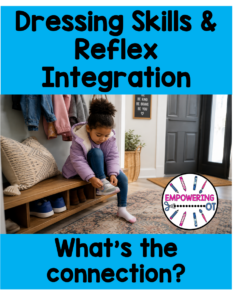
Primitive reflexes and dressing skills may not seem connected at first. But getting dressed is actually a complex developmental task requiring balance, body awareness, bilateral coordination, fine motor skills, motor planning, postural control, sensory processing, and sequencing.
For some children, getting dressed is easy.
For others, it can feel like a daily obstacle course.
A child may struggle to put a shirt over their head, lose their balance while stepping into pants, become frustrated with buttons, put clothing on backward, avoid certain fabrics, or need significantly more help getting dressed than expected.
Parents may find themselves wondering:
Why does my child struggle to get dressed independently?
There are many possible reasons. Dressing difficulties can be related to motor development, fine motor skills, sensory preferences, balance, coordination, visual-perceptual skills, executive functioning, motor planning, or simply needing more time and practice.
Another developmental factor an occupational therapist may consider as part of the larger sensory-motor picture is retained primitive reflexes.
So, could retained primitive reflexes make dressing more difficult?
Possibly, but the connection is more nuanced than saying, “This reflex causes dressing problems.”
Let’s break down what may actually be happening.
What Are Primitive Reflexes?
Primitive reflexes are automatic movement responses present during infancy. These early reflexive patterns support survival, movement, feeding, protection, and early neurological development.
As the nervous system matures, these reflexive responses typically become less dominant as voluntary motor control develops.
Primitive reflexes include:
- Moro Reflex – an early startle response to sudden sensory or movement changes
- ATNR (Asymmetrical Tonic Neck Reflex) – connects head turning with changes in arm and leg position
- STNR (Symmetrical Tonic Neck Reflex) – connects head position with upper- and lower-body movement
- TLR (Tonic Labyrinthine Reflex) – relates head position to patterns of whole-body flexion and extension
- Palmar Reflex – an early grasp response involving the hand
- Plantar Reflex – an early grasp-like response involving the foot and toes
- Babinski Reflex – an early neurological response of the toes to stimulation along the sole of the foot
- Spinal Galant Reflex – a trunk response to stimulation along the side of the spine
- Rooting Reflex – helps an infant orient toward touch around the mouth and supports early feeding
- Suck Reflex – supports early sucking and feeding
- Landau Reflex – a developmental postural response involving the head, trunk, and legs
- Perez Reflex – an early response associated with stimulation along the spine
When one of these early responses continues to be easily triggered beyond the developmental period when it would typically become less prominent, it is often described as a retained primitive reflex.
A retained reflex does not automatically mean something is wrong with a child, nor does the presence of a retained reflex prove that it is causing a functional difficulty.
Instead, occupational therapists look at the whole child.
If you’re looking for a more complete introduction to reflexes, read my guide to primitive reflexes and reflex integration to learn how these early movement patterns may relate to children’s everyday sensory-motor development.
Why Is Getting Dressed So Hard for Some Children?
Adults get dressed so automatically that it is easy to forget just how much the brain and body have to coordinate.
Consider what happens when a child puts on a pair of pants.
They have to:
- Find the front and back.
- Open the waistband.
- Maintain their balance.
- Lift one foot.
- Aim the foot into the correct opening.
- Push the leg through.
- Repeat with the other leg.
- Stand or shift position.
- Pull the pants over their hips.
- Adjust the waistband.
And that’s just pants!
Dressing requires several developmental skills to work together.
Body Awareness
The child needs an internal understanding of where their body is in space.
Where is my arm?
Where is the sleeve?
How far do I need to reach?
Did my foot actually make it through the pant leg?
Bilateral Coordination
The two sides of the body frequently have different jobs.
One hand may hold a zipper while the other pulls.
One arm may stabilize a shirt while the other searches for a sleeve.
Balance
Putting on pants, underwear, socks, and shoes often requires weight shifting or briefly balancing on one foot.
Postural Control
Children need enough trunk stability to use their arms and legs efficiently.
Fine Motor Skills
Buttons, snaps, zippers, buckles, shoelaces, and small clothing adjustments require increasingly refined hand control.
Motor Planning
The child has to figure out how to move their body through the clothing.
Sensory Processing
Clothing brings sensory input directly against the skin.
Tags, seams, waistbands, socks, elastic, buttons, fabric textures, temperature, and pressure can all affect comfort.
Visual-Perceptual Skills
Children need to determine:
- Front versus back
- Inside versus outside
- Left versus right shoe
- Correct sleeve
- Correct pant leg
- Where a button belongs
- Where a zipper connects
Executive Functioning
Getting dressed also requires sequencing, attention, initiation, working memory, and persistence.
That makes dressing much more than a “self-help skill.”
It is a whole-body sensory-motor task.
Primitive Reflexes and Dressing Skills: What’s the Connection?
There is not strong evidence that retained primitive reflexes directly cause dressing difficulties.
Instead, there can be overlap between the skills required for dressing and the sensory-motor areas that may be considered when evaluating retained primitive reflexes.
A child struggling with dressing may have difficulty with:
- Crossing midline
- Using both sides of the body together
- Maintaining balance
- Coordinating head and body movements
- Reaching behind the body
- Postural control
- Hand dexterity
- Grasp and release
- Body awareness
- Motor planning
- Tolerating clothing against the skin
Rather than asking:
“Which reflex is causing this?”
I prefer to ask:
“Which part of dressing is difficult, and what underlying skill does that part require?”
That gives us much more useful information.
ATNR and Dressing: Crossing Midline and Coordinating Both Sides of the Body
The Asymmetrical Tonic Neck Reflex (ATNR) connects early head turning with movements of the arms and legs.
ATNR is sometimes called the “archer’s reflex” because of the characteristic infant position associated with turning the head.
As voluntary movement develops, children become increasingly able to move their head without automatically changing the position of their arms and legs.
They also develop more efficient:
- Midline crossing
- Bilateral coordination
- Hand-eye coordination
- Upper-body control
- Separation of head and body movements
These skills can become important during dressing.
Think about putting on a coat.
The child may need to reach one arm backward while turning their head in another direction.
Or consider pulling pants over the hips.
One hand may cross the body while the other stabilizes the waistband.
A child having difficulty with these skills might:
- Consistently miss one sleeve
- Turn their entire body instead of reaching across
- Have difficulty reaching behind their body
- Struggle to coordinate both hands
- Need excessive repositioning
- Become frustrated putting on coats or shirts
- Prefer using one side of the body
These observations do not prove that ATNR is retained. They tell us that bilateral coordination, midline crossing, motor planning, or body awareness may deserve a closer look.
My ATNR Reflex Integration: Supports for School & Home guide explains more about ATNR, midline crossing, coordination, and functional skills such as dressing.
STNR and Dressing: Head Position, Posture, and Whole-Body Coordination
The Symmetrical Tonic Neck Reflex (STNR) is an early developmental reflex involving relationships between head movement and upper- and lower-body positioning.
STNR is often discussed in relation to crawling, posture, and coordination between the upper and lower portions of the body.
Now think about getting dressed.
A child repeatedly changes head and body position while:
- Looking down for pant openings
- Bending to reach socks
- Looking toward their shoes
- Pulling clothing upward
- Moving between sitting and standing
- Reaching for clothing
- Putting a shirt over their head
A child who has difficulty coordinating these movements may appear awkward or inefficient.
You might notice:
- Slumping while dressing
- Difficulty bending and returning upright
- Frequently changing positions
- Falling over while trying to dress
- Using the floor for extra support
- Difficulty coordinating upper- and lower-body movements
- Frustration with multistep dressing tasks
Again, these behaviors are not diagnostic of a retained STNR.
They are clues that postural control and whole-body coordination may be making dressing harder.
Learn more about STNR, posture, and upper- and lower-body coordination in my STNR Reflex Integration guide.
TLR and Dressing: Balance and Postural Control
The Tonic Labyrinthine Reflex (TLR) is associated with early flexion and extension patterns influenced by head position.
As children develop, they gain greater control over their head, trunk, and limbs while moving against gravity.
This becomes particularly relevant when we think about dressing.
Try putting on a pair of pants while standing.
You have to:
Shift your weight → lift one leg → maintain balance → coordinate your hands → guide your foot into the opening → return to standing.
That’s a lot of postural work.
A child with balance or postural-control difficulties may:
- Sit or lie down for nearly every dressing task
- Fall while stepping into pants
- Lean against furniture
- Struggle to lift one leg while standing
- Become tired during dressing
- Avoid bending down
- Have difficulty returning upright after reaching toward their feet
Sitting down to get dressed is not inherently a problem.
In fact, sitting may be an excellent accommodation that allows a child to dress more independently.
The goal is not to make every child stand while dressing.
The goal is successful participation.
My TLR Reflex Integration: Supports for School & Home resource provides additional information about TLR, balance, body awareness, core stability, and postural control.
Palmar Reflex and Dressing: Buttons, Zippers, Snaps, and Fasteners
The Palmar Reflex is especially relevant when discussing the fine motor components of dressing.
The Palmar Grasp Reflex is an early infant response in which stimulation to the palm produces automatic finger flexion or grasping.
As hand development progresses, children gain increasingly refined voluntary control of:
Grasp → release → finger isolation → dexterity → manipulation.
Those skills eventually support dressing tasks such as:
- Buttoning
- Unbuttoning
- Pulling zippers
- Connecting zipper halves
- Fastening snaps
- Adjusting waistbands
- Pulling socks
- Tying shoes
- Managing buckles
A child struggling with hand skills might:
- Avoid buttons
- Need significantly more time for fasteners
- Pull on a zipper without stabilizing the bottom
- Use their whole hand rather than fingertips
- Drop buttons repeatedly
- Have difficulty pinching small fasteners
- Become frustrated with clothing that requires precise hand movements
These difficulties can reflect many things, including fine motor development, bilateral coordination, motor planning, hand strength, or limited experience with fasteners.
A retained Palmar Reflex is only one possible sensory-motor consideration.
My Palmar Reflex Integration: Supports for School & Home guide explores the relationship between the Palmar Reflex, grasp and release, fine motor development, and functional tasks such as dressing.
Spinal Galant Reflex and Clothing Sensitivity
Sometimes the hardest part of getting dressed isn’t the motor skill.
It’s wearing the clothing afterward.
The Spinal Galant Reflex is an early response associated with stimulation along the side of the lower back.
Some children are particularly sensitive to sensory input around the back or waist.
You might notice a child who:
- Constantly adjusts their waistband
- Avoids tight pants
- Pulls shirts away from their back
- Complains about tags
- Becomes irritated by elastic
- Prefers very loose clothing
- Tucks or untucks shirts repeatedly
- Wiggles when clothing touches certain areas
It’s important not to automatically label these behaviors as a retained Spinal Galant Reflex.
Clothing sensitivity can occur for many reasons, including tactile sensory preferences, fabric texture, seams, fit, temperature, skin irritation, or simply personal preference.
The more useful question is:
What exactly about the clothing is uncomfortable?
If the waistband is the problem, changing the waistband may be more helpful than repeatedly asking the child to tolerate it.
Plantar and Babinski Reflexes: Socks, Shoes, and Balance
Getting dressed doesn’t stop at clothing.
Socks and shoes can be particularly challenging.
Children need to:
- Reach their feet
- Maintain balance
- Open the sock
- Orient the heel correctly
- Pull the sock over the toes
- Adjust the fabric
- Open the shoe
- Position the foot
- Push the heel inside
- Fasten the shoe
The Plantar and Babinski responses are early neurological responses involving the feet.
When considering a child’s overall lower-body sensory-motor development, therapists may also look at:
- Foot awareness
- Balance
- Lower-body coordination
- Sensory responses to the feet
- Weight shifting
- Postural stability
Some children strongly dislike:
- Sock seams
- Tight shoes
- Bare feet
- Certain shoe materials
- Pressure over the toes
Others may simply struggle with the motor planning required to get a sock onto their foot.
My Plantar Reflex Integration guide provides additional information about the Plantar Reflex, foot awareness, balance, and postural control.
Moro Reflex and Getting Dressed: When the Routine Itself Feels Overwhelming
The Moro Reflex is an early protective startle response.
While the Moro Reflex itself should not be used as a catch-all explanation for emotional or sensory challenges, getting dressed can contain a surprising number of potentially uncomfortable experiences.
A child may encounter:
- Clothing pulled over the face
- Hair caught in a shirt
- Sudden loss of visual input inside a shirt
- Tight neck openings
- Cold clothing
- Unexpected touch
- Changes in body position
- Rushing
- Multiple verbal directions
- A transition away from a preferred activity
For a child with a highly reactive nervous system, morning dressing may quickly become overwhelming.
Instead of assuming:
“They don’t want to get dressed.”
consider:
“Which part of getting dressed feels difficult or uncomfortable?”
That shift can completely change how we support the child.
Sensory Issues With Clothing: When the Clothes Are the Problem
Sometimes a child has the motor skills to dress independently but still strongly resists getting dressed.
This is where sensory processing deserves attention.
A child may be sensitive to:
- Tags
- Seams
- Waistbands
- Sock seams
- Tight sleeves
- Collars
- Jeans
- Buttons touching the skin
- Certain fabrics
- Layered clothing
- Temperature
- Wet clothing
Instead of focusing solely on increasing tolerance, consider whether the environment can be adapted.
Try:
- Tagless clothing
- Seamless socks
- Softer fabrics
- Looser waistbands
- Familiar clothing
- Allowing the child to choose between acceptable options
- Removing irritating tags
- Turning socks inside out when appropriate
- Dressing in layers the child can remove
An accommodation isn’t “giving in.”
If changing a shirt allows a child to comfortably participate in school, play, and family routines, that is meaningful functional support.
Why Does My Child Put Clothes on Backward?
This is another common dressing question.
Putting clothing on backward can involve more than attention.
The child may be developing:
- Body awareness
- Visual discrimination
- Spatial concepts
- Motor planning
- Clothing orientation
- Sequencing
Try adding obvious landmarks.
For example:
“The dinosaur goes in front.”
or
“The tag goes toward your back.”
You can also lay clothing out in the correct orientation before the child begins.
This reduces one demand while the child practices the motor component.
As the skill becomes easier, gradually reduce the support.
Why Does My Child Fall Over While Getting Dressed?
If a child frequently falls while putting on pants, underwear, socks, or shoes, look at the balance demands.
Standing dressing requires single-leg balance and weight shifting.
But there is no rule saying children have to get dressed standing up.
Try:
- Sitting on a bench
- Sitting on the floor
- Sitting against a wall
- Using a stable chair
- Dressing the lower body first while seated
- Standing only to pull clothing over the hips
Sometimes the easiest OT strategy is simply:
Change the position.
Why Does My Child Need Help With Dressing Even Though They Know What to Do?
Knowing the steps and independently completing them are two different things.
A child might be able to tell you:
“Underwear, pants, shirt, socks, shoes.”
But still struggle to complete the sequence.
That could involve:
- Initiation
- Working memory
- Attention
- Sequencing
- Motor planning
- Organization
- Fatigue
- Time awareness
Try reducing the amount of information the child has to manage.
Instead of:
“Go upstairs, get dressed, brush your teeth, get your socks, and come downstairs.”
try:
“Your clothes are ready. Start with your shirt.”
Visual dressing sequences can also reduce the need for repeated adult prompting.
An OT Approach: Which Part of Dressing Is Actually Hard?
Instead of viewing dressing as one skill, break it apart.
Can the Child Find the Correct Clothing?
Consider organization, visual scanning, attention, and executive functioning.
Can They Orient the Clothing?
Consider visual-perceptual skills, body awareness, and spatial concepts.
Can They Get Their Body Into the Clothing?
Consider motor planning, bilateral coordination, balance, range of motion, and body awareness.
Can They Pull the Clothing Into Place?
Consider hand strength, bilateral coordination, grasp, and postural control.
Can They Manage Fasteners?
Consider dexterity, fine motor coordination, bilateral hand use, and motor planning.
Can They Tolerate the Clothing?
Consider tactile preferences, temperature, fit, pressure, seams, tags, and fabric.
Can They Complete the Sequence?
Consider executive functioning, attention, working memory, and initiation.
This is far more useful than simply saying:
“My child can’t dress independently.”
Once we identify which part is difficult, we can choose a much more specific support.
OT Strategies for Helping Children Become More Independent With Dressing
Whether retained primitive reflexes are present or not, these strategies can support many of the underlying skills required for dressing.
Start With Easier Clothing
Elastic-waist pants, loose shirts, larger openings, and simple shoes reduce the motor demands.
A child can work toward more complicated clothing later.
Practice When You Aren’t Rushing
7:42 a.m. when everyone needs to leave the house is probably not the ideal time to teach a new zipper skill.
Practice during:
- Play
- Therapy
- After school
- Pajama time
- Dress-up play
- Weekends
Low-pressure practice can make learning much easier.
Try Backward Chaining
With backward chaining, the adult completes most of the task and allows the child to finish the last step.
For example, with a zipper:
Adult connects the zipper and pulls it halfway.
Child pulls it the rest of the way.
Once that becomes easy, the child completes a little more of the sequence.
This lets the child experience success while gradually building independence.
Stabilize the Body First
Fine motor skills are harder when the body is working overtime to maintain balance.
Let the child sit for:
- Socks
- Shoes
- Pants
- Buttons
- Zippers
A stable body gives the hands a better foundation for movement.
Practice Bilateral Hand Skills
Dressing requires the hands to work together.
Helpful play activities can include:
- Building toys
- Play dough
- Tearing paper
- Opening containers
- Stringing beads
- Pulling apart connecting toys
- Clothespins
- Simple crafts
Practice Fasteners Separately
A button on a shirt being worn is harder than a button positioned directly in front of the child.
Practice fasteners on:
- Dressing boards
- Old shirts
- Jackets placed on a table
- Dolls
- Dress-up clothing
Then move the skill onto the child’s own body.
Use Visual Landmarks
Choose clothing with obvious pictures, colored heels, or other visual cues.
Teach:
Picture = front.
Tag = back.
Colored part = heel.
Simple visual rules reduce cognitive load.
Offer Sensory-Friendly Choices
If the child can dress independently but hates the clothing, the problem may not be dressing.
It may be the clothing itself.
Offer a few acceptable choices whenever possible.
Give Enough Time
Children often need much longer than adults expect.
Constant reminders such as:
“Come on.”
“Hurry up.”
“You’re taking forever.”
can add stress without actually improving motor performance.
Build extra time into the routine when a child is actively learning dressing skills.
Should You Use Reflex Integration Exercises to Improve Dressing Skills?
Reflex-based movement activities may be used to support broader sensory-motor skills such as:
- Bilateral coordination
- Crossing midline
- Balance
- Body awareness
- Postural control
- Hand use
- Motor planning
- Sensory-motor exploration
Those skills can certainly contribute to dressing.
However, reflex integration exercises should not replace practicing the functional skill itself.
If the goal is buttoning, practice buttoning.
If the goal is putting on socks, practice socks.
If the child falls while putting on pants, address balance and positioning and practice putting on pants.
The most useful approach often combines:
Underlying sensory-motor support + environmental adaptations + direct practice of the actual dressing skill.
When considering primitive reflexes and dressing skills, the child’s functional participation should remain the priority.
When Might Occupational Therapy Help With Dressing?
Children develop independence with self-care skills at different rates.
However, occupational therapy may be helpful when dressing difficulties significantly interfere with everyday participation.
An OT can help determine whether challenges involve:
- Fine motor skills
- Bilateral coordination
- Balance
- Postural control
- Motor planning
- Body awareness
- Sensory processing
- Visual-perceptual skills
- Executive functioning
- Clothing fasteners
- Self-care routines
The goal isn’t necessarily for a child to perform every dressing task exactly like their peers.
The goal is to help the child develop greater independence, comfort, confidence, and participation using strategies and accommodations that work for their body.
The Bottom Line: Primitive Reflexes and Dressing Skills
So, can retained primitive reflexes affect dressing skills?
They may be one part of a larger sensory-motor picture, but we should be careful not to attribute every dressing difficulty to retained primitive reflexes.
Getting dressed requires an impressive combination of:
Balance + postural control + bilateral coordination + body awareness + motor planning + fine motor skills + sensory processing + visual perception + executive functioning.
Instead of asking:
“Which reflex is making dressing difficult?”
start with:
“Which part of getting dressed is hard?”
Is it getting the shirt over the head?
Finding the sleeve?
Balancing while putting on pants?
Pulling up a zipper?
Fastening buttons?
Tolerating the waistband?
Remembering what comes next?
Each answer points us toward a different support.
And sometimes the most effective solution isn’t making the child work harder.
It’s making the task work better for the child.
Looking for Primitive Reflex Activities and Resources?
If you’re an occupational therapist, educator, or caregiver looking for practical ways to explore primitive reflexes through play and movement, my Primitive Reflex Integration Bundle Toolkit brings the individual reflex resources together in one comprehensive resource.
The toolkit includes resources addressing:
- Moro
- ATNR
- STNR
- TLR
- Palmar
- Plantar
- Babinski
- Spinal Galant
- Rooting
- Suck
- Landau
- Perez
It includes 12 reflex activity packets with more than 320 play-based activities, along with educational handouts, printable visuals, functional strategies, adaptations, and explanations designed for therapists, educators, and caregivers.
You can explore my primitive reflex resources and learn more about reflex integration before deciding which reflex areas are most relevant to the child you’re supporting.
The goal isn’t simply completing reflex exercises.
It’s using movement and sensory-motor strategies thoughtfully while keeping function, participation, and the individual child at the center.
primitive reflexes and dressing skills, retained primitive reflexes and dressing, primitive reflexes and getting dressed, retained reflexes in children, occupational therapy dressing skills, child struggles to get dressed, child has difficulty dressing independently, why does my child struggle to get dressed, fine motor skills for dressing, sensory issues with clothing, sensory processing and dressing, dressing skills occupational therapy, bilateral coordination and dressing, motor planning and dressing, body awareness and dressing, ATNR and dressing skills, Palmar reflex and dressing, STNR and dressing, TLR and dressing, Spinal Galant clothing sensitivity, child struggles with buttons, child can’t button clothes, child struggles to put on socks, child puts clothes on backward, child falls while getting dressed