

Trunk Movement → Body Awareness → Postural Control
What it is & typical timeline
The Spinal Galant Reflex is an early reflex that supports movement and sensory development. When the skin along one side of a baby’s lower back is gently stimulated, the trunk and hip typically curve toward that side.
The reflex emerges prenatally and is thought to contribute to early trunk movement and movement through the birth canal. It typically becomes less prominent during the first year of life, often integrating by approximately 3–9 months of age.
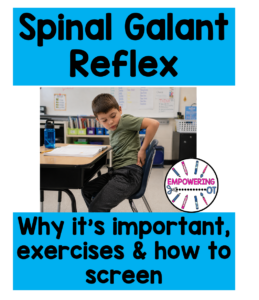
When this reflex remains strongly responsive beyond infancy, some children may show increased sensitivity around the back or waistband, frequent shifting or wiggling while seated, or difficulty maintaining a comfortable and stable seated posture.
Looking for a packet of 30 play based spinal galant exercises? Check out the packet here!
Why it matters (OT • Educators • Parents)
OTs: Spinal Galant may be considered as one piece of a broader assessment when a child demonstrates trunk instability, postural challenges, tactile sensitivity around the back or waist, or frequent movement while seated. These observations should always be interpreted alongside the child’s sensory, motor, environmental, and functional needs.
Educators: You may notice a student who frequently shifts, wiggles, changes position, or adjusts clothing during seated work. Movement may be the child’s way of finding a more comfortable or organized position rather than a sign that they are not paying attention.
Parents: You may notice sensitivity to waistbands, tags, fitted clothing, car seats, or touch along the lower back, as well as frequent repositioning during meals, homework, dressing, or other seated routines.
What you might notice (school-age)
- Frequent wiggling, shifting, or repositioning during seated activities.
- Difficulty maintaining one seated position for longer tasks.
- Sensitivity to waistbands, belts, tags, or clothing that touches the lower back.
- Discomfort when the back of a chair presses against the lower trunk.
- Trunk twisting or side bending during seated work.
- Preference for standing, kneeling, lying down, or changing positions while working.
- Frequent adjusting, pulling, or tugging at clothing around the waist.
- Difficulty maintaining stable trunk positioning during fine motor or tabletop tasks.
These signs are not specific to a retained Spinal Galant reflex and can have many possible explanations. Look at patterns across activities and environments rather than relying on any single behavior.
Quick observational screen (non-diagnostic)
Want more info on screening? Check out handouts here!
- Have the child stand comfortably with their back accessible.
- Using light, consistent touch, gently stroke downward along one side of the spine without touching directly over the spinal column.
- Observe for a noticeable trunk or hip movement toward the stimulated side.
- Repeat on the opposite side and compare responses.
- Note any significant differences between sides, sensitivity to touch, or consistent movement responses.
Screening should never be used by itself to diagnose a retained reflex or explain a child’s functional difficulties. Consider findings within a broader occupational profile and functional assessment.
Do / Don’t (language & approach)
✅ Do allow flexible seating and opportunities to change position during learning.
✅ Do consider clothing, chair surfaces, positioning, and tactile input when a child frequently moves or appears uncomfortable.
❌ Don’t assume frequent movement means a child is intentionally being disruptive or refusing to sit appropriately.
❌ Don’t require a child to tolerate uncomfortable touch, clothing, or prolonged sitting simply to reduce visible movement.
The goal is not to create a child who can “sit still.” The goal is to help the child find comfortable, functional ways to participate.
Looking for a packet of 30 play based spinal galant exercises? Check out the packet here!
Classroom supports (Tier 1 • Tier 2 • Tier 3)
Tier 1 (Whole Class):
- Build movement opportunities into lessons rather than expecting prolonged sitting.
- Allow students to work in different positions, such as sitting, standing, kneeling, or working at a vertical surface.
- Include whole-body movement such as animal walks, reaching games, stretching, and obstacle courses.
- Normalize movement as one way students support attention and participation.
Tier 2 (Small Group):
- Offer short movement routines before longer tabletop activities.
- Incorporate trunk rotation and side-to-side movement through games, beanbag activities, or reaching tasks.
- Provide opportunities for pushing, pulling, carrying, or other resistive movement.
- Experiment with seating options and work positions to determine what supports participation.
Tier 3 (Individualized):
- Adjust chair positioning or seating surfaces if contact against the lower back is uncomfortable.
- Allow individualized movement breaks based on the child’s cues rather than requiring the child to wait until discomfort escalates.
- Consider clothing accommodations when waistbands, belts, seams, or tags interfere with participation.
- Collaborate with OT to examine sensory processing, postural control, body awareness, seating, and functional participation.
Home carryover ideas
- Getting Dressed Comfortably: Let the child help choose clothing that feels comfortable around the waist and lower back. Notice whether softer fabrics, looser waistbands, or tag-free options make dressing easier.
- Kitchen Helper: Carry lightweight groceries, put pantry items away, wipe the table, or help push chairs into place for natural opportunities to use the trunk during everyday routines.
- Floor-Time Choice: Offer homework, puzzles, or reading on the floor, at a low table, or in another comfortable position when sitting in a chair becomes tiring.
- Bath & Towel Routine: Encourage reaching for bath toys, washing different parts of the body, and helping dry off afterward to build body awareness through a familiar routine.
- Bedtime Body Reset: Before bed, offer calming whole-body input the child enjoys, such as wrapping in a blanket, squeezing pillows, or lying under a preferred weighted item when appropriate.
Home carryover does not need to look like an exercise program. Everyday routines can provide opportunities for body awareness, trunk activation, sensory experiences, and varied movement while respecting the child’s preferences and comfort.
Play-based activities & progressions (short bouts; child-led)
- Log Roll Delivery: Hold a stuffed animal against the chest and roll across a mat to “deliver” it to the other side. Progress by increasing the distance or alternating directions.
- Hip Bump Balloons: Keep a balloon in the air using different body parts, including the hip, elbow, shoulder, or knee. This encourages playful trunk movement without prescribing one exact movement pattern.
- Scooter Board Mission: Lie on the belly or sit on a scooter board and travel to collect puzzle pieces, beanbags, or pretend packages placed around the room.
- Ribbon Side Bends: Hold a ribbon or scarf overhead and make large rainbow shapes from one side of the body to the other. Progress to kneeling or standing on a soft surface.
- Twist-and-Stack: Place blocks or cups behind and slightly beside the child so they rotate their trunk to retrieve each piece before building a tower in front.
- Balance Path Challenge: Walk along a taped line, stepping stones, cushions, or floor markers while reaching toward objects positioned at different heights and directions.
Progress activities by changing body position, movement direction, balance demands, resistance, or the location of materials rather than simply adding more repetitions. Keep activities brief, playful, and responsive to the child’s cues.
Data you can track (simple, actionable)
Rather than tracking whether a reflex is “gone,” focus on meaningful changes in participation:
- Length of comfortable participation during seated activities.
- Frequency of position changes or movement breaks needed during a task.
- Child-reported comfort with seating or clothing.
- Ability to maintain functional trunk positioning during tabletop tasks.
- Participation in dressing, classroom work, meals, or other routines.
- Teacher/parent observations of when movement or discomfort occurs.
Tracking function and participation provides more useful information than measuring stillness alone.
Collaboration & self-advocacy scripts
Adult→Child: “I notice you keep changing positions. Let’s find a way to work that feels comfortable for your body.”
Teacher→Team: “S frequently shifts and adjusts their waistband during seated work. We’re trying different seating positions and movement opportunities and tracking which options support comfortable participation.”
Child→Adult: “My back feels uncomfortable. Can I change how I’m sitting?”
The goal of reflex-informed support is not to eliminate natural movement. It is to better understand the child’s sensory and motor needs and provide options that make everyday participation easier.
The Reflex Integration Bundle Toolkit: Making It Easy for Therapists, Teachers & Parents
If you’re looking for a complete, play-based reflex integration program, the Reflex Integration Bundle Toolkit is your go-to solution. Created by an occupational therapist, this resource is designed for real-life use at home, in the classroom, or during therapy.
✨ What’s Inside This All-in-One Reflex Toolkit:
- ✅ 44 handouts explaining how each primitive reflex impacts movement, learning, and sensory/emotional development
- ✅ 12 themed exercise packets with over 320 play-based activities targeting every major reflex
- ✅ Black-and-white printable visuals for daily use—perfect for visual schedules and classroom routines
- ✅ Built-in regulation strategies and explanations for why each movement helps
- ✅ Designed for all developmental levels and sensory profiles
- ✅ Perfect for school-based OT, early intervention, home programs, and classroom supports
This toolkit is more than just exercises—it’s a holistic system for supporting regulation, body awareness, and developmental readiness through joyful movement.
✅ Ready to support your child or student with reflex integration? Explore the Reflex Integration Bundle Toolkit here.
Spinal Galant Reflex, Retained Spinal Galant Reflex, Spinal Galant Reflex Signs, Spinal Galant Reflex Integration, Spinal Galant Reflex Exercises, Primitive Reflex Red Flags, Retained Reflexes in Children, Primitive Reflex Integration, Play-Based Reflex Activities, Primitive Reflex Checklist, Reflex Integration for Parents, Reflex Integration for School, Occupational Therapy Primitive Reflexes, Occupational Therapy Reflex Toolkit, Reflex Integration OT Resource




2 Comments