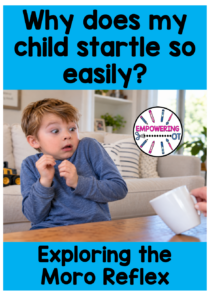
Does your child seem to startle more easily than other children?
Maybe they jump when a door suddenly closes. They cover their ears when an unexpected noise happens. They become upset when someone approaches them unexpectedly. Or perhaps a sudden movement, change in position, or surprise seems to trigger a much bigger reaction than you expected.
For some children, these reactions may be connected to sensory processing, nervous system regulation, or an immature primitive reflex pattern such as the Moro reflex.
The Moro reflex is sometimes called the startle reflex, and understanding how it works can give parents, teachers, and therapists another piece of information when trying to understand why a child reacts strongly to unexpected sensory experiences.
What Is the Moro Reflex?
The Moro reflex is one of several primitive reflexes that are present early in life.
Primitive reflexes are automatic movement responses that support development during infancy. Babies don’t consciously decide to perform these movements—the nervous system automatically responds to certain types of sensory input.
The Moro reflex is activated when an infant experiences a sudden change, particularly a sensation of falling or loss of support.
You may have seen this in a young baby.
The baby suddenly:
- throws their arms outward
- opens their hands
- extends their body
- brings their arms back toward their body
- may begin crying
This automatic response is an important and expected part of early development.
As the nervous system matures, the Moro reflex typically becomes less prominent during the first several months of life.
What Does the Moro Reflex Have to Do With Startling?
Think about what happens when you are unexpectedly startled.
Someone drops something behind you.
A dog suddenly barks.
Something moves quickly in your peripheral vision.
Your body may react before you even have time to think.
You might jump, tense your muscles, gasp, or feel your heart begin beating faster.
That quick reaction is part of the nervous system’s protective response.
For most of us, we quickly recognize:
“I’m okay. That was just a loud noise.”
And our body settles again.
For some children, however, unexpected sensory information may be harder for the nervous system to process and recover from.
A child may not simply notice the unexpected sound, movement, or touch.
Their whole body may react to it.
What Might Easy Startling Look Like in Everyday Life?
Every child is different, but parents or teachers may notice that a child:
- jumps or flinches frequently
- reacts strongly to unexpected noises
- becomes upset when someone touches them unexpectedly
- dislikes sudden changes in movement
- becomes nervous during unpredictable movement activities
- seems especially aware of what is happening around them
- has difficulty returning to an activity after being startled
- covers their ears around sudden or unpredictable sounds
- becomes overwhelmed in busy environments
- has difficulty with unexpected transitions or changes
- seems tense or cautious in unfamiliar situations
You may notice these responses during activities that seem completely ordinary to everyone else.
A chair scraping across the classroom floor.
The school bell ringing.
A sibling suddenly yelling.
A toilet flushing unexpectedly.
Someone dropping a book.
A balloon popping at a birthday party.
Being pushed unexpectedly on a swing.
A child running into them on the playground.
For a child whose nervous system is highly responsive to unexpected sensory information, these experiences can feel very different.
Could This Be a Retained Moro Reflex?
Possibly—but this is where we need to look at the whole child.
When primitive reflex patterns remain active beyond the developmental period when we would typically expect them to integrate, they are often described as retained primitive reflexes.
A retained or immature Moro reflex pattern has been associated with increased sensitivity to sensory input, particularly unexpected sounds and movement.
But this does not mean:
“My child startles easily, therefore they have a retained Moro reflex.”
There are many reasons a child may react strongly to sensory input.
Instead, easy startling is simply one observation that may encourage us to look more closely at the child’s sensory processing, movement patterns, regulation, environment, and overall participation.
Startling Is Only One Piece of the Puzzle
This is especially important when we’re talking about primitive reflexes.
We don’t want to look at a checklist and conclude that a child has a retained reflex because they demonstrate one or two characteristics.
Instead, an occupational therapist may consider questions such as:
What triggers the response?
Is it primarily sound? Movement? Touch? Visual input? Unexpected changes?
How intense is the reaction?
Does the child simply jump and continue playing, or does the experience significantly disrupt what they are doing?
How quickly does the child recover?
Can they return to the activity, or does their nervous system need much longer to settle?
Is it affecting participation?
Are they avoiding the playground, classroom activities, community outings, birthday parties, movement experiences, or other everyday activities?
Are there other motor or sensory patterns present?
Looking at the whole child provides much more useful information than looking at a single symptom.
Sensory Processing and the Moro Reflex Can Overlap
Primitive reflexes don’t exist separately from the rest of development.
The nervous system is constantly receiving and organizing information from the senses.
For example, a child might be processing:
- auditory input from the classroom
- movement from the playground
- touch from clothing or other people
- visual information from a busy environment
- vestibular information when their head or body changes position
- proprioceptive information from their muscles and joints
A child who startles easily may also demonstrate sensory sensitivity or sensory over-responsivity.
That is why reflexes should be considered within a broader picture of sensory processing, motor development, regulation, and participation rather than treated as the explanation for every challenge.
What Can I Do If My Child Startles Easily?
You don’t necessarily need to eliminate every unexpected experience from your child’s environment.
Instead, think about how you can help their nervous system experience predictability, safety, control, and opportunities to recover.
Give a Warning When Possible
If you know something loud or unexpected is about to happen, give your child information beforehand.
For example:
“The blender is going to be loud.”
“I’m going to turn on the vacuum.”
“The toilet might flush automatically.”
Knowing what is coming can make an experience feel much more predictable.
Give Your Child Control
Whenever possible, allow the child to control the sensory experience.
They might:
- turn on the vacuum themselves
- push the button on the hand dryer
- decide when the swing starts
- choose how high they want to swing
- move their own body rather than being unexpectedly moved
Having control can completely change how an experience feels.
Incorporate Predictable Movement
Some children respond well to slow, rhythmic, predictable movement.
Think:
- rocking
- walking
- marching
- animal walks
- slow swinging when enjoyed by the child
- rhythmic songs with movement
- pushing and pulling activities
Always follow the child’s cues. Movement should feel supportive—not like something the child has to tolerate.
Include Proprioceptive Activities
Activities involving pushing, pulling, carrying, climbing, and resistance provide proprioceptive input through the muscles and joints.
Try activities such as:
- carrying books
- pushing a laundry basket
- pulling a wagon
- climbing playground equipment
- animal walks
- helping carry groceries
- pushing against a wall
- moving cushions or pillows
These activities can be naturally incorporated into play and everyday routines.
Create a Predictable Recovery Option
Children may also benefit from knowing what they can do when something unexpected happens.
That could mean:
- moving to a quieter space
- using headphones
- asking for a break
- squeezing a pillow
- sitting with a trusted adult
- engaging in familiar movement
- taking time before returning to the activity
The goal isn’t to force a child to stop reacting.
The goal is to give them tools, accommodations, and support that help them participate successfully.
What About Moro Reflex Integration Activities?
If a retained Moro reflex is part of the child’s overall presentation, therapists may incorporate play-based movement activities that address the underlying movement pattern while also supporting sensory-motor development.
These might include activities involving:
- flexion and extension
- symmetrical whole-body movements
- slow rhythmic movement
- body awareness
- balance
- coordination
- breathing
- transitions between expanded and curled body positions
Reflex activities should not replace a comprehensive approach to a child’s needs.
Instead, they can be one tool within a much larger occupational therapy toolbox.
Want to Learn More About the Moro Reflex?
If you’re interested in learning more about primitive reflexes, the Moro reflex, and play-based ways to support sensory-motor development, I have additional resources available through Empowering OT Resources.
My Primitive Reflex Integration Bundle Toolkit includes educational information, assessment resources, functional strategies, and hundreds of play-based activities addressing the Moro reflex and other primitive reflex patterns.
You can also explore my individual Moro Reflex Integration Activities if you want to focus specifically on activities targeting the Moro reflex.
For an introduction to reflex integration, start with my free Primitive Reflex Integration Activities download, which includes 10 play-based activities you can try with children.
The Big Picture
If your child startles easily, you don’t have to immediately assume something is wrong—or that one reflex explains everything you’re seeing.
Instead, get curious.
What is their body responding to?
What makes the experience easier?
How quickly do they recover?
What helps them feel prepared and in control?
Is it interfering with activities that are important to them?
A child’s startle response can give us useful information about how their nervous system is processing the world around them.
The Moro reflex may be one piece of that picture.
But the most important goal isn’t simply to “integrate a reflex.”
It’s to help the child feel supported and successful while participating in the everyday activities that matter to them.