

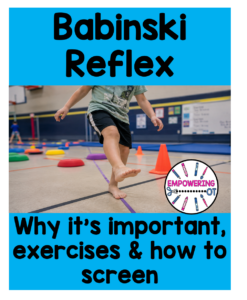
Babinski Reflex Integration: Supports for School & Home
Babinski Reflex — Foot → Toe Response → Movement Control
What it is & typical timeline
The Babinski Reflex is an early neurological response seen in infants. When the outer edge of the sole of the foot is stimulated from the heel toward the toes, the big toe typically extends upward while the other toes fan outward.
This response is considered typical during infancy while the nervous system is still developing. As the nervous system matures, this infant response typically disappears, generally by approximately 12–24 months of age.
The Babinski Reflex is different from the Plantar Grasp Reflex, in which pressure near the base of the toes causes the toes to curl or grasp.
Looking for play-based exercises for the Babinski Reflex? Check out the packet here!
Why it matters (OT • Educators • Parents)
OTs: The Babinski response involves the neurological pathways that influence movement of the toes following stimulation to the sole of the foot. When an unusual response is observed beyond the expected developmental period, it should be considered within the child’s broader neurological, sensory, motor, balance, and gait profile rather than interpreted in isolation.
Educators: You may notice children who have difficulty with balance, coordinated movement, navigating uneven surfaces, or maintaining stability during gross-motor activities. These observations have many possible causes and do not independently indicate a retained Babinski reflex.
Parents: Notice how your child manages activities involving the feet and lower body, such as walking, running, jumping, climbing, balancing, and moving across different surfaces. Changes or ongoing difficulties with gait, balance, coordination, or foot control may warrant further evaluation.
What you might notice (school-age)
- Toes appearing to spread or fan in response to stimulation along the sole of the foot.
- The big toe moving upward rather than downward following specific stimulation to the sole.
- Differences between the responses of the left and right feet.
- Difficulty with balance or stability during gross-motor activities.
- Challenges adjusting foot position when climbing, jumping, or navigating uneven surfaces.
- Unusual or inconsistent movement patterns involving the feet or toes.
- Frequently watching the feet during challenging movement activities.
- Difficulty maintaining stability when the base of support changes.
These signs do not confirm a retained Babinski reflex. Balance, gait, toe positioning, and coordination differences can have many sensory, motor, orthopedic, developmental, or neurological causes.
A Babinski response that persists beyond the expected developmental period—or appears after previously being absent—can have neurological significance and should be discussed with an appropriate medical professional.
Quick observational screen (non-diagnostic)
Looking for more information on screening? Check out handouts here!
- With the child comfortable and consenting, position the foot so it is relaxed and supported.
- Using gentle, controlled stimulation, move along the outer edge of the sole from the heel toward the toes.
- Observe the big toe and the other toes for movement.
- Note whether the big toe extends upward and whether the other toes fan outward.
- Compare observations between the left and right feet.
Screening should remain gentle, brief, and non-diagnostic. Do not repeatedly stimulate the sole in an attempt to produce or eliminate a response.
Because a Babinski response beyond the expected developmental period can have neurological significance, an unexpected positive response should be referred for appropriate medical evaluation rather than treated solely as a reflex-integration concern.
Do / Don’t (language & approach)
✅ Do consider the response within the child’s overall neurological, motor, sensory, and developmental profile.
✅ Do focus intervention on functional skills such as balance, coordination, body awareness, and safe participation in movement.
❌ Don’t repeatedly stimulate the sole of the foot in an attempt to make the Babinski response “integrate.”
❌ Don’t assume that balance difficulties, toe spreading, unusual gait patterns, or foot sensitivity automatically indicate a retained Babinski reflex. Consider other possible contributing factors and refer appropriately when concerns are present.
Classroom supports (Tier 1 • Tier 2 • Tier 3)
Tier 1 (Whole Class):
- Include regular opportunities for whole-body movement throughout the school day.
- Incorporate jumping, marching, stepping, and balance activities into movement breaks.
- Provide varied gross-motor experiences during physical education, recess, and classroom movement activities.
- Offer different ways to participate when a balance or movement activity is challenging.
Tier 2 (Small Group):
- Practice walking along taped lines, pathways, or floor markers.
- Incorporate controlled jumping, marching, and stepping games.
- Use obstacle courses that encourage children to change direction and adjust their foot placement.
- Practice moving between wide and narrow bases of support during developmentally appropriate games.
- Pair movement activities with body-awareness language that helps children notice where their feet are positioned.
Tier 3 (Individualized):
- Provide individualized balance and motor supports based on the child’s functional needs.
- Modify gross-motor activities to provide an appropriate level of challenge and physical support.
- Address functional difficulties with foot placement, balance, coordination, and movement planning.
- Collaborate with OT, PT, and the child’s medical team when gait, strength, sensation, balance, or neurological concerns affect daily participation.
Home carryover ideas
These ideas focus on incorporating foot awareness, balance, and lower-body control into everyday routines, rather than adding another set of exercises.
- Getting Dressed: Encourage the child to sit or stand as appropriate while independently placing each foot into pants, socks, and shoes.
- Shoes On, Shoes Off: Practice stabilizing the body while putting on and removing shoes. Provide a chair, wall, or other support when needed.
- Stair Practice: During everyday trips upstairs or downstairs, encourage controlled foot placement and use of the railing as needed.
- Carry & Walk: Let the child carry a light household item, such as folded towels, while walking to another room. This adds a natural balance challenge while completing a useful job.
- Kitchen Helper: Have the child move between the counter, table, and refrigerator while helping put away lightweight groceries or set the table.
- Outdoor Exploration: During walks, notice natural changes in the ground such as grass, sidewalks, ramps, and playground surfaces. Allow the child to choose what feels comfortable and safe.
- Clean-Up Around the Room: Place toys or household items in different locations so the child walks, turns, squats, and returns items to their appropriate places.
- Bath & Dressing Transitions: Practice safely stepping into clothing, onto a bathmat, or between different positions with appropriate adult support.
The goal is to build functional opportunities for foot placement, balance, body awareness, and coordinated movement within routines the child already completes.
Play-based activities & progressions (short bouts; child-led)
Looking for play-based exercises for the Babinski Reflex? Check out the packet here!
- Footprint Detective: Place paper footprints facing forward, sideways, and diagonally. The child follows the trail while matching their feet to each print.
- Lily Pad Leap: Scatter floor spots at different distances and have the child jump or step between the “lily pads” without touching the “water.”
- Freeze & Balance: Dance or move to music. When the music stops, freeze in a different position and try to maintain balance.
- Heel-to-Toe Trail: Follow a taped pathway using slow heel-to-toe steps. Make the path curved, zigzagged, or straight to change the challenge.
- Statue Challenge: Call out different positions such as “one foot forward,” “feet wide,” or “one foot on a spot,” and see how long the child can hold each statue.
- Obstacle Course Mission: Crawl under, step over, walk around, and move between obstacles that require frequent changes in body and foot position.
- Beanbag Delivery: Carry a beanbag to different targets around the room while navigating a designated movement path.
- Red Light, Green Light: Alternate between walking, marching, tiptoeing, and stopping on command to practice controlled starts, stops, and changes in movement.
Progression: Begin with stable surfaces and simple movement patterns. Gradually introduce changes in direction, narrower pathways, different foot positions, or more complex movement sequences when appropriate.
Activities should remain playful, optional, and matched to the child’s motor abilities. The goal is to provide meaningful opportunities for balance, coordinated movement, and body awareness—not to repeatedly elicit or suppress the Babinski response.
Data you can track (simple, actionable)
- Balance during functional movement and play.
- Ability to navigate uneven or changing surfaces safely.
- Foot placement during stepping, climbing, and obstacle-course activities.
- Level of assistance needed during jumping, balancing, or gross-motor tasks.
- Confidence when participating in movement activities.
- Differences between the left and right sides during functional movement.
- Teacher/parent observations of changes in participation, stability, and coordination over time.
Focus on meaningful participation, safety, coordination, and independence, rather than trying to document whether a reflex has simply “disappeared.”
Collaboration & self-advocacy scripts
Adult→Child: “That path looks tricky. Would you like to try it by yourself, hold my hand, or choose an easier path?”
Teacher→Team: “S seems to have more difficulty maintaining balance when activities require changing foot positions or moving across uneven surfaces. We’re providing additional support and tracking what helps.”
Parent→Team: “We’ve noticed some difficulty with balance and foot placement during everyday movement. Could we look at what might be contributing and what supports would help?”
Child→Adult: “This is hard for me to balance on. I need some help.”
The Reflex Integration Bundle Toolkit: Making It Easy for Therapists, Teachers & Parents
If you’re looking for a complete, play-based reflex integration program, the Reflex Integration Bundle Toolkit is your go-to solution. Created by an occupational therapist, this resource is designed for real-life use at home, in the classroom, or during therapy.
✨ What’s Inside This All-in-One Reflex Toolkit:
- ✅ 44 handouts explaining how each primitive reflex impacts movement, learning, and sensory/emotional development
- ✅ 12 themed exercise packets with over 320 play-based activities targeting every major reflex
- ✅ Black-and-white printable visuals for daily use—perfect for visual schedules and classroom routines
- ✅ Built-in regulation strategies and explanations for why each movement helps
- ✅ Designed for all developmental levels and sensory profiles
- ✅ Perfect for school-based OT, early intervention, home programs, and classroom supports
This toolkit is more than just exercises—it’s a holistic system for supporting regulation, body awareness, and developmental readiness through joyful movement.
✅ Ready to support your child or student with reflex integration? Explore the Reflex Integration Bundle Toolkit here.
Babinski Reflex, Babinski Reflex in Children, Retained Babinski Reflex, Babinski Reflex Signs, Babinski Reflex Integration, Babinski Reflex Activities, Babinski Reflex Exercises, Primitive Reflexes in Children, Retained Primitive Reflexes, Primitive Reflex Integration, Primitive Reflex Red Flags, Reflex Integration Activities, Play-Based Reflex Activities, Occupational Therapy Reflex Integration, Primitive Reflex Screening, Primitive Reflex Assessment, Reflex Integration for Kids, Reflex Integration for Parents, School-Based Occupational Therapy, Primitive Reflex OT Resources




One Comment