Reaching across the table for a crayon. Drawing a line from one side of a page to the other. Putting on shoes. Catching a ball. Reading across a page. Reaching for the seat belt.
All of these everyday activities require a child to move across the center of their body.
This skill is called crossing midline, and it plays an important role in children’s coordination, classroom participation, self-care, play, and motor development.
When a child has difficulty crossing midline, you may notice frequent hand switching, turning the entire body instead of reaching across, avoiding cross-body movements, or difficulty coordinating the two sides of the body.
There are many reasons a child may have difficulty with these movements. Primitive reflex patterns may be one developmental factor worth considering as part of the larger picture.
In particular, the Asymmetrical Tonic Neck Reflex (ATNR) has an important relationship with the development of independent movement between the head, arms, and opposite sides of the body.
Let’s look at what crossing midline means, why it matters, how primitive reflexes may relate to it, and what occupational therapists, teachers, and parents can do to support it.
What Does Crossing Midline Mean?
Imagine an invisible vertical line running from the top of the head down through the center of the body.
This is the body’s midline.
Crossing midline happens when one side of the body moves across that imaginary line to perform an activity on the opposite side.
For example:
- Reaching with the right hand to pick up something on the left
- Drawing a horizontal line across an entire page
- Reaching across the body to put on a seat belt
- Using one hand to wash the opposite arm
- Reaching across a table during a game
- Turning the trunk to retrieve an object
- Using the right hand to write on the left side of a page
- Crossing one leg over the other to put on a shoe
These movements may look simple, but they require coordination between multiple systems.
A child needs body awareness, postural stability, bilateral coordination, motor planning, and enough independence between different parts of the body to complete the movement efficiently.
Crossing midline is therefore not an isolated “skill.” It is one part of a much larger motor-development picture.
Why Is Crossing Midline Important?
Children cross midline throughout the day without necessarily realizing they’re doing it.
It supports many functional activities at school, home, and during play.
Crossing Midline During School Activities
Students may cross midline when they:
- Write across a page
- Draw horizontal lines
- Color larger pictures
- Copy information
- Reach for classroom materials
- Cut across paper
- Complete puzzles
- Use manipulatives
- Participate in movement activities
- Organize materials across a desk
- Track information across a page
Crossing midline is especially relevant to tasks requiring visual-motor integration. A child may need to visually follow information from one side of space to the other while simultaneously coordinating hand movement.
You can learn more about this relationship in my article on Primitive Reflexes and Visual-Motor Skills.
Crossing Midline During Self-Care
Cross-body movement also occurs during everyday routines such as:
- Dressing
- Putting on socks and shoes
- Washing the body
- Brushing hair
- Reaching for a seat belt
- Pulling clothing across the body
- Applying lotion
- Managing fasteners
If you’re noticing challenges during dressing specifically, read Primitive Reflexes and Dressing Skills: Could Retained Reflexes Make Getting Dressed Harder?.
Crossing Midline During Play and Movement
Children also cross midline when:
- Throwing
- Catching
- Batting
- Dancing
- Climbing
- Crawling
- Playing with blocks
- Completing floor puzzles
- Playing musical instruments
- Reaching for toys
- Participating in action songs
This is one reason crossing midline overlaps with bilateral coordination, balance, motor planning, and whole-body coordination.
For a closer look at these related motor foundations, read Primitive Reflexes and Balance & Coordination and Primitive Reflexes and Motor Planning.
Signs a Child May Have Difficulty Crossing Midline
Difficulty crossing midline doesn’t always look like a child simply refusing to reach across their body.
Sometimes the compensations are subtle.
You might notice a child:
- Switches hands when reaching the center of a page
- Uses the right hand on the right side and left hand on the left side
- Rotates the entire body instead of reaching across
- Moves the paper instead of moving the hand across it
- Frequently changes hands during drawing or coloring
- Avoids cross-body reaching
- Has difficulty with cross-crawl movements
- Struggles with coordinated opposite arm and leg movements
- Has difficulty using one side of the body while the other side stabilizes
- Turns the entire body when reaching for something beside them
- Has difficulty with games involving trunk rotation
- Appears awkward during throwing or catching
- Has difficulty completing movements that require both sides of the body to perform different jobs
None of these observations automatically means a child has a retained primitive reflex.
Crossing-midline difficulties can be associated with many factors, including motor coordination, postural control, motor planning, body awareness, strength, visual skills, developmental experience, or individual movement preferences.
Primitive reflexes are one possible piece of the puzzle—not the entire explanation.
Primitive Reflexes and Crossing Midline
Primitive reflexes are automatic movement responses that play important roles during early development.
As babies grow and develop increasingly voluntary control over movement, these early reflex patterns typically become less dominant.
Over time, children develop greater ability to:
- Move one body part independently from another
- Coordinate opposite sides of the body
- Stabilize one area while another moves
- Rotate through the trunk
- Turn the head without automatically moving the limbs
- Reach across the body
- Use both sides together in increasingly complex ways
When early reflex patterns continue to strongly influence movement, some of these coordinated movements may require additional effort.
Several primitive reflexes may be considered when looking at a child’s overall coordination, but ATNR is particularly important when discussing crossing midline.
ATNR and Crossing Midline
The Asymmetrical Tonic Neck Reflex (ATNR) is an early reflex that creates a relationship between head turning and movements of the arms and legs.
When an infant turns their head to one side, the arm and leg on the face side tend to extend while the opposite side bends.
This pattern is developmentally useful during infancy.
As the nervous system matures, however, children typically gain increasing ability to move their head, arms, trunk, and legs independently.
That independence becomes important for crossing midline and bilateral coordination.
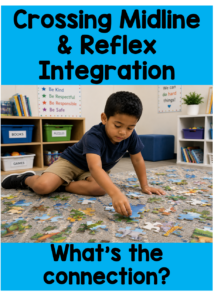
Think about reaching across the body to pick up a puzzle piece.
The child needs to:
- Keep the body relatively stable.
- Reach one arm across the center of the body.
- Allow the trunk to rotate as needed.
- Maintain visual attention on the target.
- Move the arm independently of the head.
- Return the object to the desired location.
When ATNR-related movement patterns continue to strongly influence movement, crossing the body’s center may require more effort.
Possible ATNR-Related Observations
You might notice:
- Avoiding cross-body reaching
- Turning the entire body instead of reaching across
- Difficulty keeping the head and arm movements independent
- Frequent hand switching
- Difficulty writing across the page
- Challenges with bilateral coordination
- Difficulty coordinating opposite sides of the body
- Reduced fluidity during throwing or catching
- Difficulty tracking across a page while using the hand
- Awkwardness during cross-crawl movements
Again, these signs do not diagnose a retained ATNR.
They simply provide information about how the child organizes movement.
If you’d like a deeper explanation of this reflex, read my complete ATNR Reflex Integration: Supports for School & Home.
ATNR Activities for Crossing Midline
If ATNR-related movement patterns are relevant to a child’s functional needs, activities involving cross-body movement can provide playful opportunities to practice coordination.
My ATNR Reflex Integration Activity Packet includes 32 play-based activities with specific strategies targeting crossing midline, body symmetry, visual-motor skills, head-body independence, and bilateral coordination.
Activities include cross-body movements, crawling, reaching, eye tracking, and other whole-body experiences that can be incorporated into therapy, school, or home routines.
STNR and Crossing Midline
The Symmetrical Tonic Neck Reflex (STNR) is another reflex worth considering when looking at whole-body coordination.
STNR creates an early relationship between head position and movements of the upper and lower body.
It is particularly associated with the developmental transition into hands-and-knees positioning and crawling.
Why does this matter for crossing midline?
Crawling provides opportunities for children to:
- Coordinate opposite arms and legs
- Shift weight from one side to the other
- Stabilize one side while moving the other
- Develop shoulder stability
- Coordinate the upper and lower body
- Explore alternating movement patterns
These experiences can contribute to the broader motor foundation needed for increasingly complex bilateral and cross-body activities.
A child experiencing difficulty with upper- and lower-body coordination may also find more complex cross-body movement challenging.
You can learn more in my STNR Reflex Integration guide.
My STNR Reflex Integration Activity Packet includes 35 play-based activities supporting head-body coordination, crawling patterns, upper- and lower-body coordination, posture, and whole-body movement.
TLR, Postural Stability, and Cross-Body Movement
Crossing midline doesn’t happen in isolation.
Before one arm reaches across the body, the rest of the body needs to provide a reasonably stable foundation.
The Tonic Labyrinthine Reflex (TLR) is associated with early flexion and extension patterns, head position, balance, and postural control.
If maintaining body position requires substantial effort, cross-body movements may become more difficult.
For example, reaching across a desk requires the child to maintain enough trunk stability to move the arm outside its usual working area without losing their position.
You might notice:
- Leaning heavily during reaching
- Losing balance when reaching across the body
- Moving the entire body instead of rotating
- Difficulty maintaining an upright position while the arms move
- Avoiding activities requiring larger reaching movements
These observations can have many explanations, but they highlight an important point:
Efficient crossing midline requires both mobility and stability.
You can learn more about TLR and its relationship with posture and movement in my TLR reflex article.
My TLR Reflex Integration Activity Packet includes 32 play-based activities supporting flexion and extension, core stability, balance, head control, body awareness, and whole-body movement.
What About the Spinal Galant Reflex?
The Spinal Galant Reflex involves an early response of the trunk.
It is not as directly associated with crossing midline as ATNR, but trunk control and rotation are important components of cross-body movement.
Children need to be able to stabilize and rotate through the trunk during many functional activities, including:
- Reaching across the body
- Throwing
- Catching
- Dressing
- Turning to retrieve objects
- Moving between positions
- Participating in sports and playground activities
For children whose functional difficulties also involve trunk control, posture, or body awareness, looking at the larger movement picture may be helpful.
My Spinal Galant Reflex Integration Activity Packet includes play-based activities involving trunk control, crawling, cross-body rolling, reaching, and coordinated whole-body movement.
Crossing Midline vs. Bilateral Coordination: What’s the Difference?
These terms are closely related, but they aren’t exactly the same.
Crossing midline means moving a body part across the center of the body.
Bilateral coordination means coordinating the two sides of the body together.
Sometimes both happen simultaneously.
For example, when cutting paper, one hand manipulates the scissors while the other rotates and stabilizes the paper.
When putting on a shoe, one side may stabilize the body while both hands work around the opposite foot.
When throwing a ball, the body may rotate while the opposite arm and leg contribute to balance and force.
This is why children who have difficulty crossing midline may also demonstrate challenges with bilateral coordination—but the two skills should not automatically be treated as identical.
Crossing Midline and Hand Dominance
Parents and teachers sometimes notice that a child frequently switches hands and assume they haven’t developed a dominant hand.
Sometimes that is true.
But hand switching can also happen because crossing the body’s center is difficult or inefficient.
For example, a child may color the left side of a picture with the left hand and then switch to the right hand when they reach the right side.
Rather than immediately correcting the child, observe the pattern.
Ask:
- Does the child consistently switch at midline?
- Will they reach across their body for objects?
- Do they rotate their trunk instead?
- Does one hand clearly appear more skilled?
- Does the pattern change depending on the activity?
- Is the child comfortable during cross-body movements?
These observations can provide more useful information than simply telling a child to “pick a hand.”
Crossing Midline and Handwriting
Handwriting requires repeated movement across the body’s center.
A child needs to write from one side of a page toward the other while maintaining posture, stabilizing the paper, visually tracking the writing space, and controlling the pencil.
A child who has difficulty crossing midline may:
- Frequently reposition the paper
- Rotate the trunk
- Switch hands
- Stop at the middle of the page
- Shift the entire body as writing progresses
- Have difficulty maintaining an efficient writing position
However, handwriting is much more complex than crossing midline alone.
Pencil control, fine motor skills, visual-motor integration, visual perception, letter formation, postural control, attention, instruction, and practice can all affect handwriting.
For a deeper look at those factors, read Retained Primitive Reflexes and Handwriting: An OT Guide.
Crossing Midline and Fine Motor Skills
Crossing midline also supports many fine motor activities.
Children may need cross-body coordination while:
- Cutting
- Drawing
- Coloring
- Completing puzzles
- Stringing beads
- Building
- Manipulating toys
- Using classroom materials
- Completing self-care tasks
But crossing midline and fine motor skills are not the same thing.
Fine motor skills involve controlled use of the hands and fingers, while crossing midline involves how movement is organized across the two sides of the body.
For more about hand function specifically, read Primitive Reflexes and Fine Motor Skills.
Crossing Midline and Visual-Motor Skills
Crossing midline also has a strong visual component.
Imagine completing a maze that stretches across a page.
The child needs to visually follow the path while simultaneously guiding the hand across different areas of space.
Similar demands occur during:
- Drawing
- Copying
- Prewriting
- Handwriting
- Connecting dots
- Completing puzzles
- Building from a model
- Cutting along a path
This requires the eyes and body to work together efficiently.
If visual-motor performance is the primary concern, read Primitive Reflexes and Visual-Motor Skills: Understanding the Connection.
Crossing Midline Activities for Kids
Supporting crossing midline doesn’t require a complicated exercise program.
Children can experience cross-body movement naturally through play.
Try activities such as:
- Cross-body beanbag tosses
- Reaching across to pop bubbles
- Drawing large sideways figure eights
- Washing a table using large circular movements
- Cross-crawl marching
- Crawling through obstacle courses
- Reaching across for puzzle pieces
- Placing stickers on opposite sides of a large poster
- Balloon tapping
- Dancing with cross-body movements
- Simon Says
- Action songs
- Drawing on large vertical surfaces
- Side-to-side ball passing
- Reaching for objects placed across the body
- Playing catch
- Rolling across the floor
- Pretend sword or wand movements across the body
- Large chalk drawings
- Cleaning windows or mirrors
The goal is not to force a child to cross midline repeatedly.
Instead, provide varied, meaningful opportunities for the two sides of the body to work together during play and everyday activities.
Crossing Midline Activities in the Classroom
Teachers can also incorporate cross-body movement without creating a separate therapy program.
Ideas include:
- Reaching across the desk for materials
- Large air-writing activities
- Movement songs
- Cross-body action games
- Passing materials across the body
- Cleaning whiteboards
- Drawing on vertical surfaces
- Classroom jobs involving reaching and carrying
- Movement breaks with alternating arm and leg patterns
- Gross-motor spelling or math games
Activities should remain accessible and adaptable.
Some children may need a smaller movement range, additional physical stability, more time, or a different position.
How Occupational Therapists Can Assess Crossing Midline
Occupational therapists can observe crossing midline during functional activities, rather than relying on a single isolated movement.
Consider observing the child during:
- Drawing
- Handwriting
- Cutting
- Dressing
- Ball activities
- Reaching games
- Puzzles
- Crawling
- Gross-motor play
- Classroom routines
- Self-care activities
Look not only at whether the child crosses midline, but how they accomplish the task.
Does the child:
- Rotate the trunk?
- Shift the entire body?
- Switch hands?
- Lose balance?
- Avoid reaching?
- Move the head with the arm?
- Use one side primarily?
- Need additional stabilization?
- Become fatigued?
The pattern may provide more useful information than simply recording “can/cannot cross midline.”
Should You Work on the Reflex or Crossing Midline?
This is an important distinction.
If a child has difficulty crossing midline, the functional goal shouldn’t simply become:
“Integrate the ATNR.”
Instead, ask:
What does difficulty crossing midline prevent this child from doing?
Maybe the child struggles to:
- Write efficiently
- Get dressed
- Catch a ball
- Complete classroom work
- Use scissors
- Participate in sports
- Navigate playground activities
- Complete self-care routines
Those functional needs should guide intervention.
Primitive reflex observations can help us understand movement patterns, but participation remains the goal.
This is the same function-first approach I discuss in What Is Primitive Reflex Integration?.
Primitive Reflex Activities for Crossing Midline
If you’re looking for structured primitive reflex activities, you can choose resources based on the movement patterns and functional skills you’re addressing.
For crossing-midline concerns, these are particularly relevant:
ATNR Reflex Integration Activity Packet
This is the most directly related individual reflex resource for crossing midline. It includes 32 play-based activities and strategies addressing cross-body movement, bilateral coordination, visual-motor skills, body symmetry, and head-body independence.
STNR Reflex Integration Activity Packet
Includes 35 play-based activities supporting upper- and lower-body coordination, crawling, postural control, head-body movement, and coordinated movement.
TLR Reflex Integration Activity Packet
Includes 32 activities supporting postural control, balance, core stability, body awareness, and flexion/extension—the stable motor foundation that can support reaching and cross-body movement.
Spinal Galant Reflex Integration Activity Packet
Provides play-based opportunities involving trunk control, crawling, reaching, cross-body rolling, and whole-body coordination.
Want Activities for All 12 Primitive Reflexes?
If you’re an occupational therapist, educator, or parent looking for a larger library of reflex-related activities, my Primitive Reflex Integration Bundle Toolkit includes resources for all 12 primitive reflexes:
- Moro
- ATNR
- STNR
- TLR
- Palmar
- Plantar
- Babinski
- Spinal Galant
- Rooting
- Suck
- Landau
- Perez
The bundle includes:
- 12 individual reflex activity packets
- 44 educational and practical handouts
- 320+ play-based activities with visuals
- Reflex education and developmental information
- Observation and testing information
- Classroom support strategies
- Home carryover ideas
- Parent and teacher education
- Functional routine ideas
- Practical movement strategies
The goal isn’t to put every child through the same reflex exercises.
Instead, the bundle gives therapists, educators, and families a large toolbox of movement ideas that can be selected and adapted based on the child’s functional needs, abilities, interests, sensory preferences, and environment.
Explore the complete Primitive Reflex Integration Bundle Toolkit.
Frequently Asked Questions About Primitive Reflexes and Crossing Midline
What does it mean when a child doesn’t cross midline?
Difficulty crossing midline means a child may have difficulty moving one side of the body across its center into the opposite side of space. You might notice hand switching, whole-body rotation, avoidance of cross-body reaching, or difficulty coordinating opposite sides of the body.
There are many possible reasons for this, so difficulty crossing midline does not automatically indicate a retained primitive reflex.
Which primitive reflex is associated with crossing midline?
The Asymmetrical Tonic Neck Reflex (ATNR) is particularly relevant because it creates an early relationship between head turning and movements of the arms and legs. As voluntary motor control develops, children typically become increasingly able to turn the head and move the limbs independently, supporting more complex cross-body movements.
Can retained ATNR cause difficulty crossing midline?
ATNR-related movement patterns may be one factor considered when a child demonstrates persistent difficulty crossing midline, particularly when challenges also involve bilateral coordination, head-body independence, visual tracking, handwriting, or cross-body movement.
However, difficulty crossing midline alone does not establish that ATNR is retained.
Is crossing midline important for handwriting?
Yes. Writing requires the hand to move across the page while the other hand stabilizes the paper and the eyes visually monitor the writing space.
However, handwriting also depends on fine motor control, visual-motor integration, postural stability, letter formation, visual perception, attention, and other skills.
Does switching hands mean a child can’t cross midline?
Not necessarily.
Children may switch hands for many reasons. However, if a child consistently switches hands when reaching the center of their body rather than continuing across, an occupational therapist may look more closely at crossing midline, bilateral coordination, hand dominance, and overall motor development.
What activities help children cross midline?
Play-based activities involving cross-body reaching, crawling, throwing, catching, large drawing movements, dancing, puzzles, obstacle courses, and alternating arm and leg movements can all provide opportunities to practice crossing midline.
The activity should be adapted to the child’s abilities and comfort level.
The Bottom Line
Crossing midline is an important component of coordinated movement, but it doesn’t develop in isolation.
Postural control, bilateral coordination, visual-motor skills, body awareness, motor planning, experience, and developmental movement patterns all contribute.
Primitive reflexes—particularly ATNR—may be one consideration when a child consistently has difficulty crossing the body’s center.
But rather than asking:
“Which retained reflex is causing this?”
A more useful question is:
“What is making this movement difficult, and what support would help this child participate more successfully?”
That keeps the focus on function, participation, and the individual child.
- retained primitive reflexes and crossing midline
- ATNR and crossing midline
- crossing midline occupational therapy
- difficulty crossing midline
- crossing midline activities for kids
- crossing midline and bilateral coordination
- primitive reflexes and bilateral coordination
- ATNR reflex activities
- child switches hands at midline
- crossing midline and handwriting
- crossing midline exercises
- occupational therapy crossing midline activities