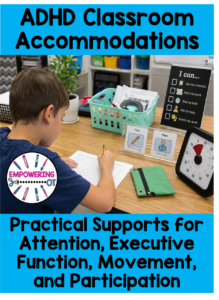
Students with ADHD may know exactly what they need to do—and still have difficulty getting started, remembering multiple directions, organizing materials, staying with a lengthy task, or regulating their bodies during the school day.
That is where ADHD classroom accommodations can make a meaningful difference.
Effective accommodations are not about making a student sit still, work like everyone else, or simply “try harder” to pay attention. They are about changing aspects of the environment or task so the student has better access to learning and participation.
For students with ADHD, helpful classroom accommodations may support:
- Task initiation
- Working memory
- Organization
- Executive functioning
- Movement and regulation
- Sensory needs
- Written work
- Attention to relevant information
- Transitions
- Flexible participation
The best accommodations are individualized. A strategy that is incredibly helpful for one student with ADHD may be distracting or unnecessary for another.
Below are practical classroom accommodations for students with ADHD that teachers, occupational therapists, school teams, and parents can consider.
What Are ADHD Classroom Accommodations?
Classroom accommodations change how a student accesses instruction, demonstrates learning, or participates in the school environment without necessarily changing what the student is expected to learn.
For a student with ADHD, an accommodation might include receiving written directions in addition to verbal directions, having access to movement breaks, completing fewer repetitive problems once mastery has been demonstrated, or using a visual checklist to support a multistep assignment.
These supports are not about lowering expectations.
Instead, they can reduce barriers that may interfere with a student’s ability to demonstrate what they know.
For example, consider a student who understands a math concept but has difficulty copying 20 problems from the board, organizing them correctly on the page, and maintaining attention long enough to complete the entire assignment.
The barrier may not be the math.
An accommodation that reduces copying demands or provides the problems on a worksheet can allow the student to spend more of their effort on the actual learning objective.
If written output is creating an additional barrier, you may also want to explore my Big List of Handwriting Accommodations for IEPs, which includes more than 60 ideas for supporting handwriting participation at school.
ADHD Is More Than “Difficulty Paying Attention”
ADHD is often discussed primarily in terms of attention or hyperactivity, but its impact in the classroom can be much broader.
Students with ADHD may experience differences with executive functioning skills such as:
- Starting tasks
- Holding information in working memory
- Estimating time
- Shifting between activities
- Organizing materials
- Prioritizing tasks
- Monitoring progress
- Remembering what comes next
- Regulating activity level
- Managing distractions
This is why telling a student to “focus,” “pay attention,” or “get started” may not address the actual barrier.
A student may want to begin the assignment but have difficulty identifying the first step.
Another student may understand three verbal directions but remember only the last one by the time they reach their desk.
Another may need movement in order to remain engaged during instruction.
Rather than viewing these behaviors only through a compliance lens, teams can ask:
What is making participation difficult, and what support would make the task more accessible?
That question can lead to much more effective accommodations.
ADHD Classroom Accommodations for Task Initiation
Getting started can be one of the biggest classroom challenges for some students with ADHD.
A student may sit in front of an assignment, sharpen a pencil repeatedly, organize materials, talk to a peer, or appear to avoid the task—even when they understand the work.
Consider accommodations such as:
- Break assignments into clearly defined starting steps.
- Highlight or visually mark the first problem.
- Provide a brief “First → Then” visual.
- Use a checklist showing what to do first, next, and last.
- Provide a model of a completed example.
- Ask the student to identify the first step before beginning.
- Reduce unnecessary materials on the desk.
- Provide a brief teacher check-in at the beginning of independent work.
- Use a visual timer when time awareness is helpful.
- Allow the student to begin with an easier or preferred portion when appropriate to build momentum.
Instead of repeatedly saying “Get started,” make the starting point easier to see.
For additional ideas that can be shared with teachers and families, my Executive Functioning Handouts include practical executive functioning activity suggestions organized for preschool, early elementary, and later elementary students.
ADHD Accommodations for Working Memory
Working memory allows us to temporarily hold and use information. Classroom activities place enormous demands on this skill.
A teacher might say:
“Take out your math book, turn to page 42, complete problems 1 through 10, and put your paper in the blue bin when you’re finished.”
A student with working memory challenges may begin walking toward the desk and already have lost part of that information.
Helpful working memory accommodations for ADHD may include:
- Pair verbal directions with written or visual directions.
- Give shorter chunks of information at one time.
- Provide step-by-step checklists.
- Keep important classroom routines visually available.
- Allow students to repeat directions back in their own words.
- Provide reference sheets for frequently used information.
- Use visual examples of finished work.
- Keep assignment expectations visible while students are working.
- Provide access to multiplication charts, writing checklists, vocabulary banks, or other appropriate references.
- Avoid relying on memory when memory is not the skill being assessed.
Whenever possible, put information into the environment instead of requiring the student to hold all of it in their head.
Movement Accommodations for Students With ADHD
Movement does not automatically mean a student is disengaged.
For some students, movement may actually support regulation and participation.
Instead of expecting a student to remain completely still throughout the school day, consider ways movement can be incorporated without making the student feel singled out.
Possible movement accommodations for ADHD include:
- Planned movement breaks
- Opportunities to stand during instruction
- Standing workstations
- Carrying materials to another classroom
- Delivering attendance or messages
- Stretching between activities
- Brief hallway walks when appropriate
- Alternative seating options
- Working at a counter or vertical surface
- Classroom jobs that naturally involve movement
- Flexible positioning during independent work
Movement opportunities do not always need to be presented as rewards that students must earn by completing work.
When movement is a regulation or access need, it may be more useful to view it as a support.
For teachers or therapists looking for an easy way to incorporate movement into the school day, my Roll the Dice Movement Breaks provide simple movement activities that can be used with an individual student, small group, or whole classroom.
Flexible Seating and ADHD
Flexible seating is often discussed as an ADHD accommodation, but simply replacing a chair with a wobble stool does not automatically improve participation.
The goal should be flexible participation, not purchasing a particular piece of equipment.
Some students may work best:
- Sitting in a traditional chair
- Standing
- Using a foot support
- Sitting on the floor during certain activities
- Working at a quieter table
- Changing positions periodically
- Using alternative seating for specific tasks
Observe what actually improves participation rather than assuming more movement is always better.
Sensory Accommodations for ADHD
Students with ADHD may also experience sensory differences that affect classroom participation.
A busy classroom can include fluorescent lighting, chairs scraping, classmates talking, hallway noise, visual clutter, unexpected touch, and constant movement.
For some students, reducing sensory demands can make it easier to access instruction.
Possible sensory accommodations include:
- Access to a quieter workspace
- Noise-reducing headphones when appropriate
- Reduced visual clutter around the workspace
- Flexible seating or positioning
- Access to appropriate fidgets or hand tools
- Opportunities for movement
- Predictable sensory breaks
- Seating away from highly distracting areas when helpful
- Advance notice before loud or unusual activities
- Access to calming or regulation tools without requiring the student to “earn” them
Sensory tools should always have a purpose.
A fidget is not automatically helpful because a student has ADHD. Teams should observe whether a support actually improves comfort, regulation, or participation.
If you’re looking for visual ways to help students access different sensory-motor strategies, my Sensory Diet Visuals include a variety of visual choices that can be individualized based on a student’s needs and used with appropriate adult guidance.
Visual Supports for Students With ADHD
Visual supports can reduce demands on working memory, organization, time awareness, and task initiation.
Useful classroom visual supports might include:
- Individual visual schedules
- Classroom schedules
- First-Then visuals
- Assignment checklists
- Morning routine checklists
- End-of-day packing lists
- Visual timers
- Color-coded folders
- Desk organization labels
- Examples of completed work
- Step-by-step task cards
- Visual transition warnings
Visual supports are often associated with younger children, but older students can benefit from them too.
For middle and high school students, a visual support might look more like a planner, digital checklist, calendar reminder, assignment tracker, rubric, or written task sequence.
The appearance can change with age while the underlying support remains valuable.
Reduce Copying Demands
Copying can create a hidden barrier for students.
A student may need to look at the board, remember a chunk of information, shift their eyes back to the paper, locate the correct place, write the information, and repeat the process while simultaneously listening to instruction.
If copying is not the actual learning objective, consider whether all of that copying is necessary.
Possible accommodations include:
- Provide printed notes.
- Give students partially completed notes.
- Provide digital copies of classroom materials.
- Allow photographs of the board when appropriate.
- Provide worksheets rather than requiring students to copy every problem.
- Reduce repetitive written work after mastery is demonstrated.
- Allow typing for longer assignments when appropriate.
- Provide graphic organizers.
- Allow alternative ways to demonstrate knowledge when handwriting is not being assessed.
Reducing unnecessary copying does not mean eliminating writing instruction.
It means separating the learning objective from additional demands that may interfere with demonstrating that learning.
For many more ideas specific to written output, see my 60+ Handwriting Accommodations for IEPs.
ADHD Accommodations for Organization
Organization is another area where students with ADHD may benefit from environmental supports.
Instead of relying primarily on reminders such as “You need to be more organized,” make organization easier to accomplish.
Try:
- Color-coded subjects
- Clearly labeled folders
- One consistent location for homework
- Visual desk organization systems
- A designated place for finished work
- Duplicate materials when appropriate
- Weekly backpack or binder organization time
- Assignment checklists
- Digital reminders for older students
- End-of-day packing routines
- A simple system for papers that need to go home and come back
The simpler the organizational system, the more likely it is to be used consistently.
ADHD Accommodations for Written Work
Writing assignments can combine many demands at once: idea generation, planning, spelling, handwriting, working memory, organization, attention, and self-monitoring.
When appropriate, consider:
- Graphic organizers
- Sentence starters
- Word banks
- Written models
- Breaking longer assignments into sections
- Reduced copying
- Extended time when needed
- Typing
- Speech-to-text
- Alternative paper formats
- Visual editing checklists
- Separate planning and writing stages
- Brief adult check-ins between sections
Teams should identify which part of writing is creating the barrier before choosing the accommodation.
For students who benefit from changes to line size, spacing, visual boundaries, positioning, or math paper, my Adapted Paper for Handwriting Bundle includes multiple paper formats that can be selected based on the student’s individual needs.
School-based occupational therapists may also find my article on How School-Based OTs Can Support Teachers With Handwriting helpful when considering classroom-wide and collaborative approaches.
Supporting Transitions
Transitions can require a student to stop one activity, shift attention, remember what comes next, gather materials, manage time, and begin something new.
That is a significant executive functioning demand.
Helpful transition accommodations may include:
- Visual schedules
- Advance warnings
- Timers
- Consistent transition routines
- Visual countdowns
- Written reminders of what materials are needed next
- Extra transition time when appropriate
- A specific transition job
- Checklists for complex transitions
Predictability can reduce the amount of executive functioning required to navigate the school day.
Flexible Participation Instead of Compliance
One of the most important shifts we can make when discussing ADHD accommodations in the classroom is moving away from the idea that successful participation must look the same for every student.
A student can listen while standing.
A student can learn while moving.
A student may understand a lesson without maintaining constant eye contact with the teacher.
A student may need a visual reminder even after hearing the same classroom routine many times.
A student may need to doodle, manipulate a quiet object, change positions, or take a brief movement break while still meaningfully participating.
The goal should not be to make every student look attentive.
The goal is to create conditions that allow students to access instruction, participate, learn, communicate, and demonstrate their knowledge.
How Occupational Therapy Can Support Students With ADHD at School
School-based occupational therapists may be part of the team supporting students with ADHD when their needs affect access to or participation in the educational environment.
Depending on the individual student, occupational therapy may help the team consider areas such as:
- Classroom participation
- Executive functioning
- Fine motor demands
- Handwriting
- Sensory processing
- Regulation
- Environmental adaptations
- Self-care routines
- Organization
- Assistive technology
- Task demands
- Movement opportunities
The occupational therapist can also help teams analyze the interaction between the student, task, and environment.
Rather than asking only, “What skill does this student need to improve?” we can also ask:
Can we change the task or environment to make successful participation more accessible?
Sometimes a relatively small environmental change can make a substantial difference.
ADHD Accommodations and 504 Plans or IEPs
Some students with ADHD may receive formal classroom accommodations through a Section 504 Plan or Individualized Education Program (IEP), while other students may receive classroom supports without one.
Accommodations should be individualized based on the student’s documented needs rather than selected simply because the student has an ADHD diagnosis.
For example, “preferential seating” is commonly listed as an ADHD accommodation, but that wording alone does not tell us what the student actually needs.
Does the student benefit from sitting:
- Near instruction?
- Away from the doorway?
- Near a supportive peer?
- At the edge of the group where movement is easier?
- In an area with less visual distraction?
The more clearly a support is connected to the student’s needs, the more useful it can be.
What Teachers Can Do Tomorrow
ADHD-friendly classroom support does not always require specialized equipment or an elaborate intervention program.
Small changes can matter.
Tomorrow, a teacher could:
- Write multistep directions on the board.
- Highlight where a student should begin.
- Reduce unnecessary copying.
- Add a visual checklist to a routine.
- Allow a student to stand while working.
- Build movement into classroom jobs.
- Provide an example of finished work.
- Break a large assignment into smaller sections.
- Offer a quieter work location.
- Ask a student which support actually helps them.
Perhaps most importantly, teachers can replace:
“Why aren’t you paying attention?”
with:
“What would help you participate in this right now?”
That shift can change the entire conversation.
Choosing the Right ADHD Classroom Accommodations
There is no universal list of accommodations that every student with ADHD needs.
Instead, start by identifying the barrier.
Ask:
What is the student being asked to do?
Where does participation break down?
What demands does this task place on attention, working memory, organization, movement, sensory processing, or executive functioning?
What can we change about the environment, materials, instructions, timing, or response method?
Then observe what happens.
An accommodation is useful because it improves access—not simply because it appears on a list of recommended ADHD strategies.
Final Thoughts on ADHD-Friendly Classrooms
An ADHD-friendly classroom is not necessarily quieter, more structured, or filled with specialized equipment.
It is a classroom that recognizes that students may need different pathways to participate successfully.
For one student, that may mean movement.
For another, it may mean written directions.
Another may need reduced copying, a visual schedule, access to a quieter space, or help identifying the first step of an assignment.
When we shift the focus from compliance to access, classroom accommodations become less about making students fit the environment and more about designing environments where more students can participate.
And many of these strategies do not benefit only students with ADHD.
Clear directions, predictable routines, visual supports, flexible participation, movement opportunities, and reduced unnecessary demands can make classrooms more accessible for many learners.
Looking for More Occupational Therapy Resources?
You can also visit my Free OT Resources Library for printable resources supporting handwriting, fine motor skills, sensory processing, regulation, school participation, and more.
accommodations for students with ADHD, ADHD accommodations for school, classroom accommodations for ADHD, ADHD 504 accommodations, ADHD classroom strategies, ADHD executive functioning accommodations, ADHD movement breaks, ADHD visual supports, ADHD school accommodations