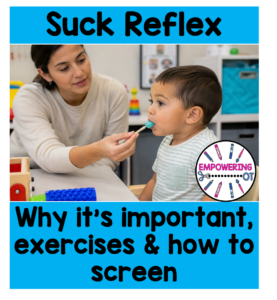
The suck reflex is one of the earliest reflexes involved in infant feeding. Working alongside other oral reflexes, it helps newborns coordinate the movements needed for sucking and supports early feeding development.
As babies grow, feeding becomes increasingly voluntary and coordinated. The early automatic suck response becomes less dominant as children develop greater oral-motor control and progress through increasingly complex feeding skills.
But what happens when patterns associated with the suck reflex appear to continue beyond infancy?
Parents and occupational therapists may begin exploring primitive reflexes when a child demonstrates oral sensory differences, feeding challenges, difficulty with oral-motor coordination, or frequent oral-seeking behaviors.
However, these concerns can have many different causes. Feeding difficulties, chewing on objects, food preferences, or oral sensory seeking do not automatically indicate a retained suck reflex.
Let’s explore the suck reflex in children, possible signs associated with a retained suck reflex, suck reflex screening and assessment, and practical ways to support oral sensory-motor development and everyday participation.
What Is the Suck Reflex?
The suck reflex is an automatic oral reflex present during early infancy that supports feeding.
When an infant receives appropriate stimulation in and around the mouth, automatic sucking movements help the baby obtain milk from the breast or bottle.
Successful infant feeding involves much more than sucking alone. Babies must coordinate:
- Sucking
- Swallowing
- Breathing
- Lip and tongue movements
- Jaw movement
- Sensory information from the mouth
The suck reflex works alongside other early oral reflexes, including the rooting reflex, as part of this developing feeding system.
As the nervous system and oral-motor system mature, feeding gradually becomes more voluntary. Babies develop greater control over the lips, tongue, jaw, and cheeks as they progress toward drinking from cups, managing different food textures, chewing, and eventually using the mouth for increasingly complex speech movements.
What Is a Retained Suck Reflex?
A retained suck reflex refers to persistence of an automatic sucking pattern beyond the developmental period when more mature voluntary oral-motor control would typically become dominant.
The suck reflex may be discussed in relation to:
- Oral sensory processing
- Feeding
- Oral-motor coordination
- Tongue and lip movements
- Chewing
- Drinking
- Managing different food textures
- Oral seeking
- Mouth awareness
It is important not to assume that every feeding or oral sensory difference is related to primitive reflexes.
A child who chews on pencils does not automatically have a retained suck reflex. A child who eats a limited variety of foods does not automatically have a retained suck reflex either.
Feeding and oral-motor development are complex and may be influenced by sensory processing, motor skills, anatomy, learned experiences, medical factors, food preferences, interoception, developmental differences, and many other factors.
Primitive reflexes should therefore be considered as one possible piece of a much larger picture.
Possible Signs of a Retained Suck Reflex in Children
When considering possible signs of a retained suck reflex, look for patterns rather than one isolated behavior.
A child may demonstrate:
- Frequent oral seeking, such as chewing on clothing, pencils, toys, or other non-food objects
- Difficulty transitioning away from sucking-based soothing habits
- Challenges coordinating tongue, lips, and jaw movements
- Difficulty managing certain food textures
- Reduced variety of oral-motor movements during eating
- Difficulty progressing to more complex chewing patterns
- Frequent preference for foods that require less oral-motor effort
- Difficulty managing food efficiently within the mouth
- Strong preference for sucking as a calming or regulating strategy
- Challenges with drinking skills
- Difficulty coordinating oral movements during feeding
- Increased need for oral sensory input throughout the day
These observations are not specific to the suck reflex.
Similar patterns can occur because of oral sensory processing differences, feeding skill development, oral-motor coordination, dental or structural factors, sensory preferences, developmental differences, medical conditions, or other factors.
Instead of asking only:
“Does this child have a retained suck reflex?”
consider:
“What oral sensory-motor patterns are we seeing, what might be contributing to them, and are they affecting feeding or participation in everyday routines?”
Suck Reflex Screening & Assessment
A suck reflex screening should involve more than checking whether a child demonstrates a sucking movement.
When primitive reflex screening is relevant, an occupational therapist may consider reflex findings alongside the child’s developmental history, feeding history, oral sensory processing, oral-motor skills, and functional participation.
Start With Functional Observation
Before completing a specific suck reflex test or screening procedure, observe the child during everyday routines.
Depending on the child’s age and concerns, consider:
- Eating: How does the child manage foods with different textures and consistencies?
- Chewing: Does the child demonstrate efficient, coordinated chewing?
- Drinking: How does the child manage developmentally appropriate cups, straws, or other drinking methods?
- Oral seeking: Does the child frequently chew, suck, or mouth non-food objects?
- Tongue movement: Can the child move food around the mouth efficiently?
- Lip control: Does the child demonstrate adequate lip closure during eating and drinking?
- Coordination: Do the lips, tongue, and jaw appear to work together during functional activities?
- Comfort: Does eating appear comfortable or effortful?
- Participation: Are oral sensory-motor differences interfering with meals, school routines, social participation, or self-care?
These observations provide important functional information before interpreting any reflex-specific findings.
What Might an OT Consider During Suck Reflex Screening?
When primitive reflex screening is appropriate and within the therapist’s training and scope, an occupational therapist may combine functional observations with a more specific suck reflex screening procedure.
Depending on the child’s age, developmental level, clinical presentation, and screening method, the therapist may consider:
- Oral responses to appropriate sensory input
- Lip movement and closure
- Tongue movement
- Jaw movement
- Oral-motor coordination
- Symmetry
- Automatic versus voluntary oral responses
- Oral sensory responses
- Consistency of the response
The therapist may also assess related areas including:
- Feeding skills
- Oral sensory processing
- Oral-motor coordination
- Postural stability during feeding
- Fine motor aspects of self-feeding
- Mealtime participation
- Sensory preferences
- Functional independence
A positive suck reflex screen does not automatically mean that a retained suck reflex is causing the child’s feeding or oral sensory difficulties.
Screening findings should be considered alongside developmental history, feeding performance, other assessment findings, and participation in everyday routines.
When Feeding Concerns Need a Broader Assessment
Feeding difficulties deserve particular care because eating and swallowing involve multiple sensory, motor, developmental, behavioral, structural, and medical systems.
A primitive reflex screen should not replace a comprehensive feeding assessment when significant feeding concerns are present.
Additional assessment may be appropriate when a child demonstrates persistent difficulty with:
- Chewing
- Managing food in the mouth
- Progressing through developmentally appropriate textures
- Drinking
- Mealtime participation
- Self-feeding
- Oral-motor coordination
- Maintaining adequate nutrition or hydration
Concerns involving swallowing safety, frequent coughing or choking with food or liquids, breathing changes during eating, or other signs of possible swallowing difficulty should be evaluated by an appropriately qualified healthcare professional.
The goal is to understand the child’s complete feeding profile rather than attributing feeding challenges to one reflex.
Why the Suck Reflex May Matter for Everyday Activities
For occupational therapists, the most useful question is usually not simply whether a reflex response is present.
Instead, consider how oral sensory-motor skills affect participation.
For example:
During meals: Can the child comfortably manage the foods available to them?
During snack at school: Can the child independently eat and drink within the available time?
During self-feeding: Can the child coordinate bringing food to the mouth with the oral movements needed to manage it?
During play and learning: Is frequent chewing or oral seeking interfering with participation or creating safety concerns?
During family routines: Are feeding challenges significantly affecting mealtime participation?
Connecting observations to functional participation helps determine what type of support may actually benefit the child.
Classroom Strategies for Oral Sensory Needs
Some children seek oral sensory input throughout the school day regardless of whether primitive reflexes are involved.
Supports should focus on safe access, participation, and individual sensory needs.
- Provide appropriate alternatives: If a child frequently chews unsafe objects, consider an individualized safe alternative when appropriate.
- Keep water accessible: Drinking water may provide useful oral input while also supporting hydration.
- Build movement into the day: Some children seek oral input more frequently when they need broader sensory or movement opportunities.
- Avoid shame: Do not describe oral seeking as babyish, gross, or inappropriate.
- Notice patterns: Does chewing increase during challenging work, transitions, waiting, fatigue, or particular sensory environments?
- Support independence: Teach the child how to access appropriate supports without unnecessary adult attention.
- Consider the environment: Look at the whole sensory context rather than focusing only on the child’s mouth.
The goal is not necessarily to eliminate oral sensory seeking. It is to provide safe and functional ways for the child to meet their needs.
Suck Reflex Activities for Children
Activities related to the suck reflex and oral sensory-motor development should be individualized to the child’s developmental level, feeding abilities, sensory preferences, and safety needs.
Straw Activities
When developmentally and medically appropriate, drinking through a straw can provide opportunities for controlled lip and oral-motor movements.
Different straw lengths or appropriate drink consistencies may change the motor demands, but these should be selected based on the individual child’s abilities.
Cotton Ball Blow
Use controlled breath to move a cotton ball across a table toward a target or through a simple maze.
Bubble Play
Blowing bubbles can turn controlled breath and lip movements into a playful activity.
Silly Face Mirror
Use a mirror to imitate voluntary movements such as smiling, puckering, opening the mouth, or moving the tongue in different directions.
The goal is playful body awareness rather than perfect performance.
Pretend Animal Mouths
Pretend to be different animals using voluntary facial and mouth movements.
Try a fish face, lion roar, or other child-created movement.
Straw Soccer
Use controlled blowing through a straw to move a lightweight ball or cotton ball toward a goal.
Oral Sensory Exploration
For children who safely tolerate different oral experiences, meals and snacks naturally provide opportunities to experience different temperatures, textures, flavors, and consistencies.
Food exposure should remain responsive to the child’s cues and should never involve forcing a child to eat or taste a food.
Pair Oral Input With Whole-Body Movement
If a child seeks significant oral sensory input, consider whether broader movement opportunities may also be helpful.
Activities such as pushing, pulling, carrying, climbing, crawling, or other preferred movement can be incorporated throughout the day.
A Note About Oral-Motor and Feeding Activities
Not every child needs oral-motor exercises.
Activities should be selected because they address an identified functional need—not simply because a child demonstrates a possible primitive reflex.
Feeding interventions should also respect the child’s:
- Communication
- Sensory preferences
- Food preferences
- Autonomy
- Comfort
- Developmental abilities
Children should not be forced to tolerate uncomfortable oral input or foods in an attempt to “integrate” a reflex.
Supporting Oral Sensory-Motor Development at Home
Home support can be incorporated into everyday routines without turning meals into therapy sessions.
Encourage independence during meals: Allow children to participate in developmentally appropriate self-feeding tasks.
Offer appropriate drinking opportunities: Practice with developmentally appropriate cups or straws when safe for the individual child.
Include varied movement throughout the day: Whole-body movement can be an important part of a child’s overall sensory regulation.
Notice oral-seeking patterns: Observe when chewing or mouthing behaviors increase and what may be happening at that time.
Respect food preferences: Exposure to foods does not require pressure to taste or eat them.
Support communication: Help children communicate preferences such as “too crunchy,” “too hot,” “I need a drink,” or “I don’t want that.”
Everyday routines can provide meaningful opportunities to build independence, body awareness, and participation.
Tracking Progress
Rather than tracking whether the suck reflex is simply “integrated,” consider changes that matter in everyday life.
You might track:
- Independence during meals and snacks
- Ability to manage developmentally appropriate food textures
- Efficiency during eating
- Independent use of safe oral sensory supports
- Frequency of chewing unsafe objects
- Participation in family or school meals
- Child communication about oral sensory needs
- Independence with drinking
- Comfort during feeding routines
Functional progress provides more useful information than whether a reflex appears present or absent on a single screen.
Supporting Body Awareness & Self-Advocacy
Children can learn to recognize and communicate oral sensory needs just as they can learn about other body signals.
A child might say:
“I need something crunchy.”
or:
“My mouth needs something to chew.”
A child experiencing discomfort with food might communicate:
“That texture doesn’t feel good in my mouth.”
Adults can respond without judgment:
“You don’t have to eat it. You can keep it on your plate or move it to the side.”
Supporting communication helps children develop body awareness, autonomy, and confidence during eating and other daily routines.
Frequently Asked Questions About the Suck Reflex
What is the suck reflex?
The suck reflex is an automatic oral reflex present during infancy that supports early feeding. It helps an infant produce sucking movements in response to appropriate oral stimulation.
When does the suck reflex become voluntary?
Automatic sucking is especially important during early infancy. As the nervous system and oral-motor system mature, feeding becomes increasingly voluntary and coordinated during the first months of life.
What are possible signs of a retained suck reflex?
Patterns sometimes discussed in relation to a retained suck reflex include oral sensory seeking, persistent sucking behaviors, feeding challenges, and differences in oral-motor coordination. These patterns have many possible causes and do not independently confirm a retained primitive reflex.
How do you screen for a retained suck reflex?
Suck reflex screening may include developmental and feeding history, functional observation, oral sensory-motor assessment, and reflex-specific screening when appropriate. Findings should be interpreted as part of the child’s broader feeding and developmental profile.
Can a retained suck reflex cause picky eating?
It would be overly simplistic to attribute picky or selective eating to a retained suck reflex. Food preferences and feeding challenges can be influenced by sensory processing, oral-motor abilities, appetite, interoception, previous experiences, developmental differences, medical factors, and many other variables.
Can occupational therapists assess the suck reflex?
Occupational therapists may consider primitive reflexes when relevant to occupational performance and within their scope and competence. When feeding concerns are present, assessment should focus broadly on the child’s feeding skills, sensory-motor abilities, environment, routines, and participation rather than reflexes alone.
Looking at the Whole Child
The suck reflex is an important part of early feeding development, but primitive reflexes should never be considered in isolation.
When exploring a possible retained suck reflex, consider the combination of:
Reflex findings + feeding development + oral sensory processing + oral-motor skills + environment + functional participation + the child’s individual experience.
For occupational therapists, parents, and educators, the most meaningful outcome isn’t simply whether a reflex appears present or absent.
It’s whether the child can participate safely, comfortably, and successfully in feeding and other everyday activities.
Reflex Integration Resources for Therapists, Teachers & Parents
If you’re looking for more support with primitive reflex screening, retained primitive reflexes, and play-based reflex activities, the Reflex Integration Bundle Toolkit includes educational handouts, printable visuals, and play-based activities addressing the major primitive reflexes.
The resources are designed for occupational therapists, teachers, and parents and focus on practical ways to incorporate sensory-motor development, body awareness, regulation, movement, and functional participation into everyday routines.
Explore the Reflex Integration Bundle Toolkit here.
suck reflex in children, retained suck reflex, suck reflex integration, suck reflex screening, suck reflex assessment, suck reflex test, suck reflex activities, primitive reflex screening, oral reflexes, primitive reflexes in children