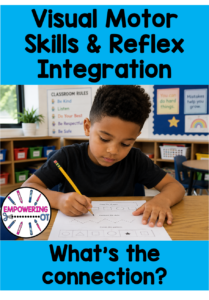
Visual motor skills help children use what they see to guide how their bodies move. These skills are involved in many everyday childhood activities—from copying shapes and writing letters to completing puzzles, building with blocks, catching a ball, and navigating a busy classroom.
When a child has difficulty with visual-motor tasks, adults may notice that they struggle to copy from the board, reproduce shapes accurately, keep writing organized on a page, complete mazes, or coordinate their movements with what they see.
There are many reasons a child may experience visual-motor challenges. Primitive reflexes may be one developmental factor worth considering as part of the bigger picture.
If primitive reflexes are new to you, start with my guide to what primitive reflex integration is and how it relates to development.
In this article, we’ll explore the possible connection between primitive reflexes and visual-motor skills, which reflex patterns may influence visual-motor performance, and practical ways occupational therapists, teachers, and parents can support children who have difficulty coordinating vision and movement.
What Are Visual-Motor Skills?
Visual-motor integration is the ability to coordinate visual information with a motor response.
In simple terms, the brain needs to interpret what the eyes see and then use that information to help the body perform an action.
For example, when a child copies a triangle, they need to:
- Look at the shape.
- Notice its lines, angles, direction, and spatial relationships.
- Plan how to reproduce it.
- Guide their hand while drawing.
- Compare what they drew with the original shape.
- Make adjustments as needed.
That’s much more complex than simply being able to hold and move a pencil.
Visual-motor skills are used during activities such as:
- Copying lines, shapes, letters, and numbers
- Completing prewriting activities
- Copying information from the board
- Writing within lines or designated spaces
- Spacing and organizing written work
- Drawing
- Completing mazes
- Building from a model
- Completing puzzles
- Cutting along a visual path
- Connecting dots
- Throwing and catching
- Placing objects accurately
- Navigating obstacles
If you’re working with younger children, my guide to the developmental progression of prewriting lines explains how children gradually progress from early lines to more complex shapes that eventually support letter formation.
This is also an important distinction between visual-motor skills and fine motor skills.
Fine motor skills generally involve the small muscles of the hands and fingers and the ability to manipulate objects. Visual-motor skills require the child to coordinate visual information with movement.
A child can therefore have adequate hand strength and dexterity but still struggle significantly with visual-motor integration.
If hand function itself is the primary concern, read Primitive Reflexes and Fine Motor Skills: Could Retained Reflexes Affect Hand Skills? for a closer look at that connection.
What Are Primitive Reflexes?
Primitive reflexes are automatic movement patterns that develop early in life. They support an infant’s early survival, movement, and neurological development.
As the nervous system matures, these early reflexive patterns typically become less dominant as increasingly controlled and voluntary movement develops.
Sometimes, however, primitive reflex patterns may continue to influence movement beyond the period when we would typically expect them to be prominent.
This is often referred to as retained primitive reflexes.
Primitive reflexes should never be considered in isolation or used as the sole explanation for a child’s difficulties. Development is complex, and visual-motor challenges can be influenced by many factors, including visual perception, motor coordination, postural control, attention, learning differences, experience, and the environment.
However, understanding early movement patterns can provide occupational therapists with another piece of information when looking at a child’s overall performance.
How Could Primitive Reflexes Affect Visual Motor Skills?
Visual-motor integration requires much more than vision and hand movement.
A child also needs sufficient:
- Postural stability
- Head and neck control
- Bilateral coordination
- Crossing of the body’s midline
- Eye-hand coordination
- Motor planning
- Spatial awareness
- Controlled movement
- Visual attention
- Efficient transitions between near and far visual targets
Several primitive reflex patterns involve relationships between the head, neck, eyes, trunk, and extremities.
If these patterns continue to strongly influence movement, a child may need to use additional effort to maintain a stable position while simultaneously looking, reaching, copying, writing, or manipulating materials.
The result may look like a visual-motor problem even though several underlying systems are contributing to the difficulty.
For a broader look at how movement planning fits into this picture, read Primitive Reflexes and Motor Planning: Understanding the Connection.
ATNR and Visual-Motor Integration
The Asymmetrical Tonic Neck Reflex (ATNR) is particularly relevant when considering visual-motor development because it involves the relationship between head turning and movement of the arms and legs.
In infancy, when the head turns to one side, the arm and leg on the face side tend to extend while the opposite side flexes.
As development progresses, children typically become increasingly able to turn their heads independently of their arms and legs.
This separation is important during many classroom activities.
For example, imagine copying a sentence from a classroom board.
The child must repeatedly:
- Look up at the board.
- Locate the correct information.
- Look back down at the paper.
- Find their place again.
- Write the information.
- Repeat the process.
If head turning continues to strongly influence arm position or postural stability, this type of task may require considerably more effort.
Children may appear slow, lose their place frequently, reposition their paper, or avoid crossing the center of the page.
ATNR may also be considered when a child demonstrates difficulty with:
- Crossing midline
- Copying across a page
- Coordinating both sides of the body
- Maintaining consistent positioning while writing
- Visually tracking while completing motor tasks
- Coordinating head movement with hand activity
These behaviors do not automatically indicate a retained ATNR. They are simply observations that may warrant a broader look at the child’s visual, motor, and developmental skills.
For therapists or families looking for structured activities, my ATNR Reflex Integration activity packet includes 32 play-based activities addressing areas such as crossing midline, visual-motor skills, body symmetry, and coordinated movement.
STNR and Visual-Motor Skills
The Symmetrical Tonic Neck Reflex (STNR) involves a relationship between head movement and movement of the upper and lower body.
This pattern can be particularly relevant when considering visual-motor tasks performed at a desk.
Children frequently move their heads between different positions while working. They may look down at a worksheet, look up at a teacher or board, and then return their gaze to the desk.
If head movement significantly affects postural stability, maintaining an efficient seated position while completing visual-motor tasks may become more difficult.
A child may:
- Slump over the desk
- Frequently change position
- Sit on their feet
- Lean heavily on the table
- Support their head with one hand
- Move very close to the paper
- Have difficulty alternating between looking up and looking down
These behaviors can have many possible causes. However, postural demands are important to consider because visual-motor performance depends on having a stable base from which the eyes and hands can work together.
You can learn more about the relationship between this reflex, seated posture, coordination, and classroom participation in my complete STNR Reflex Integration guide.
For play-based intervention ideas, my STNR Reflex Integration activity packet includes 35 activities targeting upper- and lower-body coordination, postural control, head-body movement, and visual tracking.
TLR, Head Position, and Visual-Motor Performance
The Tonic Labyrinthine Reflex (TLR) is associated with the relationship between head position, gravity, and whole-body flexion and extension.
As children develop greater postural control, they become increasingly able to maintain stable body positions while their head changes position.
This matters for visual-motor activities because children constantly adjust their head position while looking at materials.
If maintaining an upright seated posture requires significant effort, fewer resources may be available for visually demanding tasks.
A child may compensate by:
- Leaning on the desk
- Moving their face very close to the paper
- Frequently changing body position
- Using excessive effort to maintain posture
- Avoiding visually demanding tabletop tasks
Again, these observations are not diagnostic of a retained reflex. They simply illustrate how postural control and visual-motor integration are interconnected.
For a more detailed explanation of this reflex, including postural control, balance, classroom supports, and functional observations, read my Tonic Labyrinthine Reflex (TLR) Integration guide.
For activity ideas, the TLR Reflex Integration activity packet includes 32 play-based activities addressing head and body positioning, core stability, balance, and body awareness.
Moro Reflex and Visual Attention
The Moro Reflex is an early protective reflex associated with sudden changes in movement, position, and sensory input.
When considering visual-motor performance, the possible connection is somewhat different than with ATNR, STNR, or TLR.
A child who is highly responsive to environmental sensory information may have difficulty maintaining visual attention in a busy classroom.
Movement in the hallway, another student’s materials, changing displays, or activity elsewhere in the room may repeatedly pull attention away from a visual-motor task.
For these children, environmental accommodations may sometimes be just as important as direct skill practice.
Examples include:
- Reducing unnecessary visual clutter
- Providing a defined workspace
- Breaking visually complex worksheets into smaller sections
- Using visual boundaries
- Providing movement opportunities
- Allowing additional processing time
The goal is not to eliminate sensory experiences. It is to create an environment that supports successful participation.
For a closer look at the Moro Reflex, sensory responses, regulation, classroom supports, and functional participation, read my Moro Reflex Integration guide.
Primitive Reflexes and Copying From the Board
Copying from the board is one of the most demanding visual-motor tasks students encounter at school.
It requires the child to coordinate several systems simultaneously.
The child must visually locate information, remember it briefly, shift gaze from far to near, find their place on the page, reproduce what they saw, maintain posture, and repeat the sequence.
If a child has difficulty with this process, they may:
- Copy very slowly
- Skip words or lines
- Lose their place
- Frequently look back at the board
- Make copying errors
- Have difficulty organizing information on the page
- Become fatigued
- Complete less work than classmates
Rather than assuming the child is “not paying attention,” occupational therapists and educators can look more closely at the demands of the task.
Visual-motor integration, visual perception, working memory, postural control, motor coordination, and environmental demands may all contribute.
Primitive Reflexes and Prewriting Skills
Visual-motor integration begins developing long before formal handwriting.
Young children learn to imitate and copy increasingly complex lines and shapes, including:
- Vertical lines
- Horizontal lines
- Circles
- Crosses
- Diagonal lines
- Squares
- Triangles
These early prewriting skills require children to visually analyze a shape and reproduce it with their own movements.
You can see the typical progression and ideas for supporting these foundational skills in my Developmental Progression of Prewriting Lines guide.
When children struggle to copy prewriting forms, it can be helpful to look beyond pencil grasp alone.
Consider:
- Can the child visually discriminate the shape?
- Can they imitate the movement without a pencil?
- Can they cross midline?
- Can they maintain a stable seated position?
- Can they coordinate both sides of the body?
- Can they reproduce the shape using larger movements?
- Does performance change depending on body position?
These observations can provide valuable information about what may be contributing to the child’s difficulty.
Visual-Motor Skills vs. Visual Perceptual Skills
Visual-motor and visual perceptual skills are related, but they are not the same thing.
Visual perception involves interpreting and making sense of visual information.
Visual-motor integration involves using visual information to guide a motor response.
For example, a child might correctly identify which two shapes are identical on a worksheet but have difficulty copying the shape onto another piece of paper.
In that situation, visual discrimination may be adequate while visual-motor integration is more challenging.
This distinction is important during occupational therapy assessment because different underlying difficulties may require different supports.
Signs a Child May Be Struggling With Visual-Motor Integration
Possible signs of visual-motor difficulty include:
- Difficulty copying shapes
- Difficulty copying letters or numbers
- Poor organization of written work
- Difficulty staying within lines
- Inconsistent letter size
- Difficulty spacing words or objects
- Losing place while copying
- Difficulty copying from the board
- Trouble completing mazes
- Difficulty connecting dots
- Trouble recreating block designs
- Difficulty drawing recognizable forms
- Difficulty cutting along visual boundaries
- Trouble coordinating catching or throwing
- Avoidance of visually demanding activities
A child does not need to demonstrate all of these signs to have visual-motor challenges.
It is also important to remember that none of these behaviors alone indicates the presence of a retained primitive reflex.
When handwriting is one of the primary concerns, my article Retained Primitive Reflexes and Handwriting: An OT Guide looks more specifically at handwriting demands, posture, bilateral coordination, and primitive reflex patterns.
How Occupational Therapists Can Look at Visual-Motor Challenges
When an occupational therapist evaluates visual-motor performance, the goal should be to understand why the task is difficult for this particular child.
Rather than looking at one isolated skill, consider the interaction between:
Visual skills
Can the child efficiently locate, track, discriminate, and interpret visual information?
Motor skills
Can the child plan and execute the movement required by the task?
Postural control
Can the child maintain a stable position while using their eyes and hands?
Bilateral coordination
Can both sides of the body work together effectively?
Crossing midline
Can the child comfortably perform activities across the center of the body?
Motor planning
Can the child determine how to reproduce an unfamiliar visual form?
Attention and regulation
Can the child remain engaged with the visual information long enough to complete the task?
Environmental demands
Is the worksheet, classroom, or activity creating unnecessary visual or motor demands?
Primitive reflex observations may be incorporated into this broader assessment, but they should remain one component of a comprehensive occupational therapy perspective.
Activities That Support Visual-Motor Development
Supporting visual-motor skills does not have to mean completing more worksheets.
Movement-based and play-based activities can provide meaningful opportunities to coordinate vision and action.
Try activities such as:
- Copying block structures
- Building from picture models
- Drawing on a vertical surface
- Completing simple mazes
- Creating designs with pegboards
- Copying patterns
- Playing catch
- Balloon games
- Beanbag target activities
- Obstacle courses
- Chalk drawing
- Connecting dots
- Completing puzzles
- Reproducing LEGO designs
- Copying simple drawings
- Making patterns with beads or manipulatives
For children who also demonstrate motor or postural challenges, incorporating whole-body movement may be particularly helpful.
Looking for Visual-Motor Activities?
My Fine Motor Daily Skills Workbook includes quick activities targeting visual-motor, visual-perceptual, coordination, pencil-control, and related skills, including line and shape tracing, mazes, and visual scanning activities.
For home, classroom, or therapy carryover, my Daily Fine Motor, Visual Motor & Sensory Activity Calendar includes 365 activities using common household materials, with activities addressing visual-perceptual skills, bilateral hand use, coordination, and other developmental areas.
Supporting Visual-Motor Skills in the Classroom
Classroom accommodations can reduce unnecessary barriers while children continue developing visual-motor skills.
Consider:
- Providing a copy of notes instead of requiring extensive board copying
- Placing a visual model close to the student’s workspace
- Reducing copying distance
- Breaking worksheets into smaller visual sections
- Highlighting starting points
- Using visual boundaries
- Providing additional space for written responses
- Allowing additional time
- Reducing unnecessary copying demands
- Providing movement opportunities
- Using vertical surfaces when appropriate
Accommodations are not about avoiding skill development. They allow children to participate successfully while the underlying skills are still developing.
Should Primitive Reflexes Be the Focus of Treatment?
Not necessarily.
Primitive reflexes can provide useful information about development and movement patterns, but intervention should remain connected to the child’s functional participation.
If a student struggles to copy from the board, for example, the goal should not simply be to “integrate ATNR.”
Instead, consider the actual occupational performance problem.
Does the child need support with visual tracking? Crossing midline? Postural stability? Visual memory? Near-far copying? Motor planning? Classroom accommodations?
A functional, neuroaffirming approach asks:
What is making this activity difficult, and what supports will help this child participate more successfully?
That question keeps intervention centered on the child rather than on a single reflex.
The Bigger Picture: Primitive Reflexes and Visual-Motor Integration
The relationship between primitive reflexes and visual-motor skills is best understood as one part of a larger developmental picture.
Visual-motor performance depends on the coordination of multiple systems, including vision, movement, posture, bilateral coordination, attention, and motor planning.
Early reflexive movement patterns may influence some of these systems, but they should never be viewed as the sole cause of a child’s visual-motor challenges.
For occupational therapists, primitive reflex observations can provide another lens for understanding movement and participation.
For teachers and parents, the most important takeaway is that a child who struggles with copying, drawing, handwriting organization, or other visual-motor activities may be working much harder than it appears.
Instead of focusing only on the final product, look at the demands underneath the task.
You can also explore how primitive reflexes may relate to balance and coordination, motor planning, fine motor skills, and handwriting.
Primitive Reflex Resources for Therapists, Educators & Families
If you’re looking for a more comprehensive way to explore primitive reflexes, my Primitive Reflex Integration Bundle Toolkit includes resources for 12 primitive reflexes, 44 educational handouts, and 320+ play-based activities with visuals.
The bundle includes resources for:
- Moro
- ATNR
- STNR
- TLR
- Palmar
- Plantar
- Babinski
- Spinal Galant
- Rooting
- Suck
- Landau
- Perez
Rather than focusing on repetitive drills, the activities provide varied, play-based movement experiences that can be adapted for therapy sessions, classroom routines, movement breaks, and home activities.
For visual-motor concerns in particular, the ATNR resources may be useful when you’re also looking at crossing midline, visual-motor coordination, bilateral coordination, and the relationship between head movement and upper-extremity control.
Explore the complete Primitive Reflex Integration Bundle Toolkit.
primitive reflexes and visual motor integration, retained primitive reflexes and visual motor skills, primitive reflexes and eye hand coordination, ATNR and visual motor skills, primitive reflexes and copying, primitive reflexes and prewriting skills, visual motor integration occupational therapy