

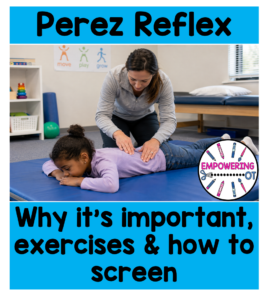
The Perez reflex is one of the lesser-known primitive reflexes that develops during infancy. While reflexes such as the Moro, ATNR, and STNR are discussed frequently, many parents, educators, and even therapists may be less familiar with the Perez reflex and its role in early development.
The Perez reflex is associated with an infant’s automatic response to sensory input along the spine. Like other early reflex patterns, it is part of the developing nervous system and typically becomes less prominent as voluntary movement and postural control mature.
When learning about a possible retained Perez reflex, it is important to look beyond a list of symptoms. Difficulties with posture, movement, sensory processing, regulation, or everyday activities can have many possible causes and do not automatically indicate a retained primitive reflex.
Let’s explore the Perez reflex in children, its typical development, possible signs associated with a retained Perez reflex, Perez reflex screening and assessment, and practical activities and strategies that may support sensory-motor development and participation.
What Is the Perez Reflex?
The Perez reflex is an early spinal reflex observed during infancy.
It is typically elicited through stimulation along the spine while the infant is positioned on the stomach. The response may involve extension of the head and trunk along with movement of the pelvis and extremities.
The Perez reflex is part of the infant’s early neurological development and is associated with sensory input along the back, spinal movement, and developing control of the body against gravity.
As the nervous system matures, automatic reflexive responses gradually give way to more controlled and voluntary movement.
The Perez reflex is generally described as being present during early infancy and becoming less prominent during the first months of life.
Understanding the Perez reflex can provide another piece of information when considering a child’s overall sensory-motor development, postural control, movement, and functional participation.
What Is a Retained Perez Reflex?
A retained Perez reflex refers to persistence of an automatic Perez reflex pattern beyond the developmental period when the response would typically become less dominant.
Because the Perez reflex involves sensory input along the spine and an associated whole-body response, it is sometimes discussed in relation to areas such as:
- Sensitivity along the back or spine
- Postural control
- Trunk movement
- Body awareness
- Sensory processing
- Regulation
- Gross motor coordination
- Comfort with certain clothing or touch
- Positioning and movement
However, these areas are influenced by many factors.
For example, a child who dislikes having their back touched does not automatically have a retained Perez reflex. Similarly, difficulty sitting upright, sensory sensitivities, or challenges with movement should not automatically be attributed to primitive reflexes.
Instead, reflex findings are most useful when considered as one part of a broader developmental and functional picture.
Possible Signs of a Retained Perez Reflex
Parents and professionals looking for signs of a retained Perez reflex in children may notice patterns involving touch, movement, posture, or regulation.
A child may:
- Be particularly sensitive to touch along the back or trunk.
- Dislike certain clothing textures or seams against the back.
- React strongly when someone unexpectedly touches their back.
- Frequently adjust clothing around the waist or trunk.
- Have difficulty maintaining a comfortable seated posture.
- Frequently shift, wiggle, or reposition during seated activities.
- Demonstrate challenges with trunk control during movement.
- Have difficulty coordinating movements involving the trunk and extremities.
- Prefer or avoid particular floor positions.
- Demonstrate sensitivity during grooming, dressing, or other activities involving touch to the back.
- Seek additional movement or body-based sensory input.
- Have difficulty maintaining comfortable participation during activities involving prolonged positioning.
These observations are not specific to the Perez reflex.
Similar patterns may occur because of tactile processing, proprioception, vestibular processing, strength, endurance, attention, motor coordination, clothing preferences, environmental factors, or other developmental differences.
Instead of asking only:
“Does this child have a retained Perez reflex?”
consider:
“What patterns are we seeing, when do they occur, and are they interfering with the child’s comfort or participation in everyday activities?”
Perez Reflex Screening & Assessment
A Perez reflex screening should not consist solely of checking whether a child demonstrates a particular movement.
Primitive reflex screening is most useful when it is combined with information about the child’s development, sensory-motor abilities, functional performance, and participation.
Start With Functional Observation
Before completing a specific Perez reflex test or screening procedure, observe the child during natural activities.
Consider:
- Touch: How does the child respond to expected and unexpected touch along the back and trunk?
- Clothing: Are particular waistbands, seams, tags, or clothing textures consistently uncomfortable?
- Posture: Does the child appear comfortable and stable while sitting, standing, and moving?
- Movement: How does the trunk move during gross motor activities?
- Body awareness: Can the child recognize and communicate when something feels uncomfortable?
- Consistency: Do the same patterns occur repeatedly and across different environments?
- Participation: Are these responses interfering with dressing, schoolwork, play, sleep routines, self-care, or other daily activities?
Looking at the child’s response during meaningful activities provides important context before interpreting a reflex-specific finding.
What Might an OT Consider During Perez Reflex Screening?
When primitive reflex screening is appropriate, an occupational therapist may combine functional observations with a more specific Perez reflex screening procedure.
Depending on the screening approach and the therapist’s training, observations may include:
- Response to sensory input along the back
- Trunk and spinal movement
- Head and neck positioning
- Pelvic or lower-extremity responses
- Symmetry of the response
- Associated automatic movements
- Intensity and consistency of the response
- The child’s comfort during the screening
Related areas may also be considered, including:
- Tactile processing
- Proprioceptive processing
- Body awareness
- Postural control
- Core stability
- Gross motor coordination
- Motor planning
- Regulation
- Functional participation
A positive Perez reflex screen does not automatically mean that a retained Perez reflex is causing the child’s difficulties.
Screening findings should be interpreted alongside the child’s developmental history, other assessment findings, sensory-motor profile, environment, and participation in everyday activities.
Why the Perez Reflex May Matter for Everyday Activities
For occupational therapists, the most important question is usually not simply whether a reflex response is present.
Instead, consider whether the child’s sensory-motor patterns are affecting daily occupations.
For example:
During dressing: Does the child frequently become uncomfortable when clothing touches the back or waist?
During classroom activities: Does the child constantly reposition because sitting feels uncomfortable or requires significant effort?
During floor play: Are certain positions consistently avoided?
During self-care: Does touch along the back make bathing, drying, dressing, or grooming more difficult?
During movement: Does the child demonstrate difficulty coordinating trunk movement with the rest of the body?
During rest: Does positioning or sensory input along the back appear to affect comfort?
Connecting observations to functional participation helps determine whether further assessment or support may be useful.
Classroom Strategies
Regardless of whether primitive reflexes contribute to a child’s difficulties, accommodations can help improve participation.
- Allow position changes: Give students appropriate opportunities to sit, stand, kneel, or change working positions.
- Consider chair comfort: Notice whether the chair back, clothing, or seating materials appear uncomfortable.
- Provide movement opportunities: Incorporate classroom jobs, carrying materials, pushing, pulling, and other functional movement.
- Avoid unexpected touch: Let the student know before touching their back or shoulders whenever possible.
- Offer seating choices: Some students may participate better with different seating options or locations.
- Respect sensory preferences: Do not require a student to tolerate uncomfortable tactile input simply to become accustomed to it.
- Reduce prolonged static positioning: Break longer seated activities into manageable periods when appropriate.
- Support self-advocacy: Help students communicate when clothing, seating, touch, or positioning feels uncomfortable.
The goal is not to make every child sit still or tolerate every sensory experience. It is to support comfort, access, and successful participation.
Perez Reflex Activities for Children
When Perez reflex activities are incorporated into therapy or play, activities should be comfortable, predictable, and responsive to the child’s sensory preferences.
Prone Puzzle Play
Complete a puzzle, matching game, or building activity while lying on the stomach and supporting the upper body through the forearms.
Slow-Motion Animal Walks
Try bear walks, puppy crawls, inchworms, or other child-selected animal movements that encourage coordinated movement of the trunk and extremities.
Therapy Ball Reach
With appropriate support, lie over a therapy ball and reach for toys or objects placed within a comfortable range.
Keep movement slow and predictable.
Crawl & Collect
Place puzzle pieces, beanbags, or toys around the room and crawl to collect them one at a time.
Pillow Push
Push a large cushion across the floor toward a target or pretend destination.
Tunnel Adventure
Crawl through a play tunnel or create a simple tunnel using safe household or therapy materials.
Roll & Reach
Roll across a mat toward an object, pause to reach for it, and then continue in another direction.
Carry & Deliver
Carry books, toys, beanbags, or other appropriately weighted objects from one location to another.
Child-Designed Obstacle Course
Create a short movement course involving crawling, stepping, reaching, carrying, or pushing. Allow the child to help select the activities and order.
Activities should never involve forceful stimulation along the spine or unwanted touch in an attempt to produce or eliminate a reflex response.
If a child is uncomfortable with touch along the back, respect that response rather than repeatedly exposing the child to the sensation.
Supporting Sensory-Motor Development at Home
Home activities do not need to become a formal reflex exercise program.
Everyday routines already provide many opportunities for varied movement and body awareness.
Floor play: Build, draw, read, or complete puzzles in different comfortable positions.
Household jobs: Carry laundry, push a basket, put groceries away, water plants, or help move lightweight household items.
Outdoor movement: Climb, crawl, walk on different surfaces, play catch, or create simple obstacle courses.
Respect clothing preferences: If certain seams, waistbands, or textures consistently bother the child, consider comfortable alternatives when possible.
Ask before touching: Giving children warning and choice before touch can increase predictability and support body autonomy.
Encourage communication: Help children identify and communicate what feels comfortable or uncomfortable to their bodies.
The goal is to provide opportunities for movement, body awareness, comfort, and participation within normal routines.
Tracking Progress
Rather than measuring whether the Perez reflex is simply “gone,” track outcomes that matter during everyday life.
Consider:
- Comfort during dressing
- Tolerance for different seated positions
- Independence adjusting clothing or positioning
- Ability to communicate sensory preferences
- Participation during tabletop activities
- Comfort during floor play
- Gross motor participation
- Independence during self-care
- Frequency of adult support needed
- Child-reported comfort during activities
Look for patterns over time rather than using a single screening response as the primary measure of progress.
Supporting Body Awareness & Self-Advocacy
Helping children recognize and communicate their sensory preferences can be just as important as supporting motor development.
A child might learn to say:
“That feels uncomfortable on my back.”
or:
“Please tell me before you touch me.”
An adult might say:
“It looks like that shirt is bothering you. Do you want to adjust it or try another one?”
For children who communicate in other ways, adults can watch body language, movement away, changes in facial expression, gestures, or other forms of communication.
The goal is not to teach children to ignore uncomfortable sensations. It is to help them develop body awareness, self-advocacy, and access to supports that improve participation.
Frequently Asked Questions About the Perez Reflex
What is the Perez reflex?
The Perez reflex is an early spinal reflex observed during infancy. It involves an automatic whole-body response to sensory stimulation along the spine and is part of early neurological and motor development.
When does the Perez reflex integrate?
The Perez reflex is present during early infancy and typically becomes less prominent as the nervous system matures and voluntary movement develops.
What are signs of a retained Perez reflex?
Patterns sometimes discussed in relation to a retained Perez reflex include sensitivity along the back or trunk, postural challenges, frequent repositioning, sensory responses to clothing, and difficulties involving trunk movement or coordination. These signs can have many possible causes and do not independently confirm a retained reflex.
How do you test for a retained Perez reflex?
Perez reflex screening may include observation of the body’s response to sensory input along the spine along with assessment of trunk movement, postural control, sensory processing, body awareness, and functional participation. Reflex-specific screening should be completed by an appropriately trained professional.
Can occupational therapists screen primitive reflexes?
Primitive reflex screening may be incorporated into occupational therapy assessment when relevant to occupational performance and within the therapist’s scope and competence. Findings should be considered alongside broader developmental and functional assessment information.
Looking at the Whole Child
The Perez reflex can provide one piece of information when looking at a child’s sensory-motor development, but primitive reflexes should not be considered in isolation.
When exploring a possible retained Perez reflex, consider the combination of:
Reflex findings + sensory processing + postural control + movement + environment + functional performance + the child’s individual experience.
For occupational therapists, the most meaningful outcome is not simply whether a primitive reflex appears present or absent.
It is whether the child can participate more comfortably, independently, and successfully in the activities that matter to them.
Reflex Integration Resources for Therapists, Teachers & Parents
If you’re looking for additional support with primitive reflex screening, reflex integration activities, and retained primitive reflexes, the Reflex Integration Bundle Toolkit includes educational handouts, printable visuals, and play-based activities addressing the major primitive reflexes.
The resources are designed for occupational therapists, teachers, and parents and focus on practical ways to incorporate movement, sensory-motor development, body awareness, regulation, and functional participation into everyday routines.
Explore the Reflex Integration Bundle Toolkit here.




One Comment