
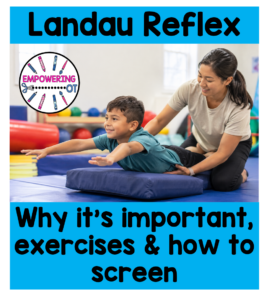
The Landau reflex is an early developmental reflex that emerges during infancy and is associated with head control, trunk extension, postural development, and movement against gravity.
Unlike primitive reflexes that are present at birth, the Landau reflex develops a little later as babies gain greater control of their head and body.
As development progresses, this automatic movement pattern becomes less dominant as increasingly mature postural reactions and voluntary motor control develop.
But what happens when patterns associated with the Landau reflex appear to persist beyond the expected developmental period?
Parents, teachers, and occupational therapists may begin exploring the possibility of a retained Landau reflex when a child demonstrates challenges with posture, core stability, coordination, balance, or controlling the body during movement.
However, these difficulties can have many possible causes. A postural or motor challenge alone does not mean that a child has a retained Landau reflex.
Let’s look at the Landau reflex in children, possible signs of a retained Landau reflex, screening and assessment considerations, and practical activities and strategies for supporting participation.
What Is the Landau Reflex?
The Landau reflex is a developmental reflex associated with the development of antigravity extension and postural control.
When an infant is supported horizontally in a prone, or belly-down, position, the Landau response involves lifting the head and extending the trunk. The legs may also extend as part of the response.
This pattern reflects the infant’s growing ability to organize the head, trunk, and extremities against gravity.
The Landau reflex typically emerges at approximately 3–4 months of age, becomes more established during infancy, and gradually becomes less dominant as more mature voluntary movement and postural control develop. It is generally described as integrating during the second year of life.
The Landau reflex is particularly interesting from a developmental perspective because it occurs during a period when babies are developing skills such as:
- Head and neck control
- Trunk extension
- Prone positioning
- Postural stability
- Balance reactions
- Coordination between different parts of the body
- Increasing control against gravity
These foundational abilities eventually contribute to increasingly complex movement and participation.
What Is a Retained Landau Reflex?
A retained Landau reflex refers to persistence of an automatic Landau movement pattern beyond the developmental period when more mature postural control would typically become dominant.
The Landau reflex is often discussed in relation to:
- Postural control
- Core stability
- Head and neck control
- Trunk extension
- Balance
- Coordination
- Gross motor development
- Motor planning
- Endurance during seated activities
It is important to remember that these skills are influenced by many developmental and environmental factors.
For example, a child who slouches while writing does not automatically have a retained Landau reflex. Likewise, difficulty with balance, core strength, or coordination is not enough to identify a retained primitive reflex.
Instead, reflex findings should be considered as one possible piece of a larger developmental and functional picture.
Signs of a Retained Landau Reflex in Children
When considering possible signs of a retained Landau reflex, look for patterns across activities rather than one isolated movement or behavior.
A child may demonstrate:
- Difficulty maintaining an upright seated posture
- Frequent slouching or leaning during tabletop activities
- Reduced endurance during seated schoolwork
- Difficulty maintaining the head and trunk against gravity
- Challenges with prone extension activities
- Difficulty coordinating the upper and lower body during movement
- Reduced core stability during gross motor activities
- Difficulty with balance or postural adjustments
- Challenges maintaining stable positions while the arms or legs are moving
- Difficulty with activities requiring whole-body coordination
- Frequent changes in position during longer seated tasks
- Greater effort during activities requiring sustained postural control
These observations are not specific to the Landau reflex.
Similar patterns may be associated with strength, endurance, motor coordination, vestibular processing, proprioception, joint stability, motor planning, attention, environmental demands, positioning, or other developmental factors.
Rather than asking only:
“Does this child have a retained Landau reflex?”
consider:
“What motor and postural patterns are we seeing, what factors may be contributing to them, and are they affecting the child’s participation in everyday activities?”
Landau Reflex Screening & Assessment
A Landau reflex screening should involve more than looking at whether a child can perform one particular movement.
For occupational therapists, primitive reflex screening may be considered alongside the child’s developmental history, postural control, coordination, sensory-motor abilities, and functional participation.
Start With Functional Observation
Before completing a specific Landau reflex test or screening procedure, observe the child during natural activities.
Consider:
- Posture: How does the child position the head, trunk, and pelvis during seated and standing activities?
- Endurance: Can the child comfortably maintain positions, or do they frequently lean, prop, or change position?
- Movement: What happens when the arms and legs move while the child attempts to maintain trunk stability?
- Balance: How does the child respond when their center of gravity changes?
- Coordination: Can different parts of the body work together efficiently?
- Participation: Do postural or motor challenges interfere with schoolwork, play, self-care, or physical activities?
- Compensation: Does the child appear to use excessive effort, tension, or alternative positioning to complete tasks?
Looking at these patterns during real activities provides important context before interpreting a reflex-specific screen.
What Might an OT Consider During Landau Reflex Screening?
When primitive reflex screening is appropriate, an occupational therapist may combine functional observations with a more specific Landau reflex screening procedure.
Depending on the screening method and the therapist’s training, the OT may observe:
- Head and neck positioning
- Trunk extension
- Upper- and lower-extremity responses
- Symmetry
- Ability to maintain antigravity positions
- Changes in body position associated with head movement
- Automatic versus voluntary movement
- Quality and consistency of the response
The therapist may also assess related areas including:
- Postural control
- Core stability
- Balance
- Bilateral coordination
- Motor planning
- Gross motor coordination
- Vestibular processing
- Proprioceptive processing
- Functional endurance
A positive Landau reflex screen does not automatically mean that a retained Landau reflex is causing the child’s difficulties or that reflex integration exercises are required.
Screening findings should be considered alongside the child’s developmental history, other assessment findings, environment, and performance during meaningful daily activities.
Why the Landau Reflex May Matter for Everyday Activities
For occupational therapists, the presence of a reflex response is less important than understanding whether a child’s sensory-motor abilities are affecting participation.
For example:
During handwriting: Does maintaining an upright position require so much effort that the child has fewer resources available for writing?
During tabletop activities: Does the child frequently lean against the table, prop their head, or change position?
During play: Are postural control or coordination challenges making playground activities difficult?
During dressing: Can the child maintain balance while moving the arms or legs to put on clothing?
During physical activities: Does the child have difficulty coordinating the head, trunk, arms, and legs during climbing, jumping, throwing, or obstacle courses?
Looking at functional participation helps connect primitive reflex screening with the child’s actual needs.
Classroom Strategies
Classroom supports can reduce unnecessary postural demands while helping the student participate successfully.
- Check seating and desk height: Feet should have access to a stable surface whenever possible.
- Provide foot support: A footrest or stable surface may help when a child’s feet do not reach the floor.
- Build in movement opportunities: Incorporate carrying, pushing, reaching, classroom jobs, and other functional movement throughout the day.
- Allow position changes: Some students work more comfortably when they can alternate between sitting, standing, or another appropriate working position.
- Reduce prolonged static sitting: Break longer tabletop activities into manageable periods when appropriate.
- Use vertical surfaces: Writing or drawing on an easel or vertical surface can provide a different postural challenge.
- Consider task demands: If maintaining posture is already difficult, reducing unnecessary copying or other simultaneous demands may improve participation.
- Focus on function: The goal is not to make every child maintain one “perfect” sitting position. Support a position that allows comfortable, successful participation.
Landau Reflex Activities for Children
When Landau reflex activities are incorporated into therapy or play, they should focus on enjoyable movement experiences rather than repeatedly drilling a reflex response.
Superman Reach
Lie on the stomach and reach forward for a toy, puzzle piece, beanbag, or other object.
The child can lift only as much of the head, chest, or arms as feels comfortable.
Scooter Board Delivery
While lying on the stomach on a scooter board, move short distances to collect or deliver objects.
Adjust the activity based on the child’s comfort and motor abilities.
Prone Puzzle Play
Complete a puzzle, matching game, or building activity while lying on the stomach and propping through the forearms.
Animal Walks
Try bear walks, crab walks, inchworms, or other child-selected animal movements that encourage whole-body coordination.
Therapy Ball Reach
With appropriate support, position the child over a therapy ball and reach for objects placed within a comfortable range.
Movement should remain slow and predictable.
Tall-Kneeling Play
Complete a throwing, reaching, building, or balloon activity while maintaining tall kneeling.
Crawl & Carry Course
Create a short course that combines crawling with pushing, pulling, reaching, or transporting objects.
Balance & Reach
Stand on a stable surface and reach for objects placed in different directions.
Increase the challenge only when the child is comfortable and successful.
Slow-Motion Movement Challenge
Choose familiar movements and complete them slowly. Slowing down can increase opportunities for body awareness and controlled movement.
Activities should be adapted to the individual child’s abilities and preferences. Stop or modify an activity if the child experiences discomfort, fatigue, dizziness, fear, or asks to stop.
Supporting Postural Control at Home
Supporting postural development does not require a formal exercise program.
Everyday activities can provide opportunities for movement and whole-body coordination.
Floor play: Build with blocks, complete puzzles, or read in different comfortable floor positions.
Household jobs: Carry laundry, push a basket, water plants, put groceries away, or help move lightweight household items.
Playground movement: Climbing, crawling, swinging, balancing, and navigating playground equipment provide varied movement experiences.
Outdoor play: Walking on different surfaces, playing catch, riding toys, and exploring obstacle courses can encourage whole-body coordination.
Change positions: Allow children to draw, read, build, or play in a variety of positions rather than requiring prolonged sitting.
The goal is to provide varied opportunities for meaningful movement, not to turn home routines into constant therapy exercises.
Tracking Progress
Rather than tracking whether the Landau reflex is simply “integrated,” consider measuring functional changes.
You might track:
- Time comfortably participating in a tabletop activity
- Number of position changes needed during a task
- Independence maintaining a functional working position
- Participation in playground activities
- Balance during dressing or self-care
- Ability to complete gross motor sequences
- Endurance during movement activities
- Independence during classroom routines
- Child-reported effort or comfort
Look for patterns over time rather than judging progress based on one activity or one screening result.
Supporting Body Awareness & Self-Advocacy
Children can also learn to recognize when their bodies need movement, rest, or a different position.
A child might say:
“I need to stand while I work.”
or:
“My body needs a movement break.”
An adult might say:
“You’ve been working for a while. Would sitting, standing, or moving for a few minutes feel better?”
Supporting self-advocacy helps shift the focus away from making a child’s body look a particular way and toward helping the child identify what supports successful participation.
Frequently Asked Questions About the Landau Reflex
What is the Landau reflex?
The Landau reflex is a developmental reflex that emerges during infancy and is associated with antigravity extension, head and trunk control, and postural development.
When does the Landau reflex integrate?
The Landau reflex typically emerges at approximately 3–4 months of age and becomes less dominant as more mature postural control develops. It is generally described as integrating during the second year of life.
What are signs of a retained Landau reflex?
Patterns sometimes discussed in relation to a retained Landau reflex include challenges with postural control, core stability, balance, coordination, antigravity extension, and motor endurance. These difficulties can have many causes and do not independently confirm a retained reflex.
How do you screen for a retained Landau reflex?
Landau reflex screening may include observation of head and trunk positioning, antigravity extension, extremity responses, symmetry, postural control, and functional movement. A reflex-specific screen should be considered alongside the child’s broader motor development and functional participation.
Can occupational therapists screen primitive reflexes?
Primitive reflex screening may be incorporated into occupational therapy assessment when relevant to occupational performance and within the therapist’s scope and competence. Reflex findings should be considered alongside broader assessment findings rather than interpreted in isolation.
Looking at the Whole Child
Primitive reflexes can provide one piece of information about a child’s sensory-motor development, but they should never be viewed in isolation.
When considering a possible retained Landau reflex, look at the combination of:
Reflex findings + postural control + sensory-motor development + environment + functional performance + the child’s individual experience.
For occupational therapists, the most meaningful outcome isn’t simply whether a reflex appears present or absent.
It’s whether the child can participate more comfortably, independently, and successfully in the activities that matter to them.
Reflex Integration Resources for Therapists, Teachers & Parents
If you’re looking for additional support with retained primitive reflexes, primitive reflex screening, and play-based reflex activities, my Reflex Integration Bundle Toolkit includes educational handouts, printable visuals, and play-based activities addressing the major primitive reflexes.
The resources are designed for occupational therapists, teachers, and parents and focus on practical ways to incorporate movement, body awareness, regulation, and functional participation into everyday routines.
Explore the Reflex Integration Bundle Toolkit here.
Landau reflex in children, retained Landau reflex symptoms, Landau reflex screening, Landau reflex assessment, Landau reflex test, Landau reflex activities, primitive reflex screening, retained primitive reflexes