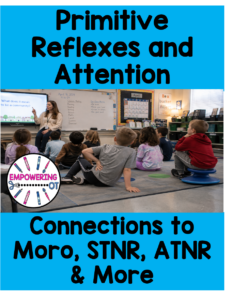
Primitive Reflexes and Attention in the Classroom: What OTs, Teachers & Parents Should Know
When a child has difficulty paying attention in the classroom, it is easy to focus on what we can see: fidgeting, looking around the room, changing positions, getting out of the chair, putting their head down, or losing their place during work.
But attention is not a single skill.
A child is also managing their body position, sensory environment, visual information, movement needs, emotional state, task demands, and the effort required to stay physically comfortable while learning.
For some children, retained primitive reflex patterns may be one factor worth considering within this larger picture.
Primitive reflexes are automatic movement responses that support early development. As the nervous system matures, children typically gain greater voluntary control over movement and these early reflex patterns become less dominant.
When reflex-related movement patterns continue to influence posture, coordination, or responses to sensory input, certain classroom tasks may require additional effort. That extra effort can sometimes look like an attention problem.
Importantly, retained primitive reflexes do not explain every attention difference, and difficulty paying attention does not mean that a child has retained reflexes.
The more useful question is:
What is making it difficult for this child to access, engage with, or sustain attention during this particular task?
Attention Requires More Than “Sitting Still”
We often associate classroom attention with sitting quietly, looking toward the teacher, and keeping the body still.
But children can attend in many different ways.
Some children listen better while moving. Others doodle, manipulate a quiet fidget, change positions, stand, or look away while processing information.
Rather than using stillness or eye contact as the measure of attention, consider whether the child is accessing the information and participating in the task.
At the same time, some children genuinely expend significant effort simply maintaining their body position during classroom activities.
Imagine trying to listen to a lesson while your chair feels uncomfortable, your body constantly wants to reposition, maintaining an upright posture requires conscious effort, and every unexpected noise pulls your attention away.
There may simply be fewer resources left for the academic task.
This is where looking at movement, posture, regulation, sensory processing, and reflex-related patterns together can provide useful information.
Moro Reflex: Startle, Arousal & Classroom Regulation
The Moro Reflex is an early protective startle response to sudden changes in sensory input or body position.
During infancy, this response serves an important protective purpose. As development progresses, children typically become better able to respond to unexpected sensory information without a whole-body reflexive response.
For a child demonstrating signs consistent with a retained Moro pattern, busy or unpredictable environments may require additional regulatory effort.
A classroom contains plenty of unexpected sensory information:
- Chairs scraping across the floor
- Bells and announcements
- Students talking
- People walking nearby
- Sudden transitions
- Objects dropping
- Unexpected touch
- Changes in routine
What might you notice?
A child may:
- Startle easily
- Look up whenever something happens in the room
- Have difficulty returning to a task after an interruption
- Become overwhelmed in noisy or busy environments
- Rush through challenging work
- Need additional recovery time after unexpected events
- Appear constantly alert to what is happening around them
A child who is monitoring the environment is not necessarily choosing not to pay attention. Their nervous system may be allocating resources to processing what is happening around them.
This is also why reducing unnecessary sensory demands can sometimes improve classroom participation more effectively than repeatedly reminding a child to focus.
STNR: Posture, Movement & Seated Attention
The Symmetrical Tonic Neck Reflex (STNR) involves a relationship between head position and movements of the arms and legs. It supports an infant’s transition toward hands-and-knees positioning and crawling.
Because STNR involves coordination between the head, upper body, and lower body, retained patterns may be considered when a child consistently struggles with seated posture.
In the classroom, you might notice:
- Slumping at the desk
- Propping the head on the hands
- Frequently changing positions
- Tucking the legs underneath the body
- Extending the legs away from the chair
- Moving very close to the desk
- Difficulty maintaining an efficient position during tabletop work
- Increasing restlessness as seated tasks continue
These behaviors can easily be interpreted as “not sitting still.”
But sitting still may actually be harder than it appears.
If maintaining an upright seated position requires substantial muscular or postural effort, changing position can be a practical way for the child to remain comfortable and continue participating.
Rather than repeatedly correcting posture, consider whether the child needs better positioning, foot support, alternative seating positions, movement opportunities, or a change in task demands.
ATNR: Head Movement, Visual Attention & Desk Work
The Asymmetrical Tonic Neck Reflex (ATNR) creates an early relationship between head turning and movements of the arms and legs.
As voluntary motor control develops, children become increasingly able to turn the head while keeping the arms and body working independently.
This independence is important during many classroom activities.
Consider copying from the board.
A student may need to:
Look toward the board → locate information → remember it → turn back toward the paper → find the correct place → write → repeat.
This requires visual attention, working memory, postural stability, eye-head coordination, and coordinated hand movements.
When ATNR-related patterns are suspected, you might notice:
- Difficulty crossing midline
- Turning the entire body when looking to the side
- Losing place when copying
- Frequently repositioning the paper
- Difficulty coordinating the helper hand
- Switching hands during tasks
- Reduced efficiency when looking between different locations
- Avoidance of tasks requiring repeated visual shifts
What looks like poor attention may sometimes reflect how demanding the visual-motor task itself has become.
TLR: Postural Control, Balance & Mental Effort
The Tonic Labyrinthine Reflex (TLR) is associated with early flexion and extension patterns and the body’s response to head position relative to gravity.
Postural control allows a child to maintain and adjust body position without consciously thinking about every movement.
When postural stability requires substantial effort, the child may have fewer resources available for academic tasks.
You might notice:
- Leaning heavily against furniture
- Slumping during seated activities
- Difficulty maintaining an upright head position
- Fatigue during longer lessons
- Frequently changing position
- Seeking additional physical support
- Avoiding activities requiring sustained posture
Instead of viewing posture as separate from attention, consider how much effort the body is using simply to stay ready for the task.
Providing appropriate positioning, opportunities for movement, and alternative working positions can reduce unnecessary physical demands.
Spinal Galant: Movement, Seating & Distraction
The Spinal Galant Reflex is an early infant reflex involving movement of the trunk in response to stimulation along the side of the lower back.
When signs consistent with retained Spinal Galant patterns are present, some children may appear particularly sensitive to tactile input or positioning around the waist or lower back.
In the classroom, you might notice:
- Frequent squirming or shifting in the chair
- Discomfort with certain waistbands or clothing
- Difficulty remaining comfortable against the back of a chair
- Frequent repositioning
- Preference for alternative seating positions
- Increased movement during longer seated activities
Again, movement itself is not necessarily a problem.
Sometimes movement is the child’s solution to discomfort.
Before asking a child to stop moving, it can be useful to ask:
What is the movement helping the child accomplish?
Could It Be Something Other Than Primitive Reflexes?
Absolutely.
Difficulty sustaining attention can be related to many factors, including:
- Task difficulty
- Sensory processing differences
- Executive functioning
- ADHD
- Anxiety or stress
- Learning differences
- Sleep
- Hunger
- Visual demands
- Motor demands
- Communication needs
- Environmental distractions
- Lack of movement
- Interest and motivation
- Unclear expectations
- A mismatch between the activity and the child’s developmental needs
This is why observing a behavior and immediately assigning it to a particular reflex can be misleading.
Fidgeting does not equal retained STNR.
Startling does not equal retained Moro.
Difficulty copying does not equal retained ATNR.
These observations are pieces of information that may help guide further assessment.
Look at When Attention Breaks Down
One of the most useful things adults can do is observe patterns.
Instead of asking only whether a child “has trouble paying attention,” ask:
When is attention easiest?
When does it become harder?
A child who participates well during hands-on science but struggles during 30 minutes of seated writing may need something different from a child who becomes overwhelmed whenever the classroom becomes noisy.
Notice whether attention changes with:
- Sitting versus standing
- Morning versus afternoon
- Writing versus listening
- Independent versus group work
- Quiet versus noisy environments
- Short versus extended tasks
- Near-copying versus copying from the board
- Before versus after movement
- Familiar versus unfamiliar activities
These patterns often provide more useful information than simply measuring how long a child remains seated.
Classroom Supports That Can Help
Children do not need to wait for a reflex assessment before adults make the classroom more accessible.
Depending on the child, helpful supports may include:
- Regular opportunities for movement
- Standing or alternative working positions
- Appropriate chair and desk height
- Foot support when needed
- Shorter work periods with breaks
- Reduced visual clutter
- Access to quieter workspaces
- Clear visual directions
- Breaking longer assignments into manageable sections
- Opportunities for pushing, pulling, carrying, or other whole-body movement
- Flexible positioning during instruction
- Reducing unnecessary copying demands
These supports are not rewards for completing work.
They are tools that can help children access and participate in learning.
A Play-Based Approach to Reflex Integration
When reflex-related movement patterns are identified as one area of need, intervention does not have to consist of repetitive drills.
Movement can be incorporated into:
- Obstacle courses
- Playground activities
- Animal walks
- Ball games
- Crawling games
- Pretend play
- Yoga-inspired movement
- Classroom movement breaks
- Heavy-work activities
- Rhythm and movement games
- Everyday home routines
Activities should be developmentally appropriate, responsive to the child’s cues, adaptable, and connected to meaningful participation.
A child should not be forced to perform uncomfortable movements simply because a retained reflex is suspected.
The goal is not perfect performance of a reflex exercise.
The goal is helping the child develop the movement, regulation, and participation skills they need in everyday life.
Looking for Primitive Reflex Integration Activities?
If you are an occupational therapist, educator, or parent looking for practical ways to incorporate reflex-related movement into play and everyday activities, my Primitive Reflex Integration Activity Packets provide visual, play-based ideas that can be incorporated into therapy sessions, movement breaks, home routines, and play.
Individual resources are available for:
Moro • ATNR • STNR • TLR • Palmar • Plantar • Babinski • Spinal Galant • Rooting • Suck • Landau • Perez
Choose an individual reflex packet when you are focusing on a particular reflex, or explore the Primitive Reflex Integration Bundle for activities and educational resources across multiple reflexes.
The Bottom Line
Attention is not simply a child’s ability to sit still and look toward an adult.
It depends on the interaction between the brain, body, environment, sensory experiences, task demands, regulation, and movement.
For some children, retained primitive reflex patterns may be one consideration within that larger picture. For others, completely different factors may better explain what adults are observing.
Rather than asking:
“Why won’t this child pay attention?”
Try asking:
“What is this child’s body telling us about what they need to access and participate in this activity?”
That shift can lead to supports that are more functional, respectful, and useful for the child.
The Reflex Integration Bundle Toolkit: Making It Easy for Therapists, Teachers & Parents
If you’re looking for a complete, play-based reflex integration program, the Reflex Integration Bundle Toolkit is your go-to solution. Created by an occupational therapist, this resource is designed for real-life use at home, in the classroom, or during therapy.
✨ What’s Inside This All-in-One Reflex Toolkit:
- ✅ 44 handouts explaining how each primitive reflex impacts movement, learning, and sensory/emotional development
- ✅ 12 themed exercise packets with over 320 play-based activities targeting every major reflex
- ✅ Black-and-white printable visuals for daily use—perfect for visual schedules and classroom routines
- ✅ Built-in regulation strategies and explanations for why each movement helps
- ✅ Designed for all developmental levels and sensory profiles
- ✅ Perfect for school-based OT, early intervention, home programs, and classroom supports
This toolkit is more than just exercises—it’s a holistic system for supporting regulation, body awareness, and developmental readiness through joyful movement.
✅ Ready to support your child or student with reflex integration? Explore the Reflex Integration Bundle Toolkit here.
primitive reflexes and attention, retained primitive reflexes, retained reflexes and attention, primitive reflexes in the classroom, primitive reflex integration, primitive reflex integration exercises, primitive reflex activities for kids, occupational therapy primitive reflexes, Moro reflex and attention, STNR and attention, ATNR and attention, TLR and attention, Spinal Galant reflex, classroom attention strategies, primitive reflexes in children