

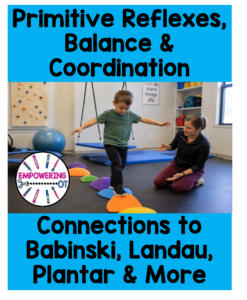
Primitive Reflexes and Balance & Coordination: What OTs, Teachers & Parents Should Know
Running across the playground. Walking up stairs. Catching a ball. Riding a bike. Navigating a crowded classroom. Stepping over a curb. Getting dressed while standing.
Balance and coordination are involved in countless everyday activities.
When these skills are difficult, a child may appear clumsy, cautious, hesitant, or constantly on the move. They may avoid playground equipment, struggle with sports, bump into objects, use more support than expected on stairs, or have difficulty coordinating both sides of the body.
Occupational therapists look at many factors when trying to understand these challenges, including postural control, strength, vestibular processing, proprioception, vision, motor planning, bilateral coordination, body awareness, and the demands of the activity itself.
Primitive reflex patterns may be one additional piece of that larger picture.
Primitive reflexes are automatic movement responses that support early development. As children mature and develop increasingly voluntary motor control, these early patterns typically become less dominant.
When reflex-related patterns continue to strongly influence movement, some children may have to work harder to maintain balance, coordinate different parts of the body, or adjust their posture during movement.
Importantly, difficulty with balance or coordination does not automatically indicate retained primitive reflexes.
The goal is not to explain every motor challenge through reflexes.
The goal is to understand:
What does this child need to move through their world more comfortably, confidently, and successfully?
✅ Ready to support your child or student with reflex integration with over 300 exercises? Explore the Reflex Integration Bundle Toolkit here.
Balance Is More Than Standing on One Foot
Balance depends on multiple systems working together.
The brain receives and organizes information from the vestibular, visual, and proprioceptive systems while the muscles and joints continually make small adjustments to keep the body stable.
Children use balance when they:
- Sit upright in a chair
- Walk across uneven ground
- Climb playground equipment
- Step over obstacles
- Bend down and stand back up
- Reach outside their base of support
- Walk up and down stairs
- Kick a ball
- Get dressed while standing
- Move through crowded environments
Balance is not a static skill. It requires the body to continually adapt to movement, gravity, surfaces, and changing positions.
What Do We Mean by Coordination?
Coordination is the ability to organize different parts of the body so they work together effectively.
This may include:
Bilateral coordination: using both sides of the body together.
Crossing midline: reaching across the center of the body.
Eye-hand coordination: using visual information to guide movement.
Motor planning: figuring out how to begin, sequence, and adjust a movement.
Postural coordination: stabilizing one part of the body while another part moves.
A child can have strengths in one area of coordination while finding another much more difficult.
This is one reason it is important to look at specific activities and movement patterns, rather than simply describing a child as “uncoordinated.”
TLR: Gravity, Postural Control & Balance
The Tonic Labyrinthine Reflex (TLR) is associated with the body’s early responses to head position relative to gravity and with flexion and extension patterns.
As children develop, they gain increasingly refined control over their head and body while moving against gravity.
Because of this connection, TLR-related patterns may be considered when a child has difficulty with postural control, balance, or maintaining body position during movement.
You might notice:
- Difficulty maintaining upright posture
- Frequent loss of balance
- Cautious movement on uneven surfaces
- Difficulty moving between floor and standing positions
- Reduced confidence with climbing
- Challenges with activities requiring the head to change position
- Using extra support during balance activities
- Difficulty maintaining stability while reaching or moving
A child may also appear more comfortable when their body has a large, stable base of support rather than when balance demands increase.
Supporting balance should not mean repeatedly placing a child in situations where they feel unsafe.
Gradual, predictable, and child-led movement experiences can provide opportunities to explore changes in body position while maintaining a sense of control.
ATNR: Crossing Midline & Coordinating Both Sides
The Asymmetrical Tonic Neck Reflex (ATNR) creates an early relationship between head turning and movement of the arms and legs.
As voluntary motor control develops, children become increasingly able to turn the head while moving the arms and legs independently.
This separation is useful during many coordinated activities.
Think about throwing a ball.
The child may turn their head toward the target while the trunk rotates, one arm prepares to throw, the opposite side helps stabilize, and the legs adjust to maintain balance.
That requires multiple parts of the body to perform different jobs at the same time.
When ATNR-related patterns are suspected, you might notice:
- Difficulty crossing midline
- Avoiding reaching across the body
- Turning the entire body instead of rotating through the trunk
- Difficulty coordinating opposite sides of the body
- Challenges with throwing or catching
- Difficulty with activities requiring rotation
- Frequently switching hands during tasks
- Reduced fluidity during bilateral movement
These observations do not confirm retained ATNR, but they can provide useful information about how the child organizes movement.
STNR: Upper- and Lower-Body Coordination
The Symmetrical Tonic Neck Reflex (STNR) supports an infant’s transition toward hands-and-knees positioning and crawling.
It involves a relationship between head position and movement of the upper and lower body.
As motor control develops, children become increasingly able to move the head, arms, trunk, and legs independently while still coordinating them as needed.
You might notice:
- Difficulty maintaining hands-and-knees positions
- Challenges with crawling patterns
- Difficulty coordinating the upper and lower body
- Awkward transitions between positions
- Difficulty with activities requiring the arms and legs to perform different actions
- Reduced postural stability during movement
- Challenges maintaining balance while looking up or down
Activities involving crawling, climbing, obstacle courses, and varied movement positions can provide opportunities to develop coordination without making movement feel like a test.
Landau Reflex: Extension & Postural Development
The Landau Reflex is a developmental reflex associated with extension and postural control during infancy.
When an infant is supported horizontally, the head, trunk, and legs typically extend against gravity.
This developmental pattern contributes to experiences that support head control, trunk extension, and postural development.
Because of this relationship, Landau may be considered as part of a broader look at postural control and whole-body movement.
You might notice difficulties with:
- Maintaining trunk extension
- Holding the head upright during movement
- Coordinating the upper and lower body
- Activities requiring sustained postural control
- Moving efficiently against gravity
- Maintaining stability during gross motor activities
Rather than practicing extension in isolation, children can experience these movement patterns through climbing, reaching, prone play, scooter activities, obstacle courses, and imaginative movement games.
Plantar Reflex: The Feet as a Foundation
✅ Ready to support your child or student with reflex integration with over 300 exercises? Explore the Reflex Integration Bundle Toolkit here.
The Plantar Grasp Reflex is an early reflex involving the toes in response to stimulation of the sole of the foot.
As development progresses, the feet become an increasingly important stable and adaptable base for standing, walking, running, jumping, and balance.
When considering a child’s balance, it can be useful to remember that the feet provide both sensory information and physical support.
You might notice:
- Toe gripping during standing activities
- Difficulty maintaining a stable base of support
- Challenges balancing barefoot
- Frequent changes in foot position
- Difficulty adapting to uneven surfaces
- Reduced confidence during standing balance activities
Foot position can be influenced by many factors, including strength, joint mobility, footwear, sensory preferences, orthopedic differences, and motor control. Toe gripping alone does not indicate a retained reflex.
Babinski Response: Early Foot Development & Movement
The Babinski response is a normal neurological response during infancy in which stimulation along the sole of the foot produces extension of the big toe and spreading of the other toes.
As the nervous system matures, the typical response changes.
Because the Babinski response is also used clinically as part of a neurological examination, it is especially important not to interpret a child’s balance difficulties or foot movements as evidence of an abnormal Babinski response without appropriate clinical assessment.
From a functional movement perspective, occupational therapy may still incorporate activities that encourage foot awareness, varied sensory experiences, balance, weight shifting, and coordinated lower-body movement.
These skills can support children’s participation in everyday gross motor activities without suggesting that a play activity is diagnosing or treating a neurological sign.
Spinal Galant: Trunk Movement & Body Awareness
The Spinal Galant Reflex is an early infant reflex involving movement of the trunk in response to stimulation along the side of the lower back.
The ability to intentionally rotate, stabilize, and adjust the trunk later becomes important during many gross motor activities.
You might notice:
- Difficulty with controlled trunk rotation
- Frequent shifting during movement activities
- Challenges stabilizing the trunk while the arms or legs move
- Difficulty coordinating side-to-side movements
- Reduced body awareness during whole-body activities
- Preference for movement patterns that require less trunk control
Activities involving reaching, twisting, climbing, crawling, rolling, and navigating obstacles can provide varied opportunities for trunk movement during play.
What Might Balance & Coordination Challenges Look Like in Everyday Life?
Motor differences do not always show up during formal balance activities.
They may be much easier to notice during everyday routines.
A child might:
- Hold the railing with two hands on stairs
- Avoid climbing playground equipment
- Frequently trip or bump into objects
- Struggle to keep up during playground games
- Have difficulty catching or kicking a ball
- Avoid riding a scooter or bicycle
- Sit down to put on pants when peers stand
- Use furniture for support when moving around
- Move cautiously on grass, sand, or uneven ground
- Struggle with jumping sequences
- Have difficulty learning new motor activities
- Prefer activities with fewer balance demands
None of these automatically indicate retained primitive reflexes.
They tell us that the activity may be requiring more from the child than we realize.
Could Something Else Be Affecting Balance or Coordination?
Yes.
Balance and coordination can be influenced by many factors, including:
- Muscle strength
- Joint stability
- Vestibular processing
- Proprioception
- Vision
- Motor planning
- Bilateral coordination
- Body awareness
- Orthopedic differences
- Neurological conditions
- Developmental differences
- Fatigue
- Sensory preferences
- Experience and opportunities for movement
- Fear or uncertainty during particular activities
This is why primitive reflexes should be considered as one possible piece of a comprehensive assessment, not as a stand-alone explanation for motor challenges.
Supporting Balance & Coordination Through Play
Children develop motor skills through varied movement experiences.
Depending on the child’s abilities, interests, and comfort level, activities might include:
- Navigating obstacle courses
- Walking along pathways or taped lines
- Stepping over objects
- Crawling through tunnels
- Climbing playground equipment
- Playing catch
- Kicking or rolling balls
- Riding scooters
- Reaching in different directions
- Moving between floor and standing positions
- Dancing and action songs
- Animal walks
- Carrying objects while walking
- Exploring different safe surfaces
- Playing games that involve stopping, starting, and changing direction
Activities can be made easier or harder by changing the surface, speed, amount of support, size of the movement, or number of steps involved.
The goal is not to make a child lose their balance.
The goal is to provide successful opportunities to explore and adapt to movement.
A Play-Based Approach to Primitive Reflex Integration
When reflex-related movement patterns are identified as relevant to a child’s functional needs, intervention can be incorporated into meaningful movement rather than relying only on repetitive exercises.
Children can experience flexion, extension, rotation, bilateral coordination, weight shifting, crawling, balance, and changes in head position through play.
Activities should be:
- Developmentally appropriate
- Adaptable to different abilities
- Responsive to the child’s cues
- Connected to meaningful goals
- Comfortable and emotionally safe
- Playful whenever possible
Children should not be forced to complete movements simply because a reflex is suspected.
Participation remains the goal.
Looking for Primitive Reflex Integration Activities?
If you are an occupational therapist, educator, or parent looking for practical ways to incorporate reflex-related movement into play, my Primitive Reflex Integration Activity Packets provide visual, play-based activities that can be used during therapy, school movement activities, home routines, and play.
Individual resources are available for:
Moro • ATNR • STNR • TLR • Palmar • Plantar • Babinski • Spinal Galant • Rooting • Suck • Landau • Perez
Choose an individual packet when you are focusing on a specific reflex, or explore the Primitive Reflex Integration Bundle for activities and educational resources across multiple reflexes.
The Bottom Line
Balance and coordination develop through the interaction of many systems.
Postural control, sensory processing, vision, strength, motor planning, body awareness, bilateral coordination, experience, and developmental movement patterns all contribute to how a child moves through the world.
Retained primitive reflex patterns may be one consideration when a child is experiencing motor challenges, but they should never become the only explanation.
Instead of asking:
“Which reflex is making this child uncoordinated?”
Ask:
“What is making this movement challenging, and what support would help this child participate successfully?”
That question keeps the focus where it belongs: on the child’s function, participation, confidence, and access to meaningful movement experiences.
The Reflex Integration Bundle Toolkit: Making It Easy for Therapists, Teachers & Parents
If you’re looking for a complete, play-based reflex integration program, the Reflex Integration Bundle Toolkit is your go-to solution. Created by an occupational therapist, this resource is designed for real-life use at home, in the classroom, or during therapy.
✨ What’s Inside This All-in-One Reflex Toolkit:
- ✅ 44 handouts explaining how each primitive reflex impacts movement, learning, and sensory/emotional development
- ✅ 12 themed exercise packets with over 320 play-based activities targeting every major reflex
- ✅ Black-and-white printable visuals for daily use—perfect for visual schedules and classroom routines
- ✅ Built-in regulation strategies and explanations for why each movement helps
- ✅ Designed for all developmental levels and sensory profiles
- ✅ Perfect for school-based OT, early intervention, home programs, and classroom supports
This toolkit is more than just exercises—it’s a holistic system for supporting regulation, body awareness, and developmental readiness through joyful movement.
✅ Ready to support your child or student with reflex integration? Explore the Reflex Integration Bundle Toolkit here.
primitive reflexes and balance, primitive reflexes and coordination, retained primitive reflexes, retained reflexes and balance, primitive reflex integration, primitive reflex integration exercises, primitive reflex activities for kids, balance and coordination in children, occupational therapy balance activities, TLR reflex and balance, ATNR and coordination, STNR and coordination, Landau reflex, plantar reflex and balance, primitive reflexes occupational therapy



2 Comments