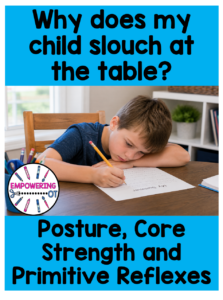
Why does my child slouch at the table? It’s a question many parents, teachers, and occupational therapists ask when a child constantly leans on the desk, rests their head on one hand, slides down in the chair, or changes positions during writing and other tabletop activities.
You may remind the child to “sit up straight,” only to find them leaning over the table again a few minutes later.
While slouching is sometimes viewed as a bad habit, maintaining an upright sitting position actually requires a lot from the body. Postural control, core stability, muscle endurance, balance, body awareness, sensory processing, and motor control all work together to help a child sit comfortably and use their hands at the same time.
For some children, early movement patterns, including primitive reflexes, may also be one part of the larger developmental picture.
So when a child slouches at the table, instead of only asking, “Why won’t they sit up?” it may be more useful to ask:
“What is making this position difficult to maintain?”
Why Does My Child Slouch at the Table?
There isn’t one single reason a child may slouch, lean on the desk, or frequently change positions.
Possible factors include:
- Postural endurance
- Core stability
- Muscle tone
- Balance
- Body awareness
- Sensory needs
- A need for movement
- Fatigue
- Motor control
- Motor planning
- Attention
- Visual demands
- Physical discomfort
- Poorly fitting furniture
- The length or difficulty of the activity
- Early motor patterns, including primitive reflexes
It is also important to remember that children don’t need to maintain perfect posture all day.
Children naturally move, wiggle, lean, stand, and reposition themselves. For some children, changing positions actually helps them remain comfortable and engaged.
The concern isn’t whether a child’s sitting posture looks perfect.
A more useful question is whether their posture is interfering with comfort, endurance, handwriting, fine motor skills, learning, or participation in everyday activities.
Signs Sitting Upright May Require Extra Effort
A child who has difficulty maintaining an upright seated position may show more than just slouching.
You might notice that the child:
- Leans heavily on the desk or table
- Props their head on one hand
- Frequently puts their head down on the desk
- Slides forward in the chair
- Wraps their feet around the chair legs
- Tucks one or both legs underneath their body
- Hooks their feet behind the chair
- Constantly changes positions
- Moves very close to the paper
- Uses one arm to support their body while working
- Avoids longer tabletop activities
- Complains of feeling tired during writing
- Has difficulty keeping the head upright
- Prefers working on the floor
- Frequently gets out of the chair
- Becomes increasingly restless during longer seated activities
These positions aren’t necessarily “bad.”
In fact, they may tell us something important about what the child’s body needs.
For example, leaning the trunk against a table provides additional external support. Propping the head on one hand reduces some of the muscular work required to keep the head upright. Tucking the legs underneath the body changes the child’s base of support.
Rather than immediately correcting the position, consider asking:
What is this position doing for the child?
What Is Postural Control in Children?
Postural control is the ability to maintain and adjust the body’s position while sitting, standing, moving, or completing an activity.
Good postural control doesn’t mean sitting rigidly upright.
In fact, the body makes constant small adjustments to maintain stability while allowing movement.
Think about everything a child has to do while writing at a desk.
The child needs to:
- Stabilize the trunk
- Maintain the head in a functional position
- Move the writing arm
- Stabilize the paper with the opposite hand
- Look down at the paper
- Look back toward a teacher or board
- Reach for supplies
- Move the eyes across the page
- Manipulate a pencil
- Plan what to write
- Listen to directions
- Maintain attention
That’s a lot happening simultaneously.
Ideally, maintaining the seated position happens relatively automatically.
If a child has to use significant effort simply to keep the body upright, there may be less energy available for handwriting, fine motor control, attention, and learning.
This may help explain why a child who slouches at the table often does so even more as a writing or tabletop activity continues.
Does Slouching Mean My Child Has a Weak Core?
This is one of the most common questions parents ask about poor sitting posture.
When a child constantly leans on the desk, adults often assume:
“They need a stronger core.”
Sometimes strength and endurance are part of the picture.
But posture is more complicated than abdominal strength alone.
Postural stability requires coordinated activity throughout the:
- Trunk
- Back
- Shoulders
- Neck
- Pelvis
- Hips
- Legs
- Feet
The sensory systems also contribute.
The vestibular system provides information related to movement, balance, and head position. Proprioception provides information about body position and force. Vision provides additional information about the body and environment.
The nervous system continually combines this information to make small adjustments to the body’s position.
That’s why it can be more helpful to think about postural control and postural endurance, rather than simply labeling a child as having a “weak core.”
A child may even be able to complete challenging strengthening activities for a short period but still have difficulty maintaining an efficient seated position throughout a longer classroom assignment.
Why Does My Child Lean on the Desk While Writing?
Writing is one of the times parents and teachers may notice poor sitting posture most often.
That’s because handwriting is not just a hand skill.
The child needs a stable but adaptable base so that the shoulder, arm, wrist, and fingers can move efficiently.
A child who is working hard to maintain their body position may:
- Lean heavily on the writing arm
- Prop their head with the opposite hand
- Move very close to the paper
- Hold the pencil tightly
- Frequently stop writing
- Change positions
- Complain that their hand or body feels tired
- Show decreasing handwriting quality as the task continues
- Avoid longer writing activities
This doesn’t necessarily mean posture is causing the handwriting difficulty. Handwriting is complex and can be influenced by many different factors.
However, posture is one important part of the bigger picture.
You can learn more in Retained Primitive Reflexes and Handwriting: An OT Guide.
How Posture Affects Fine Motor Skills
Postural stability can also influence many activities beyond handwriting.
Children use their hands for:
- Cutting with scissors
- Coloring
- Drawing
- Building
- Manipulating small toys
- Completing puzzles
- Buttoning
- Using utensils
- Crafts
- Keyboarding
- Managing school supplies
One way to think about this relationship is to imagine a crane.
The moving arm of the crane works more efficiently when the base underneath it is stable.
Fine motor skills work in a similar way. The hands are performing small, precise movements while the larger parts of the body provide a stable foundation.
That doesn’t mean the child’s body needs to remain perfectly still. Instead, the child needs enough stability to allow controlled movement where it is needed.
Read more about this connection in Primitive Reflexes and Fine Motor Skills: Could Retained Reflexes Affect Hand Skills?.
Could Primitive Reflexes Affect Sitting Posture?
Primitive reflexes are automatic movement responses that are present during infancy and support early development.
As babies develop and gain increasingly voluntary control over their bodies, these early reflex patterns typically become less dominant.
If you’re new to this topic, start with What Is Reflex Integration? A Parent, Therapist & Educator’s Guide.
It is important to be clear:
A child who slouches at the table does not automatically have retained primitive reflexes.
Poor posture can have many different causes, and primitive reflexes should never be used as the sole explanation for a child’s postural difficulties.
However, if a child demonstrates persistent difficulties with posture along with challenges involving balance, coordination, bilateral coordination, handwriting, fine motor skills, visual-motor skills, motor planning, or body awareness, primitive reflex patterns may be one factor considered as part of a broader occupational therapy assessment.
Several early reflex patterns are particularly relevant when considering posture.
STNR and Sitting Posture
The Symmetrical Tonic Neck Reflex (STNR) is an early movement pattern involving a relationship between head position and movements of the arms and legs.
STNR supports the developmental transition toward hands-and-knees positioning and crawling.
As children develop, they gain greater independence between movements of the head, upper body, and lower body.
That independence is important during desk work.
Think about how often a child needs to look down at a worksheet, look up at the teacher, move the arms, reposition the legs, and maintain the trunk—all without one movement significantly disrupting another.
When STNR-related patterns continue to strongly influence movement, seated tasks may require additional effort.
You might notice:
- Slouching at the desk
- Frequent changes in leg position
- Legs extending away from the chair
- Legs tucked underneath the body
- Head propped on the hands
- Difficulty maintaining an upright seated position
- Restlessness during desk work
- Difficulty shifting between looking up and looking down
- Reduced endurance during handwriting
- Difficulty coordinating the upper and lower body
This does not mean that STNR is the reason every child slouches.
Instead, look at the larger pattern of movement and function.
You can learn more in Symmetrical Tonic Neck Reflex (STNR) Integration and Posture.
You may also find Primitive Reflexes and Attention in the Classroom helpful when looking at the relationship between movement, posture, and classroom participation.
STNR Activities
My STNR Reflex Integration Activity Packet includes 35 play-based activities targeting head-body coordination, postural alignment, upper- and lower-body coordination, flexion and extension, and functional movement.
TLR, Gravity, and Postural Control
The Tonic Labyrinthine Reflex (TLR) is another primitive reflex that may be considered when looking at posture.
TLR is associated with early flexion and extension patterns and the body’s developing relationship with gravity.
This makes TLR relevant when considering:
- Head control
- Balance
- Body awareness
- Muscle tone
- Flexion and extension
- Movement against gravity
- Postural stability
A child who has difficulty efficiently maintaining their body against gravity may seek additional external support.
You might notice the child:
- Slumping in the chair
- Leaning against furniture
- Propping their head
- Frequently changing positions
- Demonstrating reduced sitting endurance
- Having difficulty with balance
- Avoiding activities requiring sustained postural control
These observations alone don’t tell us that a child has a retained TLR.
They are simply pieces of information that can be considered alongside the child’s overall movement and participation.
Landau Reflex and Postural Extension
The Landau reflex is another early movement pattern associated with postural development.
It involves head control, spinal extension, and coordination between different parts of the body.
Postural extension is important because children need to work against gravity to maintain the head and trunk during seated and movement activities.
When a child frequently collapses into a slumped position, an occupational therapist may consider the child’s ability to:
- Maintain trunk extension
- Keep the head upright
- Coordinate the upper and lower body
- Sustain positions against gravity
- Transition between flexed and extended positions
- Maintain posture while using the hands
Again, a child who slouches does not automatically have a retained Landau reflex. It is one potential component of a much larger developmental picture.
My Landau Reflex Integration Activity Packet includes 35 whole-body activities addressing postural control, core strength, extension, body awareness, and coordination.
Posture, Attention, and Classroom Participation
Sometimes a child leaning on the desk or putting their head down is interpreted as:
“They’re not paying attention.”
But body position and attention aren’t always separate issues.
Imagine trying to listen to a lesson while simultaneously using significant effort to maintain your body position.
Some children may shift, lean, stand, or move because these strategies help them remain comfortable enough to continue participating.
Instead of automatically assuming:
“This child isn’t paying attention.”
Consider:
“How much effort is this child using just to maintain this position?”
Read more in Primitive Reflexes and Attention in the Classroom: An OT Guide.
Posture and Motor Planning
Postural control also contributes to motor planning—the ability to figure out, organize, and carry out movement.
Before children can efficiently plan a movement, they need information about where their bodies are and how they are positioned.
Think about activities such as:
- Climbing
- Crawling
- Navigating playground equipment
- Riding a bike
- Getting dressed
- Using scissors
- Playing sports
- Completing an obstacle course
The child has to stabilize and adjust the body while simultaneously figuring out what movement comes next.
If maintaining balance or posture already requires significant effort, planning a new movement may become more challenging.
Learn more in Primitive Reflexes and Motor Planning: Understanding the Connection.
Why Doesn’t “Sit Up Straight” Fix the Problem?
Imagine this:
A child is leaning over the desk.
You say:
“Sit up straight.”
The child immediately sits upright.
A minute later, the child is leaning over the desk again.
This tells us something important.
The child understood the direction.
They were capable of assuming an upright position.
But something made it difficult or uncomfortable to maintain.
Repeated verbal reminders don’t necessarily address:
- Postural endurance
- Furniture positioning
- Foot support
- Fatigue
- Sensory needs
- Movement needs
- Motor control
- Task demands
- Task length
If your child slouches at the table almost immediately after being reminded to sit upright, consider looking beyond behavior.
Check the Chair and Table First
Before assuming that slouching reflects a developmental concern, look at the child’s environment.
Does the furniture actually fit?
This can be particularly important in classrooms, where children of different heights may use similar desks and chairs.
A child’s feet dangling well above the floor may make it more difficult to maintain a stable seated position.
Consider whether the child has:
- A stable seat
- Appropriate back support when needed
- Feet supported by the floor or a footrest
- Enough room for the legs
- A table height that allows comfortable arm positioning
- Materials positioned within an easy viewing and reaching distance
Sometimes a relatively simple environmental accommodation makes a noticeable difference.
Providing support isn’t “cheating.”
If changing the environment allows a child to participate more comfortably and independently, that’s useful information.
Does Good Posture Mean Sitting Still?
No.
Good posture does not mean motionless posture.
Children naturally change positions throughout the day.
Some children may participate more effectively when allowed to:
- Stand while working
- Work on the floor
- Kneel at a low surface
- Change positions
- Take movement breaks
- Use alternative seating when appropriate
- Alternate between seated and movement activities
The goal shouldn’t be to create a classroom full of children sitting perfectly still.
The goal is participation.
A more useful question is:
Can this child comfortably access and participate in the activity?
Activities That Can Support Postural Control and Core Stability
Children develop postural control through movement, exploration, and play.
Supporting core stability doesn’t necessarily mean giving a child a formal “core workout.”
Movement activities can provide opportunities to stabilize the body, shift weight, work against gravity, balance, and coordinate different parts of the body.
Depending on the child’s interests, abilities, and comfort, activities might include:
- Crawling through tunnels
- Animal walks
- Playground climbing
- Scooter-board play
- Building forts
- Crawling over cushions
- Playing on hands and knees
- Reaching outside the base of support
- Rolling
- Dancing
- Swimming
- Playing catch
- Obstacle courses
- Yoga-inspired movement
- Playing while lying on the stomach
- Kneeling at a low surface
- Pushing and pulling activities
- Carrying appropriate objects during play or daily routines
The goal isn’t perfect performance or repetitive drills.
Instead, provide varied opportunities for children to move, stabilize, shift weight, balance, reach, push, pull, crawl, and explore different body positions.
When Should I Be Concerned About My Child’s Slouching?
Occasional slouching is common.
If your child slouches at the table but comfortably participates in school, play, self-care, and other daily activities, the posture itself may not be a significant concern.
It may be worth looking more closely when slouching occurs alongside other difficulties or begins interfering with participation.
Consider talking with an occupational therapist, physical therapist, pediatrician, or another appropriate professional if you frequently notice:
- Significant fatigue during seated activities
- Difficulty maintaining the head or trunk upright
- Persistent slouching across environments
- Complaints of pain
- Difficulty with balance or coordination
- Significant handwriting difficulties
- Fine motor challenges
- Frequent falls
- Difficulty learning new movements
- Challenges with dressing or other self-care activities
- Avoidance of physical activity
- Difficulty participating in classroom tasks
An occupational therapy evaluation can look beyond what the child’s posture looks like and consider how the child is functioning during meaningful everyday activities.
Does Slouching Mean My Child Has Retained Primitive Reflexes?
No.
A child’s posture alone cannot tell us whether primitive reflexes are retained.
Many different factors can contribute to poor sitting posture.
Primitive reflex patterns may be worth considering when postural difficulties occur alongside a broader pattern involving:
- Balance
- Coordination
- Bilateral integration
- Crossing midline
- Fine motor skills
- Handwriting
- Visual-motor skills
- Motor planning
- Body awareness
- Sensory processing
If you’re interested in learning more about individual primitive reflexes and some of the observations that may be associated with them, read 12 Primitive Reflexes Every Parent and Educator Should Know — And the Red Flags to Watch For.
Primitive Reflex Activities for Posture and Movement
If primitive reflex patterns are relevant to a child’s occupational performance, support should still focus on the whole child.
Movement can be purposeful, playful, functional, and adaptable.
Movement experiences might incorporate:
- Crawling
- Rolling
- Weight shifting
- Balance
- Flexion and extension
- Reaching
- Bilateral movement
- Crossing midline
- Pushing and pulling
- Whole-body coordination
- Movement against gravity
These activities can support many of the underlying skills involved in posture, coordination, body awareness, and participation.
Looking for Ready-to-Use Primitive Reflex Activities?
My Primitive Reflex Integration Bundle Toolkit includes resources addressing 12 primitive reflexes along with educational handouts and hundreds of play-based movement activities.
It was designed to give occupational therapists, educators, parents, and caregivers practical ways to incorporate movement experiences into therapy, school routines, home activities, and play.
You can also explore individual reflex resources, including:
STNR Reflex Integration Activity Packet
Landau Reflex Integration Activity Packet
Frequently Asked Questions About Children Who Slouch at the Table
Why does my child slouch at the table?
A child may slouch at the table for many reasons, including postural endurance, core stability, fatigue, furniture positioning, balance, body awareness, sensory or movement needs, motor control, or the demands of the activity. Occasional slouching is common. Persistent difficulties are more important to investigate when they interfere with comfort or participation.
Why does my child lean on the desk while writing?
Leaning on the desk provides additional external support. Some children may lean, prop their head, or change positions because maintaining an upright position while simultaneously writing requires additional effort.
Does slouching mean my child has a weak core?
Not necessarily. Core strength contributes to posture, but sitting also depends on postural control, endurance, balance, sensory information, body awareness, positioning, muscle tone, and environmental factors.
Can primitive reflexes affect a child’s posture?
Primitive reflex patterns may be one factor considered when a child has persistent postural difficulties along with other motor, balance, coordination, or functional concerns. However, posture alone cannot tell us whether a child has retained primitive reflexes.
Which primitive reflexes are associated with posture?
STNR may be considered when looking at coordination between the head, upper body, and lower body. TLR is related to early flexion and extension patterns and movement in relation to gravity. Landau is associated with postural extension and head-body control.
Why does my child put their head on the desk?
Children may put their heads on the desk because of fatigue, postural effort, sensory needs, task demands, attention, comfort, or other factors. Look at when the behavior occurs, how long the child has been sitting, whether the furniture fits, and whether other motor or functional concerns are present.
Should I keep telling my child to sit up straight?
Occasional cues may help, but if your child slouches at the table again almost immediately, consider why maintaining the position may be difficult. Check furniture fit, foot support, task length, fatigue, movement needs, comfort, and postural endurance.
Can occupational therapy help with poor sitting posture?
Occupational therapists can evaluate how posture, motor skills, sensory processing, fine motor abilities, visual-motor skills, environmental demands, and other factors affect a child’s participation in daily activities. Recommendations may include positioning strategies, accommodations, movement opportunities, motor activities, or other individualized supports.
The Bottom Line: Look Beyond the Slouch
If your child slouches at the table, it’s easy to focus on the posture you can see.
But posture may give us useful information about what is happening underneath.
Instead of repeatedly saying “Sit up straight,” consider asking:
Does the furniture fit?
Are the child’s feet supported?
How long has the child been sitting?
Is the child tired?
Would another position help?
Is maintaining this posture requiring significant effort?
Are there also difficulties with balance, coordination, handwriting, fine motor skills, or motor planning?
What support would make this activity easier?
For some children, primitive reflex patterns may be one piece of the larger picture. For others, they may not be relevant at all.
The goal isn’t perfect posture.
The goal is helping children develop the stability, movement options, accommodations, and support they need to comfortably participate in learning, play, self-care, and everyday life.
Continue Reading
Primitive Reflexes and Attention in the Classroom
Retained Primitive Reflexes and Handwriting
Primitive Reflexes and Fine Motor Skills
Primitive Reflexes and Motor Planning
12 Primitive Reflexes Every Parent and Educator Should Know
This article is for educational purposes and is not intended to diagnose retained primitive reflexes or replace individualized medical, developmental, physical therapy, or occupational therapy evaluation.