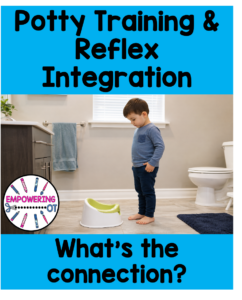
Retained primitive reflexes and potty training may seem like two completely different topics. However, toileting is a surprisingly complex developmental skill involving body awareness, interoception, sensory processing, posture, balance, motor planning, and coordination. For some children, difficulties in these underlying areas can make potty training much more challenging.
Potty training is often described as a simple developmental milestone: a child feels the urge to go, gets to the bathroom, manages their clothing, uses the toilet, and moves on with their day.
But for some children, toileting is much more complicated.
A child may not seem to notice when they need to go. They may wait until the very last second, have frequent accidents, avoid sitting on the toilet, struggle to manage their clothing, become uncomfortable with wiping, or have difficulty relaxing enough to have a bowel movement.
Parents may find themselves wondering:
Why is potty training so hard for my child?
There are many possible reasons for toileting difficulties, including developmental readiness, constipation, bladder or bowel concerns, sensory processing differences, interoception, motor skills, emotional factors, and environmental demands.
Another developmental factor that occupational therapists may consider as part of the larger picture is the presence of retained primitive reflexes.
So, can retained primitive reflexes affect potty training?
The answer requires some nuance.
Primitive reflexes should not be assumed to be the cause of toileting difficulties, and reflex integration should not replace medical evaluation or evidence-based treatment for bladder, bowel, or constipation concerns. However, some of the developmental skills involved in toileting, such as body awareness, postural control, movement, sensory processing, and motor coordination, overlap with areas sometimes discussed when evaluating retained primitive reflexes.
Let’s look at the connection.
What Are Primitive Reflexes?
Primitive reflexes are automatic movement responses that develop before or shortly after birth. They support an infant’s early survival, movement, feeding, protection, and neurological development.
As the nervous system matures, these early reflexive responses typically become less dominant and are gradually replaced by more intentional, voluntary movement.
Examples include:
- Moro Reflex – an early startle response to sudden sensory or movement changes
- ATNR (Asymmetrical Tonic Neck Reflex) – connects head turning with changes in arm and leg position
- STNR (Symmetrical Tonic Neck Reflex) – connects head position with upper- and lower-body movement
- TLR (Tonic Labyrinthine Reflex) – relates head position to patterns of whole-body flexion and extension
- Palmar Reflex – an early grasp response involving the hand
- Plantar Reflex – an early grasp-like response involving the foot and toes
- Babinski Reflex – an early neurological response of the toes to stimulation along the sole of the foot
- Spinal Galant Reflex – a trunk response to stimulation along the side of the spine
- Rooting Reflex – helps an infant orient toward touch around the mouth and supports early feeding
- Suck Reflex – supports early sucking and feeding
- Landau Reflex – a developmental postural response involving the head, trunk, and legs
- Perez Reflex – an early response associated with stimulation along the spine
When an early reflexive response continues to be easily triggered beyond the developmental period when it would typically become less prominent, it is often referred to as a retained primitive reflex.
A retained reflex does not automatically mean that something is wrong with a child. It is one piece of information that may be considered alongside the child’s functional skills, developmental history, sensory-motor abilities, environment, and participation in daily activities.
Want to learn more about how primitive reflexes may influence everyday skills? My Primitive Reflex Integration Toolkit includes educational handouts, screening information, functional examples, and activity ideas to help therapists and caregivers better understand retained primitive reflexes.
Why Is Potty Training Such a Complex Skill?
Using the toilet is an excellent example of a task that looks simple but actually requires many developmental systems to work together.
Successful toileting can involve:
Interoception
The child needs to recognize internal body signals associated with a filling bladder or bowel movement.
They eventually learn:
“My body feels this way → I need to use the bathroom.”
Some children notice these signals very early. Others recognize them only when the urge becomes extremely strong.
Postural Control
Sitting on a toilet requires enough stability to feel physically secure.
A child may need to maintain an upright position while also allowing the abdominal and pelvic floor muscles to function appropriately.
Balance
Unlike sitting in a supportive chair, sitting on a toilet may leave a child’s feet dangling.
A footstool or other stable foot support can make a significant difference because the child has a more secure base of support.
Motor Planning
Think about how many steps are involved:
Feel the urge → stop playing → find the bathroom → manage clothing → turn around → sit → eliminate → wipe → stand → dress → flush → wash hands.
That is a substantial motor and executive-function sequence.
Fine Motor and Bilateral Coordination
Children may need to:
- Pull pants up and down
- Manipulate underwear
- Manage buttons or snaps
- Tear toilet paper
- Coordinate wiping
- Turn faucets
- Use soap dispensers
Sensory Processing
Bathrooms can contain many sensory experiences:
- Loud flushing
- Echoing sounds
- Hand dryers
- Bright lights
- Strong smells
- Cold toilet seats
- Unfamiliar bathrooms
- The sensation of wiping
- The sensation of eliminating
Emotional Safety and Regulation
A child who feels unstable, rushed, pressured, frightened, or uncomfortable may have much more difficulty participating in toileting.
This is why potty training is not simply a matter of motivation or compliance.
Retained Primitive Reflexes and Potty Training: What’s the Connection?
There is not strong evidence that a retained primitive reflex directly causes potty-training difficulties.
That’s an important distinction.
Instead, an occupational therapist may consider whether a child’s broader sensory-motor development is contributing to the functional challenges occurring during toileting.
For example, if a child has difficulty with:
- Recognizing body signals
- Sitting securely
- Coordinating movements
- Managing clothing
- Tolerating bathroom sensations
- Transitioning away from an activity
- Maintaining balance
- Relaxing on the toilet
…the therapist may assess the underlying skills involved rather than viewing accidents as simply a behavioral issue.
Primitive reflexes may be one component of that broader sensory-motor assessment.
The Spinal Galant Reflex and Potty Training
Of all the primitive reflexes discussed in relation to toileting, the Spinal Galant Reflex is probably the one parents and therapists encounter most often.
The Spinal Galant Reflex is an early reflex in which stimulation along one side of an infant’s lower back produces movement of the trunk or hip toward that side.
If you are working specifically on this reflex, my Spinal Galant Reflex Integration Packet includes 30 play-based activities with visuals, adaptations, body-awareness strategies, and explanations for why each activity may be helpful.
You may see online claims that a retained Spinal Galant Reflex directly causes:
- Bedwetting
- Bladder problems
- Frequent urination
- Potty-training delays
These claims should be interpreted cautiously.
There is not enough high-quality evidence to say that a retained Spinal Galant Reflex is the cause of these problems.
However, when an OT observes unusual sensitivity or movement responses around the lower back and trunk, the therapist may consider how those responses interact with the child’s posture, body awareness, clothing tolerance, movement, and participation in toileting routines.
That distinction matters.
The goal isn’t:
“Find the reflex causing the potty problem.”
It is:
“Figure out which parts of the toileting routine are difficult for this particular child and why.”
Tonic Labyrinthine Reflex (TLR) and Toileting
The Tonic Labyrinthine Reflex, or TLR, is associated with early flexion and extension patterns influenced by head position.
As children develop, they gain increasingly independent control of their head, trunk, and limbs.
For therapists and caregivers looking for practical movement ideas, my TLR Reflex Integration Packet includes 32 play-based activities designed around flexion, extension, core stability, body awareness, and postural control.
Why might this be relevant to toileting?
Think about the physical demands of sitting on a toilet.
A child needs enough postural stability and balance to sit comfortably without feeling as though they are going to fall.
A child who struggles with postural control may:
- Brace against the toilet
- Lean excessively
- Wrap their legs around the toilet
- Avoid larger toilets
- Ask an adult to hold them
- Constantly reposition their body
- Have difficulty sitting long enough for a bowel movement
Rather than assuming these behaviors are refusal, consider whether the child actually feels physically secure.
A stable toilet insert and foot support may be much more helpful than repeatedly reminding the child to “sit still.”
STNR and the Motor Demands of Toileting
The Symmetrical Tonic Neck Reflex (STNR) is an early developmental reflex associated with changes in upper- and lower-body positioning in response to head movement.
STNR is often discussed in relation to posture, crawling, and coordination between the upper and lower portions of the body.
My STNR Reflex Integration Packet includes 35 play-based activities targeting upper- and lower-body coordination, postural control, head and body movement, and motor organization.
Toileting requires quite a bit of coordinated movement.
A child has to bend, reach, rotate, sit, stand, manage clothing, and sometimes look down while manipulating clothing or toilet paper.
If these movements are challenging, an OT may assess:
- Postural control
- Bilateral coordination
- Motor planning
- Trunk rotation
- Balance
- Body awareness
- Fine motor skills
Again, the functional difficulty is more important than simply identifying whether a reflex response is present.
Palmar Reflex, Fine Motor Skills, and Clothing Management
Potty training isn’t finished once a child gets to the bathroom.
Clothing can become a major obstacle.
Children may struggle with:
- Tight waistbands
- Leggings
- Buttons
- Snaps
- Zippers
- Underwear
- Pulling clothing evenly over the hips
The Palmar Reflex is an early grasp response of the hand.
When therapists assess a child with fine motor challenges, they may look at hand development, grasp patterns, dexterity, bilateral coordination, strength, and motor planning.
If hand development and retained Palmar Reflex responses are an area of concern, explore my Palmar Reflex Integration Packet for play-based activities focused on hand use, grasp, coordination, and sensory-motor development.
Rather than practicing toilet sitting over and over, sometimes it is helpful to practice the specific skill that is breaking down.
For example:
Can’t get pants down quickly enough?
Practice pulling elastic-waist pants up and down during dressing routines when there is no urgency.
That reduces the number of skills the child has to learn simultaneously.
Plantar Reflex, Babinski Reflex, and Foot Support
The feet might seem unrelated to potty training, but they can be surprisingly important.
Children often sit on adult-sized toilets with their feet completely unsupported.
Imagine trying to have a bowel movement while sitting on a tall chair with your feet dangling several inches above the floor.
It wouldn’t feel particularly stable.
Early foot reflexes such as the Plantar Reflex and Babinski response are part of infant neurological development. When therapists assess lower-extremity sensory-motor development, they may also consider foot awareness, balance, stability, and movement patterns.
For children working on foot awareness, grounding, balance, and lower-body control, my Plantar Reflex Integration Packet includes play-based activities focused on foot awareness, weight shifting, postural control, and sensory-motor development.
You can also explore my Babinski Reflex Integration Packet for additional activities related to foot awareness, balance, postural stability, and controlled lower-body movement.
For toileting, however, the practical takeaway is simple:
Support the Feet
A sturdy stool can provide a stable base and improve positioning.
Sometimes changing the environment is more useful than asking the child to change their body.
Moro Reflex, Bathroom Anxiety, and Sensory Sensitivity
The Moro Reflex is an early protective startle response.
Bathrooms can be surprisingly intense sensory environments.
Consider:
FLUSH!
Then add:
- Automatic toilets
- Hand dryers
- Echoes
- Running water
- Bright fluorescent lights
- Unfamiliar smells
- Crowded public bathrooms
- Unexpected noises
A child with a highly reactive nervous system may experience these sensations much more intensely than another child.
That child may refuse to enter a bathroom, cover their ears, become distressed by flushing, avoid public toilets, or wait until they return home.
For children who benefit from movement and regulation-focused supports, my Moro Reflex Integration Packet includes 33 play-based activities with regulation, breathing, movement, and calming strategies.
The most helpful response to bathroom sensory sensitivity is not necessarily more exposure or insisting that the child “get used to it.”
Instead, identify the specific barrier and provide support.
That might include:
- Noise-reducing headphones
- Covering an automatic flush sensor
- Warning before flushing
- Allowing the child to leave before an adult flushes
- Using a quieter bathroom
- Providing predictable routines
- Practicing in familiar environments first
These accommodations support participation whether or not a retained reflex is involved.
Interoception: The Missing Piece in Some Potty-Training Struggles
One of the most important skills for toileting is interoception.
Interoception is the nervous system’s ability to notice and interpret signals coming from inside the body.
These signals include:
- Hunger
- Thirst
- Heart rate
- Temperature
- Fatigue
- Bladder fullness
- Bowel sensations
Some children notice a bladder signal when it is relatively mild.
Another child may not recognize it until:
“I HAVE TO GO RIGHT NOW!”
That can look like poor potty training when the underlying challenge may actually involve recognizing the body’s earlier signals.
Instead of repeatedly asking:
“Do you have to go potty?”
help the child become curious about their body’s signals.
You might notice together:
- “Your body got really still.”
- “You’re squeezing your legs together.”
- “You said your belly feels full.”
- “You started moving your feet really fast.”
- “I wonder what your body is telling you.”
The goal is not to teach children that one specific sensation always means they need to use the toilet.
It is to help them gradually build their own body-signal vocabulary.
Could Constipation Look Like a Sensory or Reflex Problem?
Absolutely.
And this is one of the most important things to rule out.
Constipation is common during childhood and can significantly interfere with toilet training. Children may withhold stool because bowel movements hurt, because they don’t want to stop playing, because they dislike a bathroom, or because toilet training itself has become stressful.
Over time, chronic stool retention can also make it harder for a child to recognize when they need to have a bowel movement.
That means a child who “doesn’t notice they have to poop” should not automatically be assumed to have an interoception problem or retained reflex.
Constipation needs to be considered.
Signs that warrant discussion with the child’s healthcare provider can include:
- Hard or painful stools
- Significant straining
- Stool withholding
- Frequent poop accidents
- Very large stools
- Persistent abdominal discomfort
- Ongoing constipation
- Blood in the stool
- New urinary accidents
- Pain or burning with urination
- Significant changes in toileting abilities
Medical concerns should be evaluated before assuming that a child’s difficulties are primarily sensory-motor.
What Might Toileting Difficulties Look Like?
A child struggling with the sensory-motor components of toileting might:
- Not notice the urge until the last second
- Have frequent daytime accidents
- Avoid bowel movements
- Hide when having a bowel movement
- Become distressed when asked to sit on the toilet
- Refuse unfamiliar bathrooms
- Fear automatic flushing
- Cover their ears around hand dryers
- Struggle to pull pants down quickly
- Have difficulty wiping
- Feel unstable on an adult toilet
- Constantly move while sitting
- Avoid sitting long enough to have a bowel movement
- Become overwhelmed by the number of toileting steps
- Need substantial adult assistance despite understanding what the toilet is for
None of these behaviors alone proves that a child has retained primitive reflexes.
Instead, they provide clues about where the toileting routine may be breaking down.
An OT Approach: Stop Asking “Why Won’t They Go?”
Try asking:
“Which Part Is Hard?”
Break toileting into individual components.
1. Does the Child Notice the Body Signal?
Consider interoception and body awareness.
2. Can They Stop What They’re Doing?
Consider transitions and executive functioning.
3. Can They Get to the Bathroom?
Consider mobility, motor planning, and environmental access.
4. Can They Manage Their Clothing?
Consider fine motor skills, bilateral coordination, clothing design, and motor planning.
5. Can They Comfortably Sit?
Consider postural control, foot support, balance, toilet size, and sensory comfort.
6. Can They Relax Enough to Eliminate?
Consider comfort, constipation, positioning, emotional safety, and medical factors.
7. Can They Tolerate Wiping?
Consider sensory preferences, reach, balance, coordination, and motor planning.
8. Can They Complete the Entire Routine?
Consider sequencing, memory, attention, and executive functioning.
Suddenly, “potty-training problems” become much more specific.
And specific problems are easier to support.
OT Strategies to Support Potty Training and Toileting
Whether retained primitive reflexes are present or not, these strategies can support many of the underlying skills needed for toileting.
Provide Stable Foot Support
Use a secure footstool when the child’s feet do not reach the floor.
Aim for a position in which the child feels stable rather than suspended over the toilet.
Consider a Toilet Insert
A smaller toilet seat can reduce the feeling that the child might fall into the toilet.
Physical security matters.
Simplify Clothing
During early toilet learning, consider:
- Elastic waistbands
- Loose-fitting pants
- Easy-to-manage underwear
- Fewer buttons, snaps, or complicated fasteners
Independence can come later. First, make the routine accessible.
Use Visual Sequences
Break the routine into predictable steps:
Pants down → underwear down → sit → wipe → dress → flush → wash hands
Some children benefit from pictures rather than repeated verbal reminders.
Practice Outside the Urgent Moment
Don’t wait until a child desperately needs to urinate to practice clothing management.
Practice:
- Pulling pants up and down
- Sitting and standing
- Reaching for toilet paper
- Wiping motions
- Handwashing
during calm, low-pressure moments.
Explore Body Signals
Build interoceptive awareness throughout the entire day, not only during toileting.
Talk about:
- Hungry/full
- Thirsty
- Hot/cold
- Fast/slow heartbeat
- Tired/awake
- Tight/relaxed muscles
- Bladder and bowel sensations
This helps children develop a broader understanding of their internal body signals.
Reduce Bathroom Sensory Barriers
Ask:
What does this bathroom feel like to this child?
Modify the environment when possible.
The goal is participation, not proving that the child can tolerate an unpleasant sensory experience.
Use Predictable Routines Without Pressure
Some children benefit from predictable opportunities to use the bathroom, particularly around naturally occurring routines.
But toileting should not become a battle.
Pressure, punishment, shame, or forced sitting can increase stress around the bathroom.
Should You Do Reflex Integration Exercises for Potty Training?
This is where it is important to separate supporting developmental skills from promising a specific outcome.
Movement activities may support areas such as:
- Body awareness
- Balance
- Postural control
- Bilateral coordination
- Motor planning
- Sensory-motor exploration
Those are valuable skills.
However:
A reflex integration exercise should not be presented as a treatment for constipation, urinary incontinence, bedwetting, or another medical condition.
If reflex-based activities are being used, they should be incorporated thoughtfully within a broader functional approach.
The question should always be:
Is this helping the child participate more successfully in daily life?
When Should Parents Seek Additional Help?
Potty training develops differently for every child, and accidents are expected during the learning process.
However, consider talking with your child’s pediatrician if you are concerned about:
- Persistent constipation
- Painful bowel movements
- Blood in the stool
- Significant stool withholding
- Frequent urinary accidents after toilet training
- Pain or burning with urination
- Recurrent urinary tract infections
- Significant toileting regression
- Bowel accidents in an older child
- Other sudden changes in bladder or bowel function
An occupational therapist may also be helpful when the primary barriers involve:
- Sensory processing
- Interoception
- Fine motor skills
- Dressing
- Motor planning
- Postural control
- Bathroom routines
- Environmental accessibility
- Participation in self-care
Some children with bladder or bowel dysfunction may also benefit from specialized medical care or pediatric pelvic floor therapy.
The Bottom Line: Retained Primitive Reflexes and Toileting
So, can retained primitive reflexes affect potty training?
Possibly as one piece of a much larger developmental picture, but the relationship should not be oversimplified.
There is not currently strong evidence that retained primitive reflexes directly cause potty-training delays, bedwetting, constipation, or bladder dysfunction.
What we do know is that toileting requires an impressive combination of:
Body awareness + interoception + postural control + balance + motor planning + sensory processing + fine motor skills + executive functioning + emotional safety.
Many of these are areas occupational therapists already support.
Instead of looking for one explanation for a child’s potty-training difficulty, look at the entire routine.
What does the child notice?
What can their body comfortably do?
What does the environment demand?
Where does the routine break down?
And most importantly:
What support would make that part easier?
That approach keeps toileting support functional, individualized, neuroaffirming, and focused on the child’s participation rather than simply achieving a milestone on someone else’s timeline.
Looking for Primitive Reflex Activities and Resources?
Understanding why a child is struggling with a daily task is only the first step. Therapists, educators, and caregivers also need practical ideas they can actually use.
My Primitive Reflex Integration Bundle Toolkit includes:
- 12 primitive reflex exercise packets
- 320+ play-based activities
- Step-by-step printable visuals
- Primitive reflex educational handouts
- Functional strategies
- Adaptations for different sensory and developmental needs
- “Why It Helps” explanations
- Activities that can be incorporated into therapy, school, play, and everyday routines
The bundle includes resources for the Moro, ATNR, STNR, TLR, Palmar, Plantar, Babinski, Spinal Galant, Rooting, Suck, Landau, and Perez reflexes.
Explore the Complete Primitive Reflex Integration Bundle →
Prefer to work on one reflex at a time? You can also browse all of my Primitive Reflex Integration Resources.
retained primitive reflexes and potty training, primitive reflexes and potty training, retained reflexes and toileting, primitive reflexes and toileting, Spinal Galant reflex potty training, Spinal Galant reflex and toileting, retained primitive reflexes in children, primitive reflexes and bladder control, primitive reflexes and bedwetting, sensory issues and potty training, interoception and potty training, occupational therapy potty training, child doesn’t know when they need to pee, potty training sensory issues, potty training difficulties, toileting difficulties in children, OT toileting strategies, body awareness and potty training, sensory processing and toileting